

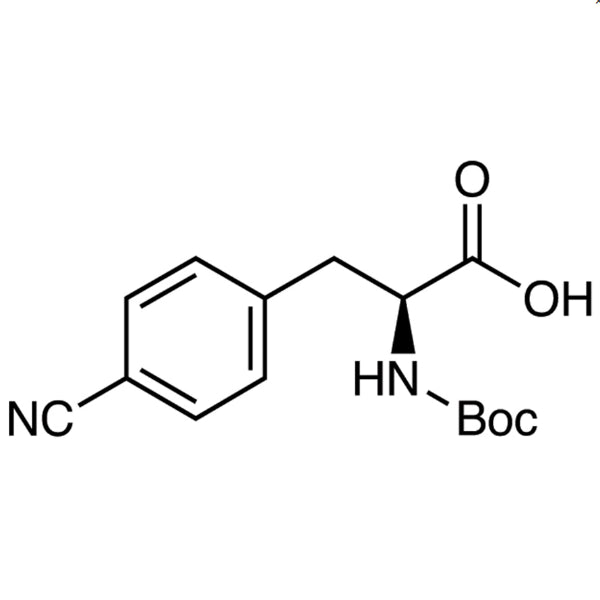
N-(tert-Butoxycarbonyl)-4-cyano-L-phenylalanine is a chemical compound widely used in organic and biochemical research, particularly in peptide chemistry. This compound plays a crucial role in the synthesis of complex molecules, serving as a building block for the development of bioactive substances. Its unique structure allows for targeted chemical reactions, making it an essential component in the creation of pharmaceutical and biotechnological products. In laboratory settings, it is frequently utilized as a starting material for the synthesis of various peptides and derivatives with specific biological functions.
The compound is valued for its chemical stability under controlled conditions, which ensures consistent performance during synthesis processes. Its sensitivity to moisture and air necessitates careful handling, but this also allows for precise control over reaction environments. The ability to participate in substitution and coupling reactions makes it highly versatile in synthetic applications. Its molecular complexity enables the formation of specific chemical bonds, which is critical in the development of advanced pharmaceutical compounds.
In Indonesian laboratories, this compound is commonly used in research related to peptides and bioactive compounds. It is a key reagent in the development of new drugs, protein processing, and the study of biological mechanisms. Researchers in academic and industrial settings rely on its properties to advance their work in pharmacology and biotechnology. Its application requires technical expertise and a deep understanding of chemical reactivity to ensure successful outcomes in synthesis processes.
TCI brochures (PDF)
- Amino Acids and Peptide Synthesis Reagents 2025-08-14 · p. 15
Related TCI products
- TCI B5350 68856-96-2 N-(tert-Butoxycarbonyl)-4-methoxy-D-phenylalanine
- TCI B5011 85466-66-6 N-(tert-Butoxycarbonyl)-N-methyl-D-phenylalanine
- TCI B4369 114873-07-3 N-(tert-Butoxycarbonyl)-4-trifluoromethyl-L-phenylalanine
- TCI B4289 147923-08-8 N-(tert-Butoxycarbonyl)-4-phenyl-L-phenylalanine
- TCI B3668 61280-75-9 N-(tert-Butoxycarbonyl)-4-nitro-D-phenylalanine
- TCI B3627 198474-90-7 N-(tert-Butoxycarbonyl)-3,4-difluoro-L-phenylalanine
- Peptide Synthesis: This compound is ideal for constructing complex peptides due to its reactivity and structural versatility.
- Drug Development: It is used in the synthesis of bioactive compounds that have potential therapeutic applications.
- Protein Modification: Its ability to participate in coupling reactions makes it useful for modifying protein structures.
- Biochemical Research: It supports studies on molecular interactions and biological mechanisms in various systems.
- Analytical Chemistry: It serves as a standard for identifying and quantifying similar compounds in complex mixtures.
| Brand | TCI |
|---|---|
| CAS number | 131724-45-3 |
| Molecular formula | — |
| Purity | — |
| Category | Chemistry > Chemical Biology > Peptide Chemistry |
| Pack sizes | Available in various quantities as per supplier specifications |
| Physical form | Solid powder |
| Storage | Requires protection from moisture and air exposure |
This compound should be stored in a dry, cool environment to prevent degradation. It is recommended to use airtight containers to minimize exposure to moisture and air, which can affect its stability. Proper labeling of containers is essential for safe handling and identification. Laboratory personnel should wear appropriate personal protective equipment when handling the compound to ensure safety. The compound should be kept away from heat sources and direct sunlight to maintain its integrity. Regular monitoring of storage conditions is necessary to ensure optimal performance and safety in laboratory settings.
—
Product Categories
- Chemical BiologyPeptide ChemistryAmino Acid Derivatives [Peptide Chemistry]
- Chemical BiologyPeptide ChemistryUnnatural Amino Acid Derivatives
- Pharmaceutical Development and Drug Discovery Research ReagentsPeptide ChemistryAmino Acid Derivatives [Peptide Chemistry]
- Pharmaceutical Development and Drug Discovery Research ReagentsPeptide ChemistryUnnatural Amino Acid Derivatives
Produk Terkait
-
N-(tert-Butoxycarbonyl)-4-methoxy-D-phenylalanine TCI B5350
Regular price From Rp 1.723.050,00Regular priceRp 1.220.100,00Sale price From Rp 1.723.050,00 -
N-(tert-Butoxycarbonyl)-N-methyl-D-phenylalanine TCI B5011
Regular price From Rp 1.643.250,00Regular priceRp 1.164.450,00Sale price From Rp 1.643.250,00 -
N-(tert-Butoxycarbonyl)-4-trifluoromethyl-L-phenylalanine TCI B4369
Regular price Rp 6.306.300,00Regular priceRp 4.425.750,00Sale price Rp 6.306.300,00 -
N-(tert-Butoxycarbonyl)-4-phenyl-L-phenylalanine TCI B4289
Regular price Rp 2.623.950,00Regular priceRp 1.850.100,00Sale price Rp 2.623.950,00 -
N-(tert-Butoxycarbonyl)-4-nitro-D-phenylalanine TCI B3668
Regular price Rp 2.384.550,00Regular priceRp 1.683.150,00Sale price Rp 2.384.550,00 -
N-(tert-Butoxycarbonyl)-3,4-difluoro-L-phenylalanine TCI B3627
Regular price Rp 4.636.800,00Regular priceRp 3.258.150,00Sale price Rp 4.636.800,00 -
N-(tert-Butoxycarbonyl)-4-chloro-L-phenylalanine TCI B3614
Regular price From Rp 1.351.350,00Regular priceRp 960.750,00Sale price From Rp 1.351.350,00 -
N-(tert-Butoxycarbonyl)-4-fluoro-L-phenylalanine TCI B3304
Regular price From Rp 1.563.450,00Regular priceRp 1.108.800,00Sale price From Rp 1.563.450,00


