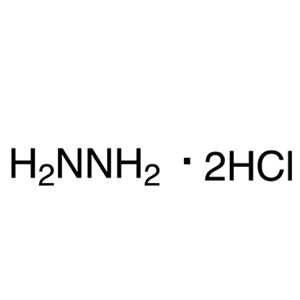
Hydrazine Dihydrochloride from TCI is a hydrazine salt formed with two equivalents of hydrochloric acid, supplied as a crystalline solid, and it stands as one of the most common laboratory sources of hydrazine in synthetic work. Its role is to deliver a reactive N–N unit for the formation of hydrazones, pyrazoles, triazoles, and a wide range of other nitrogen-containing compounds, without requiring the laboratory to store hydrazine hydrate, which is a liquid and readily volatile. Because it exists as a salt, the material is stable under ordinary storage, easy to transfer with a spatula, and well suited for use as a measurable reagent in both research-scale and preparative reactions.
The principal reason this dihydrochloride salt is so widely chosen is its good solubility in water and polar solvents, the availability of chloride ions that rarely interfere with common reaction pathways, and the acidic character of its solutions, which allows hydrazine to be liberated gradually through neutralisation. The solid is not strongly hygroscopic, so weighing proceeds in a stable manner, while its low volatility reduces vapour exposure for the operator. In many synthetic procedures, use of this salt gives cleaner condensation results because the concentration of free hydrazine in the mixture remains controlled rather than present in excess from the outset.
In Indonesian laboratories, this reagent is typically encountered in university organic synthesis groups, heterocyclic chemistry research, and analytical or preparative units that build nitrogen-containing intermediates. Its solid form suits laboratories that prefer to avoid storing volatile liquid reagents, and it fits routine practice where reagents are weighed out on an analytical balance and used in measured portions across repeated experiments. The salt form also simplifies handling in shared teaching and research facilities where several operators draw from the same container over time.
Related TCI products
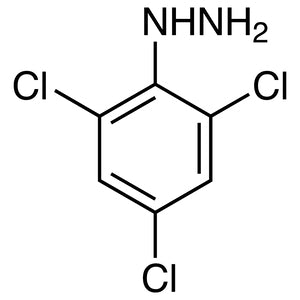
- TCI T4137 5329-12-4 (2,4,6-Trichlorophenyl)hydrazine
- TCI B3480 16114-05-9 N,N'-Bis(dimethylaminomethylene)hydrazine
- TCI H1517 13775-80-9 Hydrazine Monohydrobromide (ca 50% in Water)
- TCI H0175 634-62-8 Hydrazine L-(+)-Tartrate
- TCI H0174 2644-70-4 Hydrazine Monohydrochloride
- TCI H0173 13775-80-9 Hydrazine Monohydrobromide
- Hydrazone formation from aldehydes and ketones, where the salt supplies hydrazine in a controlled manner after neutralisation, giving cleaner condensation products than an excess of free hydrazine.
- Pyrazole ring synthesis, in which the reactive N–N unit condenses with 1,3-dicarbonyl compounds and related substrates to build the five-membered heterocyclic core used in many research programmes.
- Triazole preparation and related nitrogen heterocycle work, where the compound acts as a measurable solid source of the hydrazine fragment required to close the ring system.
- General preparation of nitrogen-containing compounds at research and preparative scale, benefiting from accurate weighing on a balance and reproducible stoichiometry across repeated runs.
- Aqueous and polar-solvent reaction systems, where the good solubility of the dihydrochloride and the non-interfering chloride ions allow the reagent to be introduced directly into the reaction medium.
| Brand | TCI |
|---|---|
| CAS number | 5341-61-7 |
| Molecular formula | — |
| Purity | — |
| Category | Chemistry > Building Blocks > Non-Heterocyclic Building Blocks |
| Pack sizes | available in standard TCI research pack sizes; please confirm the currently listed options when ordering |
| Physical form | crystalline solid |
| Storage | stable under ordinary laboratory storage conditions; keep the container tightly closed |
- Catalogue Code: H0170
Store the material in its original tightly closed container in a cool, dry, well-ventilated area, away from moisture and from incompatible substances such as strong oxidising agents. Glass or chemically resistant plastic containers with secure closures are appropriate for both storage and any repackaging. Weigh and transfer the solid in a fume hood or a well-ventilated working area, using a clean dry spatula to avoid contaminating the stock. Operators should wear safety glasses, gloves, and a laboratory coat, and should avoid inhaling dust or allowing contact with skin and eyes. Because solutions of this salt are acidic, handle them with the same care applied to other acidic reagents, and clean all glassware and work surfaces after use. Follow the supplier safety data sheet and institutional waste disposal procedures.
—
Produk Terkait
-
(2,4,6-Trichlorophenyl)hydrazine TCI T4137
Regular price Rp 2.411.850,00Regular priceRp 1.702.050,00Sale price Rp 2.411.850,00 -
N,N'-Bis(dimethylaminomethylene)hydrazine TCI B3480
Regular price From Rp 3.419.850,00Regular priceRp 2.406.600,00Sale price From Rp 3.419.850,00 -
HydrazineMonohydrobromide(ca50%inWater) TCI H1517
Regular price From Rp 477.750,00Regular priceRp 333.900,00Sale price From Rp 477.750,00 -
HydrazineL-(+)-Tartrate TCI H0175
Regular price Rp 2.359.350,00Regular priceRp 1.649.550,00Sale price Rp 2.359.350,00 -
HydrazineMonohydrochloride TCI H0174
Regular price From Rp 769.650,00Regular priceRp 537.600,00Sale price From Rp 769.650,00 -
HydrazineMonohydrobromide TCI H0173
Regular price From Rp 689.850,00Regular priceRp 481.950,00Sale price From Rp 689.850,00 -
HydrazineDihydrobromide TCI H0169
Regular price From Rp 557.550,00Regular priceRp 389.550,00Sale price From Rp 557.550,00 -
Methyl2-(2-Chloro-1-iminoethyl)hydrazine-1-carboxylate TCI C3681
Regular price From Rp 1.351.350,00Regular priceRp 960.750,00Sale price From Rp 1.351.350,00