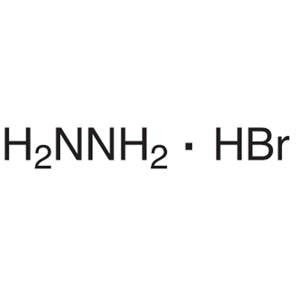
Hydrazine Monohydrobromide from TCI is a hydrazine salt formed with one equivalent of hydrobromic acid, supplied as a crystalline solid. The material serves as a hydrazine source that can be weighed and stored safely, and at the same time as a reagent that contributes the N–N unit in the formation of hydrazones, pyrazoles, and other nitrogen-rich heterocycles. Unlike the dihydrochloride or dihydrobromide forms, the monohydrobromide salt binds only one equivalent of acid, so its solutions are less acidic and the availability of nucleophilic hydrazine is comparatively higher. This choice is useful when a reaction demands an active nucleophile while still avoiding the handling of liquid hydrazine.
The property that makes it sought after is the balance between reactivity and ease of handling. As a solid, the material is virtually non-volatile, so weighing on an analytical balance proceeds in a stable manner and vapour exposure for the operator is greatly reduced. The accompanying bromide ion is sometimes desirable because it gives solubility or crystallisation behaviour different from that of the chloride salt, and in some reactions bromide can act as an assisting nucleophile. Good storage stability under cool and dry conditions makes the reagent practical to keep as a standing stock item.
In Indonesian laboratories, this building block is typically used in university and institutional organic synthesis groups, in heterocyclic chemistry research, and in the preparation of intermediates for pharmaceutical and agrochemical study. It is favoured where a hydrazine equivalent is needed but the handling of hydrazine hydrate solutions is impractical, such as in teaching-adjacent research laboratories, small-scale synthesis benches, and facilities where fume hood capacity or waste handling is limited and a solid reagent is simply easier to manage.
Related TCI products
- TCI H1517 13775-80-9 Hydrazine Monohydrobromide (ca 50% in Water)
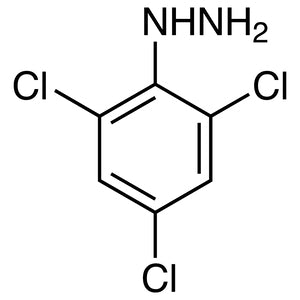
- TCI T4137 5329-12-4 (2,4,6-Trichlorophenyl)hydrazine
- TCI B3480 16114-05-9 N,N'-Bis(dimethylaminomethylene)hydrazine
- TCI H0175 634-62-8 Hydrazine L-(+)-Tartrate
- TCI H0174 2644-70-4 Hydrazine Monohydrochloride
- TCI H0170 5341-61-7 Hydrazine Dihydrochloride
- Hydrazone formation from aldehydes and ketones, where the solid salt releases hydrazine in a controlled manner and gives reproducible stoichiometry compared with aqueous hydrazine solutions.
- Pyrazole ring synthesis from 1,3-dicarbonyl substrates, since the reagent supplies the N–N fragment directly while its lower acidity leaves more nucleophilic hydrazine available for cyclisation.
- Preparation of nitrogen-rich heterocyclic scaffolds in medicinal chemistry programmes, where a weighable crystalline hydrazine source simplifies small-scale reaction setup and repeat experiments.
- Synthesis of non-heterocyclic building blocks and functionalised intermediates that require an N–N linkage, benefiting from the salt's stability during storage between synthetic campaigns.
- Reactions where bromide counterion behaviour is preferred, because it can alter solubility and crystallisation of products and may act as an assisting nucleophile in the reaction medium.
| Brand | TCI |
|---|---|
| CAS number | 13775-80-9 |
| Molecular formula | — |
| Purity | — |
| Category | Chemistry > Building Blocks > Non-Heterocyclic Building Blocks |
| Pack sizes | — |
| Physical form | crystalline solid |
| Storage | keep in a cool, dry place in a tightly closed container |
- Catalogue number: H0173
Store the material in a cool, dry area inside its original tightly closed container, protected from moisture and away from oxidising agents and sources of heat. Amber or opaque glass bottles with well-sealing caps are suitable, and secondary containment on a designated chemical shelf is recommended. Handle and weigh the solid in a fume hood while wearing nitrile gloves, safety goggles, and a laboratory coat, and avoid generating dust. Use clean, dry spatulas to prevent contamination and close the container promptly after each use. Consult the manufacturer's safety data sheet before first use and dispose of residues through the laboratory's chemical waste procedure.
—
Produk Terkait
-
HydrazineMonohydrobromide(ca50%inWater) TCI H1517
Regular price From Rp 477.750,00Regular priceRp 333.900,00Sale price From Rp 477.750,00 -
(2,4,6-Trichlorophenyl)hydrazine TCI T4137
Regular price Rp 2.411.850,00Regular priceRp 1.702.050,00Sale price Rp 2.411.850,00 -
N,N'-Bis(dimethylaminomethylene)hydrazine TCI B3480
Regular price From Rp 3.419.850,00Regular priceRp 2.406.600,00Sale price From Rp 3.419.850,00 -
HydrazineL-(+)-Tartrate TCI H0175
Regular price Rp 2.359.350,00Regular priceRp 1.649.550,00Sale price Rp 2.359.350,00 -
HydrazineMonohydrochloride TCI H0174
Regular price From Rp 769.650,00Regular priceRp 537.600,00Sale price From Rp 769.650,00 -
HydrazineDihydrochloride TCI H0170
Regular price Rp 505.050,00Regular priceRp 352.800,00Sale price Rp 505.050,00 -
HydrazineDihydrobromide TCI H0169
Regular price From Rp 557.550,00Regular priceRp 389.550,00Sale price From Rp 557.550,00 -
Methyl2-(2-Chloro-1-iminoethyl)hydrazine-1-carboxylate TCI C3681
Regular price From Rp 1.351.350,00Regular priceRp 960.750,00Sale price From Rp 1.351.350,00