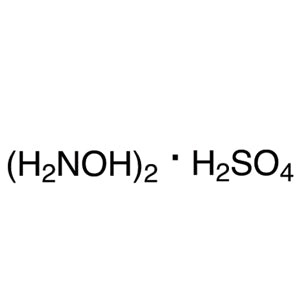
TCI H0196 Hydroxylamine Sulfate is the sulfate salt of hydroxylamine, and it offers a practical and considerably safer way to bring hydroxylamine chemistry into the laboratory than the unstable free base form. Supplied as a solid salt, the material is straightforward to weigh, to store, and to dissolve at the moment it is needed. Its role in the laboratory is broad: it serves as the standard reagent for forming oximes from aldehydes and ketones, as a reducing agent in a range of analytical chemistry procedures, and as an important reagent in the synthesis of nitrogen-containing compounds. Many classical carbonyl group identification procedures rely on this reagent to generate solid derivatives that are easy to characterize.
The properties that make this reagent a preferred choice begin with the nucleophilicity of an amine group carrying an attached hydroxyl group, which allows it to react rapidly and selectively with carbonyl groups to form oximes, together with its ability to act as a mild reducing agent in aqueous systems. The material is a white crystalline solid that dissolves in water, which makes the preparation of working solutions at a variety of concentrations convenient. The sulfate salt form gives markedly better storage stability than free hydroxylamine, and the TCI grade provides the batch-to-batch uniformity that repeated procedures depend on.
In Indonesian laboratories, this reagent finds a natural place in university teaching and research laboratories, in industrial quality control laboratories, and in the organic synthesis work of research institutions. Its solid, weighable form and its water solubility suit laboratories that prepare fresh working solutions rather than holding standing stocks, which is a common practice under local conditions. The improved stability of the salt form is particularly useful where storage facilities are shared and where reagents must remain serviceable over extended periods.
Related TCI products
- TCI I0877 50632-53-6 N-Isopropylhydroxylamine Hydrochloride
- TCI T3860 31938-11-1 O-Tritylhydroxylamine
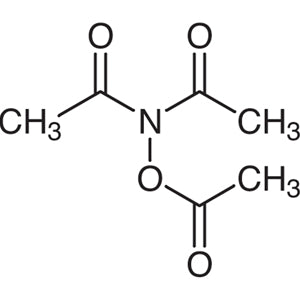
- TCI T1202 17720-63-7 N,N,O-Triacetylhydroxylamine
- TCI B4780 85006-25-3 N,O-Bis(tert-butoxycarbonyl)hydroxylamine
- TCI B4589 39684-28-1 O-(tert-Butyl)hydroxylamine Hydrochloride
- TCI B4073 29601-98-7 N-Benzylhydroxylamine Hydrochloride
- Oxime formation from aldehydes and ketones — the hydroxylamine group reacts rapidly and selectively with carbonyl carbon, giving clean oxime products that form the basis of a great many synthetic sequences.
- Classical carbonyl group identification — the reagent converts liquid or oily carbonyl compounds into solid oxime derivatives that can be isolated and characterized, a long-standing qualitative organic analysis approach.
- Reducing agent in analytical procedures — its capacity to act as a mild reductant in aqueous systems suits analytical methods requiring controlled reduction without the harshness of stronger reducing reagents.
- Synthesis of nitrogen-containing compounds — as a source of the N–OH functionality, this material serves as a key building block in preparing a broad range of nitrogen-based target molecules.
- Preparation of aqueous working solutions — the white crystalline solid dissolves readily in water, allowing laboratories to weigh accurately and prepare solutions at whatever concentration a given procedure calls for.
| Brand | TCI |
|---|---|
| CAS number | 10039-54-0 |
| Molecular formula | — |
| Purity | — |
| Category | Chemistry > Building Blocks > Non-Heterocyclic Building Blocks |
| Pack sizes | available in the standard TCI catalogue pack sizes; please confirm the size required when ordering |
| Physical form | white crystalline solid, soluble in water |
| Storage | store in a closed container in a cool, dry place away from moisture |
Store the container tightly closed in a cool, dry, well-ventilated area, away from moisture, since the material is water soluble and will take up humidity if left open. Original manufacturer containers or tightly sealed glass or chemically compatible plastic bottles are appropriate, and containers should be clearly labelled with the substance name and CAS number. Handle the solid in a fume hood or a well-ventilated area to avoid inhaling dust, and wear standard laboratory personal protective equipment including gloves, safety goggles, and a laboratory coat. Avoid contact with skin and eyes, and avoid generating dust when weighing. Keep the reagent separated from strong oxidizing agents. Prepare aqueous working solutions fresh where the procedure allows, and consult the manufacturer's safety data sheet before first use.
—
Produk Terkait
-
N-IsopropylhydroxylamineHydrochloride TCI I0877
Regular price From Rp 1.618.050,00Regular priceRp 1.146.600,00Sale price From Rp 1.618.050,00 -
O-Tritylhydroxylamine TCI T3860
Regular price From Rp 1.033.200,00Regular priceRp 738.150,00Sale price From Rp 1.033.200,00 -
N,N,O-Triacetylhydroxylamine TCI T1202
Regular price Rp 3.498.600,00Regular priceRp 2.462.250,00Sale price Rp 3.498.600,00 -
N,O-Bis(tert-butoxycarbonyl)hydroxylamine TCI B4780
Regular price From Rp 1.431.150,00Regular priceRp 1.016.400,00Sale price From Rp 1.431.150,00 -
O-(tert-Butyl)hydroxylamineHydrochloride TCI B4589
Regular price From Rp 2.650.200,00Regular priceRp 1.869.000,00Sale price From Rp 2.650.200,00 -
N-BenzylhydroxylamineHydrochloride TCI B4073
Regular price From Rp 2.677.500,00Regular priceRp 1.887.900,00Sale price From Rp 2.677.500,00 -
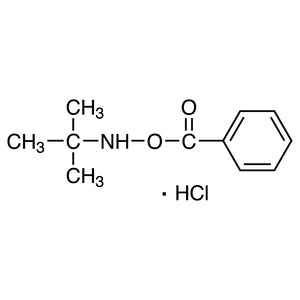
O-Benzoyl-N-tert-butylhydroxylamineHydrochloride TCI B3238
Regular price Rp 1.510.950,00Regular priceRp 1.072.050,00Sale price Rp 1.510.950,00 -
N-(tert-Butyl)hydroxylamineHydrochloride TCI B1700
Regular price From Rp 1.378.650,00Regular priceRp 979.650,00Sale price From Rp 1.378.650,00