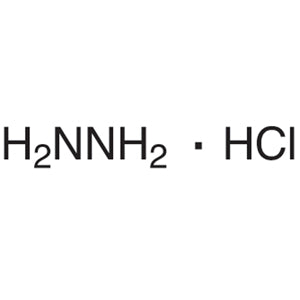
Hydrazine Monohydrochloride from TCI is a hydrazine salt formed with one equivalent of hydrochloric acid, supplied as a crystalline solid, and it serves as a reference reagent whenever a laboratory needs a practical source of hydrazine. The material contributes the N–N unit used to build hydrazones, hydrazides, pyrazoles, and other nitrogen-rich heterocycles, and it can also act as a mild reducing agent. Because only one group is protonated, the nucleophilic nitrogen remains available to attack carbonyl centres without requiring a large addition of base.
The combination of easy handling as a solid and reactivity that remains high is what makes this material a frequent first choice. The properties behind that preference include good solubility in water and polar solvents, a chloride ion that stays neutral toward most reaction pathways, and very low volatility compared with hydrazine hydrate. As a solid, it can be weighed precisely down to the milligram scale, which suits reaction optimisation work that demands tight stoichiometry. The moderate acidity of its solutions also helps keep the hydrazine in a protected form until the reaction is started, suppressing oxidation by air.
In Indonesian laboratories this reagent fits naturally into synthetic chemistry, organic teaching, and analytical method development, where a solid hydrazine source is easier to store, transport, and dispense than a liquid alternative. Research groups, university laboratories, and industrial method-development units use it as a building block for nitrogen-containing structures, relying on its straightforward weighing and its low volatility to keep exposure and handling requirements manageable in routine bench work.
Related TCI products
- TCI B1396 1073-62-7 Benzylhydrazine Monohydrochloride
- TCI A0289 2051-79-8 2-Amino-5-(diethylamino)toluene Monohydrochloride
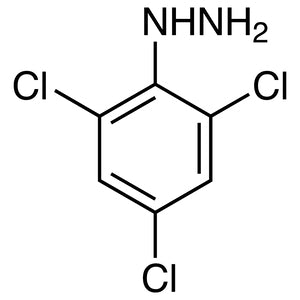
- TCI T4137 5329-12-4 (2,4,6-Trichlorophenyl)hydrazine
- TCI B3480 16114-05-9 N,N'-Bis(dimethylaminomethylene)hydrazine
- TCI H1517 13775-80-9 Hydrazine Monohydrobromide (ca 50% in Water)
- TCI H0175 634-62-8 Hydrazine L-(+)-Tartrate
- Hydrazone formation: the free nucleophilic nitrogen attacks aldehyde and ketone carbonyl centres directly, so condensation proceeds without a large excess of added base.
- Hydrazide synthesis: the reagent supplies the N–N unit for converting esters and acyl derivatives into hydrazides used as intermediates in further nitrogen chemistry.
- Pyrazole and heterocycle construction: it provides the nitrogen-nitrogen backbone required to close pyrazole rings and other nitrogen-rich heterocyclic systems in building-block synthesis.
- Mild reduction steps: its capacity to act as a mild reducing agent lets chemists carry out reductions where stronger reagents would compromise sensitive functional groups.
- Precise stoichiometric reaction optimisation: the crystalline solid form allows accurate weighing down to the milligram scale, supporting screening work that depends on tightly controlled reagent ratios.
| Brand | TCI |
|---|---|
| CAS number | 2644-70-4 |
| Molecular formula | — |
| Purity | — |
| Category | Chemistry > Building Blocks > Non-Heterocyclic Building Blocks |
| Pack sizes | available in the standard TCI catalogue pack sizes; please confirm the size required when ordering |
| Physical form | crystalline solid |
| Storage | keep in a closed container under the storage conditions stated on the manufacturer's label |
Store the container tightly closed in a cool, dry, well-ventilated place, away from moisture and from oxidising agents, and follow the storage conditions given on the manufacturer's label. Keep the material in its original container or in a comparable tightly sealed chemical container that resists moisture uptake, and reseal it promptly after each weighing so the solid does not absorb atmospheric water. Handle it in a fume hood using gloves, safety glasses, and a laboratory coat, avoid contact with skin and eyes as well as inhalation of dust, and weigh it carefully to limit airborne particles. Label all prepared solutions clearly and dispose of residues in accordance with local chemical waste procedures.
—
Produk Terkait
-
BenzylhydrazineMonohydrochloride TCI B1396
Regular price From Rp 3.815.700,00Regular priceRp 2.683.800,00Sale price From Rp 3.815.700,00 -
2-Amino-5-(diethylamino)tolueneMonohydrochloride TCI A0289
Regular price Rp 2.571.450,00Regular priceRp 1.797.600,00Sale price Rp 2.571.450,00 -
(2,4,6-Trichlorophenyl)hydrazine TCI T4137
Regular price Rp 2.411.850,00Regular priceRp 1.702.050,00Sale price Rp 2.411.850,00 -
N,N'-Bis(dimethylaminomethylene)hydrazine TCI B3480
Regular price From Rp 3.419.850,00Regular priceRp 2.406.600,00Sale price From Rp 3.419.850,00 -
HydrazineMonohydrobromide(ca50%inWater) TCI H1517
Regular price From Rp 477.750,00Regular priceRp 333.900,00Sale price From Rp 477.750,00 -
HydrazineL-(+)-Tartrate TCI H0175
Regular price Rp 2.359.350,00Regular priceRp 1.649.550,00Sale price Rp 2.359.350,00 -
HydrazineMonohydrobromide TCI H0173
Regular price From Rp 689.850,00Regular priceRp 481.950,00Sale price From Rp 689.850,00 -
HydrazineDihydrochloride TCI H0170
Regular price Rp 505.050,00Regular priceRp 352.800,00Sale price Rp 505.050,00