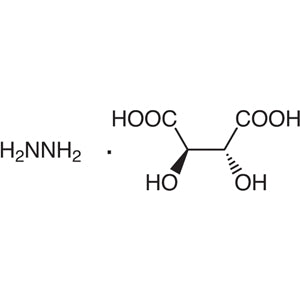
Hydrazine L-(+)-Tartrate from TCI is the salt formed between hydrazine and L-(+)-tartaric acid, supplied as a crystalline solid. The material serves as a stable, easy-to-handle source of hydrazine, distinguished by its chiral counter-anion derived from naturally occurring tartaric acid. In the laboratory it is used to introduce the N–N unit into target molecules, to form hydrazones and hydrazides, and to build nitrogen-rich heterocyclic frameworks. Researchers frequently select the tartrate salt when they want a solid that crystallises well, is not strongly hygroscopic, and carries no halide ion that might interfere with certain reactions.
The characteristics that make it a preferred choice are its stability as a solid, its practically zero volatility, and a solubility profile that differs from the hydrohalide salts, giving greater freedom in selecting solvents and purification methods. The tartrate anion is chiral and carries both hydroxyl and carboxylate groups, so the salt can be of interest in work involving chiral resolution or chiral recognition. The absence of chloride and bromide ions is an added advantage for reactions that are sensitive to halides and for catalytic systems where halide ions may interfere.
In Indonesian laboratories this reagent is typically found in synthetic organic chemistry and medicinal chemistry groups at universities and research institutes, as well as in pharmaceutical and fine-chemical development work. It is handled at the bench on a small preparative scale, where a well-behaved crystalline hydrazine source is more convenient to weigh and store than a liquid alternative. The material is normally kept as part of a building-block inventory and drawn on as intermediate synthesis requires.
Related TCI products
- TCI C3681 155742-64-6 Methyl 2-(2-Chloro-1-iminoethyl)hydrazine-1-carboxylate
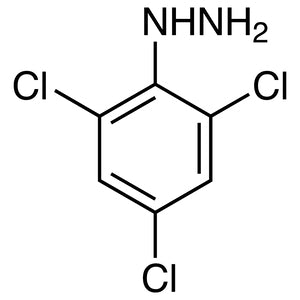
- TCI T4137 5329-12-4 (2,4,6-Trichlorophenyl)hydrazine
- TCI B3480 16114-05-9 N,N'-Bis(dimethylaminomethylene)hydrazine
- TCI H1517 13775-80-9 Hydrazine Monohydrobromide (ca 50% in Water)
- TCI H0174 2644-70-4 Hydrazine Monohydrochloride
- TCI H0173 13775-80-9 Hydrazine Monohydrobromide
- Hydrazone formation: the salt releases hydrazine in situ for condensation with aldehydes and ketones, giving crystalline hydrazone derivatives without introducing halide ions into the reaction mixture.
- Hydrazide synthesis: it provides the N–N unit needed for converting esters and activated acyl compounds into hydrazides, with the solid form making stoichiometry easier to control by weight.
- Nitrogen-rich heterocycle construction: chemists use it as a starting building block for assembling heterocyclic ring systems that require a hydrazine fragment, drawing on its stability and low volatility during handling.
- Chiral resolution and chiral recognition studies: the L-(+)-tartrate counter-anion is itself chiral and bears hydroxyl and carboxylate groups, making the salt relevant to work on separating or recognising enantiomers.
- Halide-sensitive and catalytic reactions: because the salt contains neither chloride nor bromide, it suits reaction systems and catalysts that are disturbed by halide ions present in conventional hydrazine hydrohalide salts.
| Brand | TCI |
|---|---|
| CAS number | 634-62-8 |
| Molecular formula | — |
| Purity | — |
| Category | Chemistry > Building Blocks > Non-Heterocyclic Building Blocks |
| Pack sizes | available in the standard TCI catalogue pack sizes; please confirm the size required when ordering |
| Physical form | crystalline solid |
| Storage | keep in a closed container in a cool, dry place |
Store the material in a tightly closed original container in a cool, dry, well-ventilated place, away from heat sources, direct sunlight, and incompatible substances such as strong oxidising agents. Although the salt is not strongly hygroscopic, containers should be reclosed promptly after weighing to keep moisture out and preserve the quality of the crystalline solid. Handle the compound in a fume hood using standard personal protective equipment — safety glasses, gloves, and a laboratory coat — and avoid the generation or inhalation of dust. As with all hydrazine derivatives, minimise skin and eye contact, wash hands after use, and follow the manufacturer's safety data sheet together with your institution's chemical waste procedures for disposal.
—
Produk Terkait
-
Methyl2-(2-Chloro-1-iminoethyl)hydrazine-1-carboxylate TCI C3681
Regular price From Rp 1.298.850,00Regular price -
(2,4,6-Trichlorophenyl)hydrazine TCI T4137
Regular price Rp 2.359.350,00Regular price -
N,N'-Bis(dimethylaminomethylene)hydrazine TCI B3480
Regular price From Rp 3.367.350,00Regular price -
HydrazineMonohydrobromide(ca50%inWater) TCI H1517
Regular price From Rp 477.750,00Regular price -
HydrazineMonohydrochloride TCI H0174
Regular price From Rp 769.650,00Regular price -
HydrazineMonohydrobromide TCI H0173
Regular price From Rp 689.850,00Regular price -
HydrazineDihydrochloride TCI H0170
Regular price Rp 505.050,00Regular price -
HydrazineDihydrobromide TCI H0169
Regular price From Rp 557.550,00Regular price