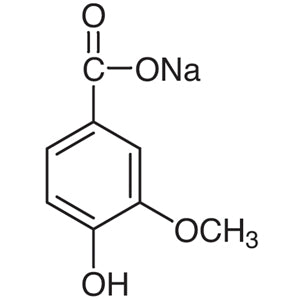
Sodium 4-Hydroxy-3-methoxybenzoate is a chemical compound widely used in laboratory settings for its versatility in organic synthesis and chemical reactions. It serves as a building block in the creation of aromatic compounds and phenolic derivatives, making it essential for researchers and students in Indonesia. This compound plays a crucial role in the development of complex chemical structures, supporting both academic and industrial research. Its presence in various laboratory applications highlights its importance in the field of chemistry.
The compound's stability and reactivity make it a preferred choice for chemical experiments requiring high reactivity. Its molecular structure, consisting of hydroxyl and methoxy groups, provides both polar and reactive characteristics. These properties allow it to dissolve in organic solvents such as ethyl acetate and ethanol, facilitating mixing and reaction processes. This solubility enhances its usability in a range of chemical reactions, including substitution, esterification, and the synthesis of complex compounds.
In Indonesian laboratories, Sodium 4-Hydroxy-3-methoxybenzoate is commonly used in educational and research environments. It is a staple in both academic institutions and research facilities, supporting a wide array of chemical processes. Its reliability and consistent performance make it a trusted material for chemical synthesis and experimentation in the region.
Related TCI products
- TCI M2794 24093-81-0 Methyl 3,5-Dihydroxy-4-methoxybenzoate
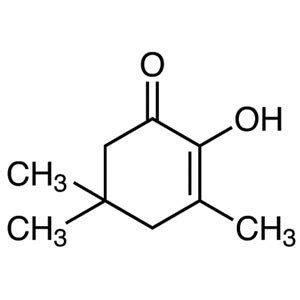
- TCI T2723 4883-60-7 2-Hydroxy-3,5,5-trimethyl-2-cyclohexen-1-one
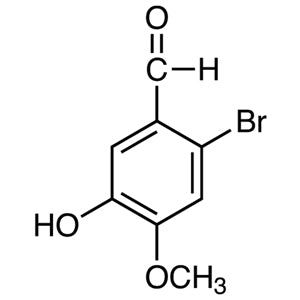
- TCI B4681 2973-59-3 2-Bromo-5-hydroxy-4-methoxybenzaldehyde
- TCI B3229 2208-15-3 4-Bromo-3-hydroxy-2-naphthoic Acid
- TCI B3180 1779-11-9 7-Bromo-3-hydroxy-2-naphthoic Acid
- TCI M3737 567-61-3 2-Hydroxy-6-methylbenzoic Acid
- Organic synthesis applications benefit from its reactivity and solubility in organic solvents, allowing for efficient reaction processes.
- Phenolic derivative production relies on its ability to form stable compounds, making it ideal for creating aromatic structures.
- Educational experiments utilize its predictable behavior, providing students with a reliable material for learning chemical reactions.
- Industrial research uses it as a building block for developing new chemical compounds and materials.
- Analytical chemistry procedures benefit from its stability and reactivity, supporting accurate and reproducible results.
| Brand | TCI |
|---|---|
| CAS number | 28508-48-7 |
| Molecular formula | — |
| Purity | — |
| Category | Chemistry > Building Blocks > Non-Heterocyclic Building Blocks |
| Pack sizes | Available in standard laboratory quantities |
| Physical form | Solid |
| Storage | Store in a cool, dry place away from moisture and light |
Sodium 4-Hydroxy-3-methoxybenzoate should be stored in a cool, dry environment to maintain its stability and prevent degradation. It is recommended to use airtight containers to protect it from moisture and light exposure. Since it is a solid, it should be kept in a secure location away from potential contaminants. Laboratory personnel should handle the compound with care, using appropriate personal protective equipment when necessary. Proper storage ensures the compound remains effective for use in chemical reactions and synthesis processes. Regular inspection of storage conditions is advised to maintain optimal performance and safety standards.
—
Produk Terkait
-
Methyl3,5-Dihydroxy-4-methoxybenzoate TCI M2794
Regular price Rp 3.630.900,00Regular price -
2-Hydroxy-3,5,5-trimethyl-2-cyclohexen-1-one TCI T2723
Regular price Rp 1.273.650,00Regular price -
2-Bromo-5-hydroxy-4-methoxybenzaldehyde TCI B4681
Regular price Rp 4.293.450,00Regular price -
4-Bromo-3-hydroxy-2-naphthoicAcid TCI B3229
Regular price From Rp 2.174.550,00Regular price -
7-Bromo-3-hydroxy-2-naphthoicAcid TCI B3180
Regular price From Rp 769.650,00Regular price -
2-Hydroxy-6-methylbenzoicAcid TCI M3737
Regular price From Rp 2.332.050,00Regular price -
Methyl4-Hydroxy-3,5-dimethoxybenzoate TCI M2806
Regular price From Rp 1.193.850,00Regular price -
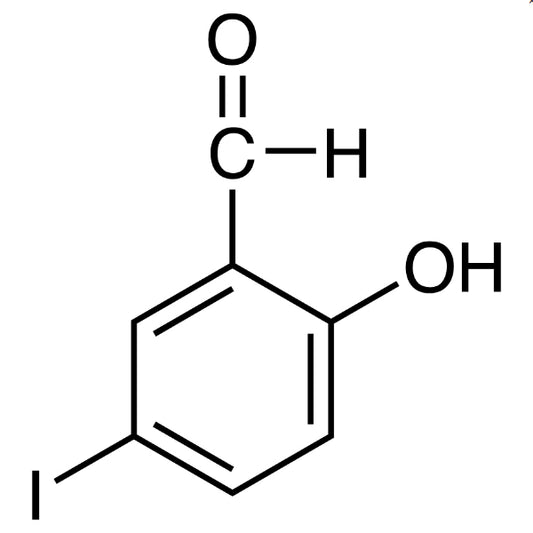
2-Hydroxy-5-iodobenzaldehyde TCI I1175
Regular price From Rp 903.000,00Regular price