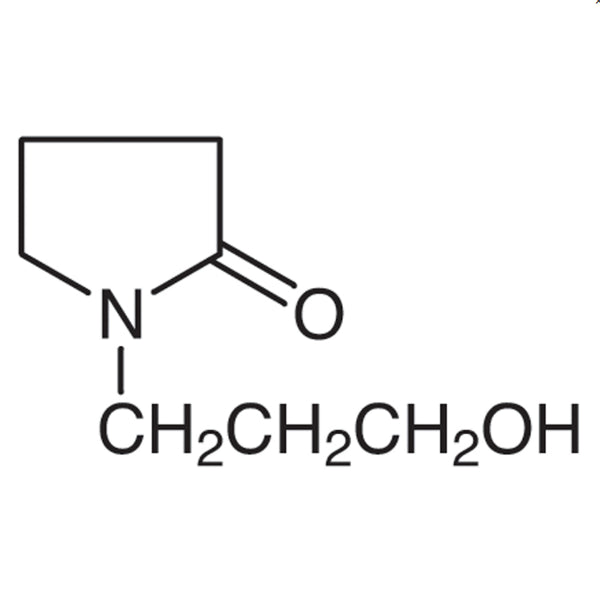
TCI H0541 1-(3-Hydroxypropyl)-2-pyrrolidone is a five-membered lactam derivative carrying a hydroxyl-terminated propyl chain on its nitrogen atom. The compound is a close relative of N-methylpyrrolidone, the polar aprotic solvent very widely known in laboratory work, but with an additional hydroxyl group that opens the door to further reaction. Classified in this catalogue as a non-heterocyclic building block, the material is used by chemists as a bifunctional linker, as a synthetic intermediate toward polymers and surfactants, and as a specialty solvent in reactions that call for a high-boiling polar medium.
The property that makes this compound attractive is the combination of a polar, stable cyclic amide group with a primary hydroxyl group that is reactive yet not unduly hindered sterically. The hydroxyl group can be esterified, etherified, converted into a leaving group, or used as a starting point for polymerisation, while the pyrrolidone ring confers excellent solubility in water and in almost all polar organic solvents. That pairing of a robust polar core with a single accessible reactive handle is what allows one molecule to serve in so many roles across a synthetic programme.
In Indonesian laboratories the material is typically encountered in academic and industrial research settings where custom organic synthesis, polymer development, and surfactant formulation work is carried out. Because the compound is supplied in volume units, indicating that it is a liquid at room temperature, it is handled with the usual liquid-transfer equipment on the bench. The hygroscopic character characteristic of lactams means that containers are kept properly closed between uses, which matters in the humid conditions common across the region.
- Bifunctional linker chemistry — the molecule presents one reactive primary hydroxyl alongside a stable lactam ring, letting chemists attach a pyrrolidone moiety onto a larger scaffold through a single, predictable coupling point.
- Polymer synthesis intermediate — the primary hydroxyl group serves as an initiation or chain-extension site for polymerisation, while the pendant pyrrolidone ring imparts strong polarity and water compatibility to the resulting material.
- Surfactant intermediate preparation — pairing a hydrophilic pyrrolidone head with a hydroxyl group available for esterification or etherification makes the compound a convenient starting point for building amphiphilic structures.
- Specialty polar solvent applications — reactions requiring a high-boiling polar medium can use this material where a conventional low-boiling solvent would evaporate, benefiting from the same polar amide character that makes N-methylpyrrolidone so useful.
- Hydroxyl group derivatisation studies — the primary alcohol can be esterified, etherified, or converted into a leaving group, giving teaching and research laboratories a clean substrate for exploring standard functional group interconversions.
| Brand | TCI |
|---|---|
| CAS number | 62012-15-1 |
| Molecular formula | — |
| Purity | — |
| Category | Chemistry > Building Blocks > Non-Heterocyclic Building Blocks |
| Pack sizes | supplied in volume units |
| Physical form | liquid at room temperature |
| Storage | keep the container tightly closed; the material is hygroscopic |
Store the container tightly closed in a cool, dry place away from direct sunlight and sources of heat. Because lactams of this type are hygroscopic, minimise the time the container stands open and reseal it immediately after dispensing; prolonged exposure to humid air allows moisture uptake that can affect the material. Original manufacturer packaging or a clean, chemically compatible closed vessel is appropriate for storage. Handle the liquid in a well-ventilated area or fume hood, wear gloves, safety glasses, and a laboratory coat, and avoid contact with skin and eyes. Consult the manufacturer's safety data sheet before use and dispose of residues according to applicable laboratory waste procedures.
—
Produk Terkait
-
5-Acetamido-N,N'-bis(2,3-dihydroxypropyl)-2,4,6-triiodoisophthalamide TCI A2169
Regular price Rp 7.473.900,00Regular price -
1-Butyl-2-pyrrolidone TCI B1254
Regular price Rp 2.386.650,00Regular price -
1-Acetyl-2-pyrrolidone TCI A1418
Regular price From Rp 1.724.100,00Regular price -
4-Hydroxy-2-pyrrolidone TCI H1573
Regular price Rp 1.115.100,00Regular price -
3-Chloro-2-hydroxypropylMethacrylate(stabilizedwithHQ) TCI C2105
Regular price From Rp 584.850,00Regular price -
(3-Chloro-2-hydroxypropyl)trimethylammoniumChloride(ca.65%inWater) TCI C1180
Regular price From Rp 584.850,00Regular price -
HydroxypropylAcrylate(mixtureof2-Hydroxypropyland2-Hydroxy-1-methylethylAcrylate)(stabilizedwithMEHQ) TCI A0744
Regular price From Rp 477.750,00Regular price -
HydroxypropylMethacrylate(mixtureof2-Hydroxypropyland2-Hydroxy-1-methylethylMethacrylate)(stabilizedwithMEHQ) TCI M0512
Regular price From Rp 505.050,00Regular price