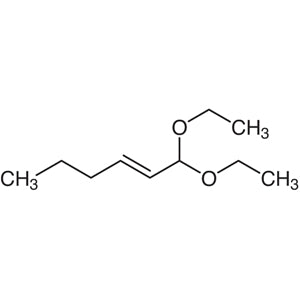
TCI H0575 trans-2-Hexen-1-al Diethyl Acetal is the protected form of trans-2-hexenal, an unsaturated aldehyde widely recognised as one of the compounds responsible for the aroma of fresh green leaves. In this material, the aldehyde group has been converted into a diethyl acetal, so it is no longer reactive toward nucleophiles or mild oxidation. In the laboratory the compound plays a dual role: it serves as a building block that allows chemists to work on other parts of the molecule without disturbing the carbonyl group, and it serves as a reference material in studies of green-note volatile compounds.
The property that makes the acetal form the preferred choice is its stability under basic and neutral conditions, which differs markedly from the parent aldehyde that readily oxidises, polymerises, and reacts as a Michael acceptor. This protection is temporary yet fully reversible: hydrolysis in aqueous acidic conditions releases the original aldehyde together with ethanol. The trans double bond at the two position is retained and remains available for addition, epoxidation, and metathesis reactions. As an organic liquid with good solubility in non-polar solvents, the compound is straightforward to handle and to purify by conventional means.
Indonesian research laboratories typically work with this material in synthetic organic chemistry and flavour and fragrance chemistry programmes, where a protected aldehyde is needed for multi-step preparations. It is used in university and institutional laboratories as an intermediate for functional group transformations, and as a comparison compound in studies of volatile green-note substances. Its handling requirements are consistent with routine organic liquid reagents already established in such laboratories.
Related TCI products
- TCI B3822 75148-49-1 3-Bromobenzaldehyde Diethyl Acetal
- TCI B3800 35822-58-3 2-Bromobenzaldehyde Diethyl Acetal
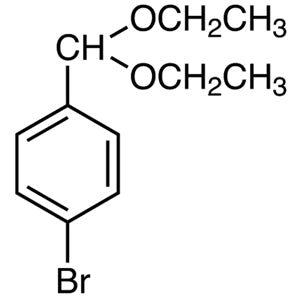
- TCI B2845 34421-94-8 4-Bromobenzaldehyde Diethyl Acetal
- TCI B1893 774-48-1 Benzaldehyde Diethyl Acetal
- TCI B0957 2032-35-1 Bromoacetaldehyde Diethyl Acetal
- TCI A0640 3054-95-3 Acrolein Diethyl Acetal
- Carbonyl protection strategy in multi-step synthesis, where the acetal masks the aldehyde so that reactions can be carried out selectively on other parts of the molecule without carbonyl interference.
- Non-heterocyclic building block work, since the compound supplies a six-carbon unsaturated chain with a latent aldehyde that can be revealed later by acidic aqueous hydrolysis.
- Alkene chemistry studies exploiting the retained trans double bond at position two, which remains available for addition, epoxidation, and metathesis reactions while the carbonyl stays protected.
- Reference material for green-note volatile compound research, providing a defined protected form related to trans-2-hexenal for comparison work in flavour and fragrance chemistry.
- Method development for deprotection conditions, because acid-catalysed hydrolysis cleanly regenerates the parent aldehyde and ethanol, making it a convenient model substrate for optimisation.
| Brand | TCI (Tokyo Chemical Industry) |
|---|---|
| CAS number | 67746-30-9 |
| Molecular formula | — |
| Purity | — |
| Category | Chemistry > Building Blocks > Non-Heterocyclic Building Blocks |
| Pack sizes | supplied in standard TCI catalogue pack sizes; please confirm the available option when ordering |
| Physical form | organic liquid, soluble in non-polar solvents |
| Storage | keep in a tightly closed container, away from acidic conditions and moisture |
Store the container tightly closed in a cool, dry, well-ventilated area, away from acids and sources of moisture, since aqueous acidic conditions will hydrolyse the acetal back to the parent aldehyde. Use chemically compatible glass or approved solvent containers and keep them clearly labelled. Handle the liquid in a fume hood, wearing safety glasses, gloves, and a laboratory coat, and keep it away from heat and ignition sources. Transfer with clean, dry glassware to avoid introducing water, close containers immediately after use, and consult the manufacturer's safety data sheet before first handling.
—
Produk Terkait
-
3-BromobenzaldehydeDiethylAcetal TCI B3822
Regular price Rp 2.625.000,00Regular price -
2-BromobenzaldehydeDiethylAcetal TCI B3800
Regular price Rp 2.121.000,00Regular price -
4-BromobenzaldehydeDiethylAcetal TCI B2845
Regular price Rp 3.419.850,00Regular price -
BenzaldehydeDiethylAcetal TCI B1893
Regular price Rp 1.776.600,00Regular price -
BromoacetaldehydeDiethylAcetal TCI B0957
Regular price From Rp 848.400,00Regular price -
AcroleinDiethylAcetal TCI A0640
Regular price From Rp 2.147.250,00Regular price -
PropargylaldehydeDiethylAcetal TCI P1173
Regular price From Rp 955.500,00Regular price -
PropionaldehydeDiethylAcetal TCI P0781
Regular price From Rp 505.050,00Regular price