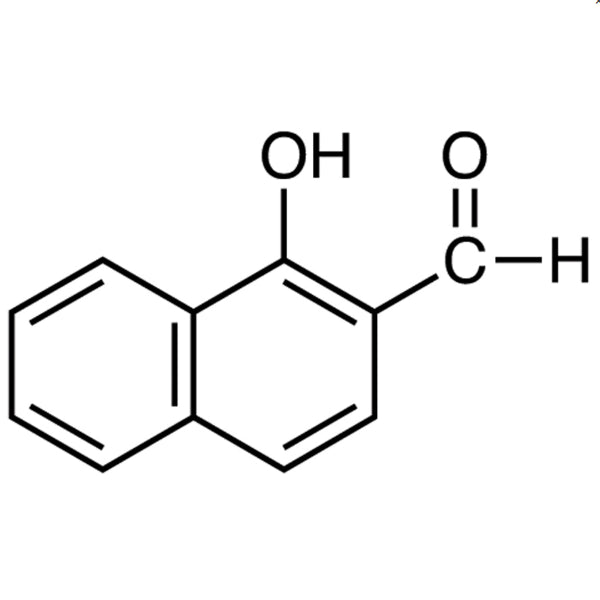
TCI H0839 1-Hydroxy-2-naphthaldehyde is an aromatic aldehyde built on a naphthalene framework that carries a hydroxyl group at the position adjacent to the formyl group. This ortho arrangement between the hydroxyl and the aldehyde is what makes the compound distinctive, because it permits the formation of an intramolecular hydrogen bond as well as the formation of highly stable Schiff bases. In the laboratory, the compound serves as a primary building block for coordination chemistry ligands, fluorescence-based molecular sensors, and dyes and azo colourants, with a role that reaches across inorganic chemistry, analytical chemistry, and materials chemistry at the same time.
The characteristic that leads researchers to select this material is its ability to form chelate complexes with a wide range of metal ions once it has been condensed with primary amines or diamines to give salen- and salophen-type ligands. The naphthalene phenolic group is more acidic and possesses a more extended conjugated electron system than salicylaldehyde, so the complexes that result generally display electronic and optical properties of considerable interest. The naphthalene system also acts as a good light-emitting group, which is why its derivatives are frequently designed as colorimetric and fluorometric chemosensors for detection work.
In Indonesian laboratories, 1-Hydroxy-2-naphthaldehyde is typically encountered in university and institutional research groups working on coordination chemistry, synthetic organic chemistry, and materials characterisation. It is commonly used at bench scale for ligand preparation, metal complex synthesis, and the development of sensor molecules, and it also appears in postgraduate research and thesis work where Schiff base chemistry and metal ion detection are the subject of study. Supply through AMI Scientific places this TCI building block within reach of both academic and industrial research users.
Related TCI products
- TCI H0275 708-06-5 2-Hydroxy-1-naphthaldehyde
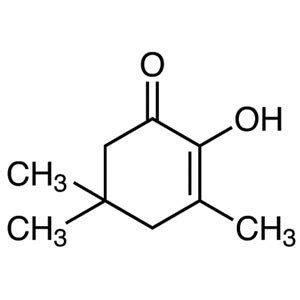
- TCI T2723 4883-60-7 2-Hydroxy-3,5,5-trimethyl-2-cyclohexen-1-one
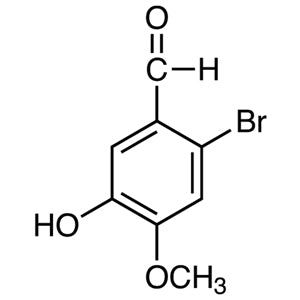
- TCI B4681 2973-59-3 2-Bromo-5-hydroxy-4-methoxybenzaldehyde
- TCI B3229 2208-15-3 4-Bromo-3-hydroxy-2-naphthoic Acid
- TCI B3180 1779-11-9 7-Bromo-3-hydroxy-2-naphthoic Acid
- TCI M3737 567-61-3 2-Hydroxy-6-methylbenzoic Acid
- Salen and salophen ligand synthesis: condensation with primary amines or diamines produces highly stable Schiff bases whose ortho-hydroxy arrangement provides the donor set required for well-defined chelating ligands.
- Metal complex preparation in coordination chemistry: the resulting ligands form chelate complexes with a broad range of metal ions, giving complexes with electronic and optical behaviour worth characterising in detail.
- Colorimetric chemosensor development: the extended naphthalene conjugation gives visible colour responses on metal binding, making derivatives well suited to designing detection systems for analytical chemistry.
- Fluorometric sensor design: because the naphthalene system is an effective light-emitting group, derivatives of this aldehyde are frequently built into fluorescence-based molecular sensors for ion detection.
- Dye and azo colourant synthesis: the reactive formyl group and naphthalene backbone make the compound a practical starting material for preparing dyes and azo colourants in materials chemistry work.
| Brand | TCI (Tokyo Chemical Industry) |
|---|---|
| CAS number | 574-96-9 |
| Molecular formula | — |
| Purity | — |
| Category | Chemistry > Building Blocks > Non-Heterocyclic Building Blocks |
| Pack sizes | available in the standard TCI catalogue pack sizes for this product code; please confirm the size required when ordering |
| Physical form | — |
| Storage | store according to the conditions stated on the manufacturer's label and safety data sheet |
- Product code: H0839
Store 1-Hydroxy-2-naphthaldehyde in its original tightly closed container, kept in a cool, dry, and well ventilated place away from direct sunlight, heat sources, and incompatible materials. Amber glass or the manufacturer's supplied packaging is appropriate, since aromatic aldehydes are generally sensitive to prolonged light and air exposure. Handle the material in a fume hood using standard laboratory personal protective equipment, including safety glasses, gloves, and a laboratory coat, and avoid generating dust when weighing. Always consult the manufacturer's safety data sheet before use, and follow local institutional procedures for waste collection and disposal of organic residues.
—
Produk Terkait
-
2-Hydroxy-1-naphthaldehyde TCI H0275
Regular price From Rp 1.829.100,00Regular price -
2-Hydroxy-3,5,5-trimethyl-2-cyclohexen-1-one TCI T2723
Regular price Rp 1.273.650,00Regular price -
2-Bromo-5-hydroxy-4-methoxybenzaldehyde TCI B4681
Regular price Rp 4.293.450,00Regular price -
4-Bromo-3-hydroxy-2-naphthoicAcid TCI B3229
Regular price From Rp 2.174.550,00Regular price -
7-Bromo-3-hydroxy-2-naphthoicAcid TCI B3180
Regular price From Rp 769.650,00Regular price -
2-Hydroxy-6-methylbenzoicAcid TCI M3737
Regular price From Rp 2.332.050,00Regular price -
Methyl4-Hydroxy-3,5-dimethoxybenzoate TCI M2806
Regular price From Rp 1.193.850,00Regular price -
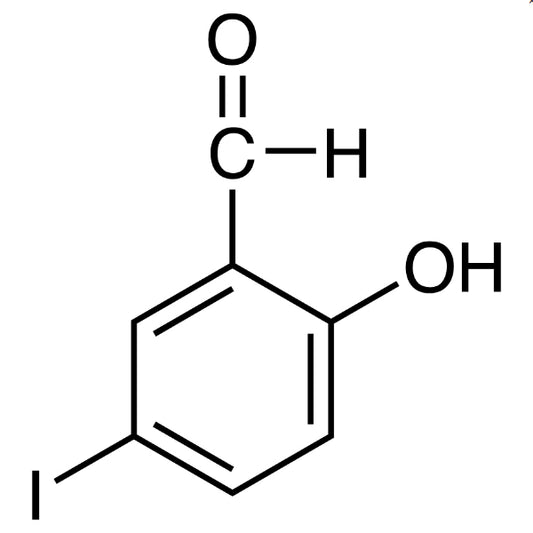
2-Hydroxy-5-iodobenzaldehyde TCI I1175
Regular price From Rp 903.000,00Regular price