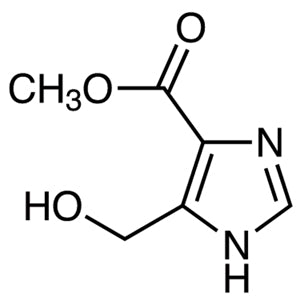
TCI H0840 Methyl 5-(Hydroxymethyl)-1H-imidazole-4-carboxylate is a heterocyclic building block built around an imidazole ring bearing two adjacent functional substituents: a hydroxymethyl group and a methyl carboxylate ester group. The imidazole ring is itself one of the most important heterocyclic cores in medicinal chemistry, because it appears in histidine, in histamine, and in a large number of active pharmaceutical ingredients. In the laboratory, this compound serves as a high-value intermediate for constructing substituted imidazole derivatives, including synthetic purines, drug candidate compounds, and organic ligands for coordination chemistry.
The property that makes this material a preferred choice is the presence of three distinct reactive sites on a single compact molecule. The hydroxymethyl group can be oxidised to an aldehyde or an acid, activated into a leaving group, or esterified and etherified. The methyl ester group can be hydrolysed to the carboxylic acid, converted to an amide by amidation, or reduced to an alcohol. Meanwhile, the imidazole ring nitrogen can be alkylated or arylated to tune electronic character and solubility. The adjacent 4- and 5-positions also permit intramolecular cyclisation to form fused ring systems, giving chemists several independent routes from one starting material.
In Indonesian laboratories, this building block is typically used in university and institutional synthetic organic chemistry groups, in medicinal chemistry and drug discovery research, and in laboratories developing heterocyclic compounds for coordination chemistry. It is normally handled at bench scale for multi-step synthesis routes, where the intermediate is elaborated further rather than used directly as a final product. Researchers preparing imidazole and purine analogues generally order it as a defined starting material for reproducible synthetic work.
Related TCI products
- TCI M2228 17325-26-7 Methyl 1H-Imidazole-5-carboxylate
- TCI I0457 33457-48-6 4,5-Bis(hydroxymethyl)imidazole
- TCI I0809 10111-08-7 Imidazole-2-carboxaldehyde
- TCI T1985 2232-08-8 1-(p-Toluenesulfonyl)imidazole
- TCI B4064 68282-49-5 2-Butyl-1H-imidazole-5-carboxaldehyde
- TCI B3941 37734-89-7 1-Benzyl-2-phenyl-1H-imidazole
- Synthesis of substituted imidazole derivatives — the ring nitrogen accepts alkylation or arylation, letting researchers systematically vary electronic properties and solubility across a compound series.
- Preparation of synthetic purine analogues — the adjacent 4- and 5-substituents allow intramolecular cyclisation into fused ring systems characteristic of purine-type scaffolds.
- Medicinal chemistry and drug candidate research — the imidazole core is present in histidine, histamine, and many pharmaceutical actives, making derivatives directly relevant to bioactive compound design.
- Preparation of organic ligands for coordination chemistry — the imidazole nitrogen and the oxygen-bearing substituents offer donor positions suitable for constructing metal-binding ligand frameworks.
- Functional group transformation studies — three independent reactive sites permit oxidation, hydrolysis, amidation, reduction, and etherification exercises on a single compact, well-defined molecular platform.
| Brand | TCI (Tokyo Chemical Industry) |
|---|---|
| CAS number | 82032-43-7 |
| Molecular formula | — |
| Purity | — |
| Category | Chemistry > Building Blocks > Heterocyclic Building Blocks |
| Pack sizes | available in standard TCI research-scale packaging; please confirm the required size when ordering |
| Physical form | — |
| Storage | store in a closed original container under the conditions stated on the product label and Safety Data Sheet |
- Product code: TCI H0840
Store the material in its original tightly closed container in a cool, dry, well-ventilated place, away from direct sunlight, moisture, and incompatible chemicals. Glass containers with chemically resistant closures are suitable for transfer and short-term working quantities. Handle the compound in a fume hood using appropriate personal protective equipment, including safety goggles, a laboratory coat, and chemical-resistant gloves. Avoid generating dust and avoid contact with skin and eyes. Because the hydroxymethyl and ester groups are chemically reactive, keep the container closed when not in use to limit moisture uptake. Always consult the manufacturer's Safety Data Sheet before handling, and dispose of residues according to applicable laboratory waste procedures.
—
Produk Terkait
-
Methyl1H-Imidazole-5-carboxylate TCI M2228
Regular price From Rp 1.035.300,00Regular price -
4,5-Bis(hydroxymethyl)imidazole TCI I0457
Regular price From Rp 5.274.150,00Regular price -
Imidazole-2-carboxaldehyde TCI I0809
Regular price From Rp 769.650,00Regular price -
1-(p-Toluenesulfonyl)imidazole TCI T1985
Regular price From Rp 1.087.800,00Regular price -
2-Butyl-1H-imidazole-5-carboxaldehyde TCI B4064
Regular price From Rp 3.658.200,00Regular price -
1-Benzyl-2-phenyl-1H-imidazole TCI B3941
Regular price From Rp 875.700,00Regular price -
1-(tert-Butyldimethylsilyl)imidazole[tert-ButyldimethylsilylatingAgent] TCI B1043
Regular price From Rp 2.439.150,00Regular price -
5-Amino-1H-imidazole-4-carboxamide TCI A3078
Regular price From Rp 1.618.050,00Regular price


![54925-64-3 1-(tert-Butyldimethylsilyl)imidazole [tert-Butyldimethylsilylating Agent] - AMI Scientific](http://amiscientific.com/cdn/shop/files/TCI2510B1043_62a593eb-d572-4812-b0c7-1817f56f84d9.jpg?v=1767230995&width=533)