

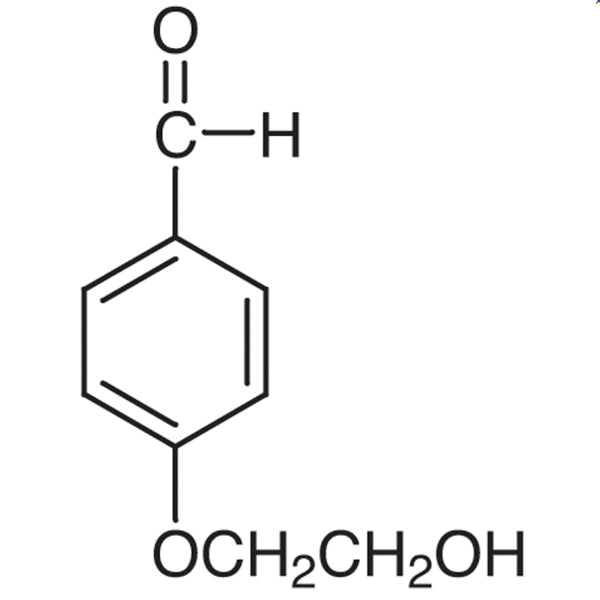
TCI H0859 4-(2-Hydroxyethoxy)benzaldehyde is the para isomer of the hydroxyethoxybenzaldehyde family, with the aldehyde group and the 2-hydroxyethoxy chain positioned directly opposite one another on the benzene ring. This linear arrangement makes it a highly favoured building block for constructing elongated molecules, chain connectors, and functional material frameworks. In the laboratory, the compound serves as a starting material for the synthesis of liquid crystals, dendrimers, and conjugated polymers, as well as a linker in solid-phase synthesis, because its two functional groups can be developed in two opposing directions in a neat and controlled manner.
The properties that make it a frequent choice are its structural directionality and its readily managed dual reactivity. The para aldehyde group is highly responsive to Knoevenagel condensation, Wittig reactions, imine formation, and reduction to the corresponding benzylic alcohol, so extension of a conjugated system can be achieved in a compact sequence of steps. Meanwhile, the primary hydroxyl group at the end of the ethylene glycol chain provides a polar attachment point that is useful for anchoring molecules to surfaces, resins, or polymer chains, while simultaneously raising the solubility of the product in polar solvents.
In Indonesian laboratories, this building block is typically used in university and institutional organic synthesis groups, in materials chemistry research covering liquid crystals and functional polymers, and in medicinal chemistry work where a linear, bifunctional aromatic scaffold is required. It is handled on the bench scale in fume-hooded synthesis laboratories, where the two orthogonal functional groups allow a research team to build a target molecule step by step without the need for extensive protecting-group strategies.
Related TCI products
- TCI H0858 60345-97-3 3-(2-Hydroxyethoxy)benzaldehyde
- TCI H0857 22042-72-4 2-(2-Hydroxyethoxy)benzaldehyde
- TCI H0820 3204-73-7 Methyl 4-(2-Hydroxyethoxy)benzoate
- TCI H0730 163451-82-9 4-(2-Hydroxyethoxy)salicylic Acid
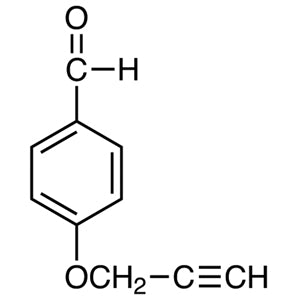
- TCI P2339 5651-86-5 4-(Propargyloxy)benzaldehyde
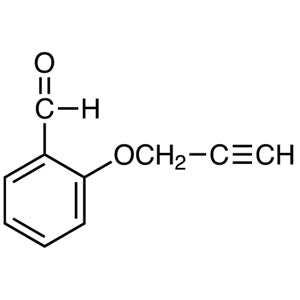
- TCI P2338 29978-83-4 2-(Propargyloxy)benzaldehyde
- Liquid crystal synthesis: the linear para geometry gives the rigid, elongated molecular shape required for mesophase behaviour, while the terminal hydroxyl allows the flexible tail to be tuned.
- Dendrimer construction: the two opposing functional groups let each generation be grown outward in a controlled direction, making the compound a convenient branching and core unit.
- Conjugated polymer preparation: the para aldehyde readily undergoes Knoevenagel and Wittig chemistry, extending the conjugated backbone in compact steps while the hydroxyethoxy chain improves processing solubility.
- Solid-phase synthesis linkers: the primary hydroxyl provides a polar attachment point for anchoring the scaffold onto resins, and the free aldehyde remains available for subsequent coupling.
- Imine and reductive amination chemistry: the responsive para aldehyde forms imines cleanly and can be reduced to the benzylic alcohol, supporting flexible derivatisation routes in medicinal chemistry.
| Brand | TCI (Tokyo Chemical Industry) |
|---|---|
| CAS number | 22042-73-5 |
| Molecular formula | — |
| Purity | — |
| Category | Chemistry > Building Blocks > Non-Heterocyclic Building Blocks |
| Pack sizes | supplied in standard TCI research-scale packaging; please confirm the available pack size when ordering |
| Physical form | — |
| Storage | store in a tightly closed container in a cool, dry, well-ventilated place, following the storage statement on the supplier label and Safety Data Sheet |
- Product code: H0859
Store the container tightly closed in a cool, dry, well-ventilated area, away from heat sources, direct sunlight, and incompatible materials such as strong oxidising agents. Keep the material in its original supplier container or in a compatible tightly sealed glass bottle, clearly labelled and kept in a designated chemical store. Handle in a fume hood using safety goggles, chemical-resistant gloves, and a laboratory coat, and avoid generating dust or aerosols. Since the aldehyde group is reactive, minimise exposure of the opened container to air and moisture and reseal promptly after weighing. Always consult the manufacturer's Safety Data Sheet before use, and dispose of residues and contaminated materials in accordance with applicable chemical waste procedures.
—
Produk Terkait
-
3-(2-Hydroxyethoxy)benzaldehyde TCI H0858
Regular price From Rp 1.298.850,00Regular price -
2-(2-Hydroxyethoxy)benzaldehyde TCI H0857
Regular price From Rp 1.405.950,00Regular price -
Methyl4-(2-Hydroxyethoxy)benzoate TCI H0820
Regular price From Rp 3.287.550,00Regular price -
4-(2-Hydroxyethoxy)salicylicAcid TCI H0730
Regular price Rp 6.253.800,00Regular price -
4-(Propargyloxy)benzaldehyde TCI P2339
Regular price From Rp 1.458.450,00Regular price -
2-(Propargyloxy)benzaldehyde TCI P2338
Regular price From Rp 717.150,00Regular price -
4-Methoxy-3-(methoxymethoxy)benzaldehyde TCI M3066
Regular price Rp 3.976.350,00Regular price -
4-[(2-Hydroxyethyl)(methyl)amino]benzaldehyde TCI H1844
Regular price From Rp 1.510.950,00Regular price



![1201-91-8 4-[(2-Hydroxyethyl)(methyl)amino]benzaldehyde - AMI Scientific](http://amiscientific.com/cdn/shop/files/TCI2510H1844.jpg?v=1767118605&width=533)