


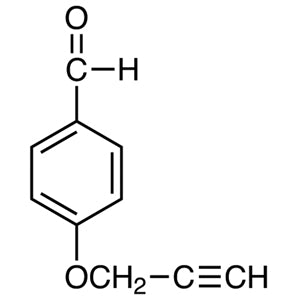
2-(Propargyloxy)benzaldehyde is a chemical compound widely used as a building block in the synthesis of complex organic molecules. Its unique molecular structure, featuring both an aldehyde group and a propargyloxy group, makes it a valuable reagent in various chemical reactions. This compound plays a crucial role in laboratory settings by enabling the construction of more intricate molecular frameworks. It is particularly useful in the development of pharmaceutical compounds and organic materials due to its versatile reactivity.
The compound is known for its high reactivity, especially towards nucleophilic reagents such as amines and alcohols. Its ability to participate in nucleophilic and conjugate addition reactions makes it a preferred choice for synthetic chemists. Additionally, it exhibits stability under certain conditions, which allows for controlled reactions in different environments. These properties make it a reliable and efficient reagent for a wide range of chemical applications.
In Indonesian laboratories, 2-(Propargyloxy)benzaldehyde is commonly used in organic chemistry research, particularly in academic institutions and research organizations. It is frequently applied in projects related to the synthesis of new compounds, drug development, and material science. Its availability and chemical properties make it an essential component in the toolkit of many researchers working in the field of organic chemistry.
- Organic synthesis projects benefit from this compound due to its reactivity in nucleophilic and conjugation reactions, enabling the formation of complex molecular structures.
- Pharmaceutical research utilizes this reagent for the development of bioactive compounds, as its structure allows for the creation of molecules with potential therapeutic applications.
- Material science applications leverage its unique chemical properties to design new organic materials with specific functional characteristics.
- Academic research in chemistry relies on this compound for teaching and experimental purposes, providing students with hands-on experience in synthetic techniques.
- Industrial chemical processes incorporate this reagent for the production of specialty chemicals, taking advantage of its versatility in reaction pathways.
| Brand | TCI |
|---|---|
| CAS number | 29978-83-4 |
| Molecular formula | — |
| Purity | — |
| Category | Chemistry > Building Blocks > Non-Heterocyclic Building Blocks |
| Pack sizes | Available in various quantities as per supplier specifications |
| Physical form | Liquid |
| Storage | Store in a cool, dry place away from light and incompatible substances |
This compound should be stored in a cool, dry environment, away from direct sunlight and sources of heat. It is recommended to use airtight containers made of materials that are chemically inert, such as glass or high-density polyethylene. Due to its reactivity, it should be kept separate from strong nucleophiles, oxidizing agents, and reducing agents to prevent unwanted side reactions. In laboratory settings, proper personal protective equipment, including gloves and safety goggles, should always be worn when handling this material. Regular monitoring of storage conditions is advised to ensure the stability and integrity of the compound.
—
Produk Terkait
-
4-(Propargyloxy)benzaldehyde TCI P2339
Regular price From Rp 1.458.450,00Regular price -
N-(Propargyloxy)phthalimide TCI P2342
Regular price From Rp 928.200,00Regular price -
4-Methoxy-3-(methoxymethoxy)benzaldehyde TCI M3066
Regular price Rp 3.976.350,00Regular price -
4-[(2-Hydroxyethyl)(methyl)amino]benzaldehyde TCI H1844
Regular price From Rp 1.510.950,00Regular price -
4-(11-Hydroxyundecyloxy)benzaldehyde TCI H1216
Regular price From Rp 2.625.000,00Regular price -
4-(2-Hydroxyethoxy)benzaldehyde TCI H0859
Regular price From Rp 1.060.500,00Regular price -
3-(2-Hydroxyethoxy)benzaldehyde TCI H0858
Regular price From Rp 1.298.850,00Regular price -
2-(2-Hydroxyethoxy)benzaldehyde TCI H0857
Regular price From Rp 1.405.950,00Regular price


![1201-91-8 4-[(2-Hydroxyethyl)(methyl)amino]benzaldehyde - AMI Scientific](http://amiscientific.com/cdn/shop/files/TCI2510H1844.jpg?v=1767118605&width=533)


