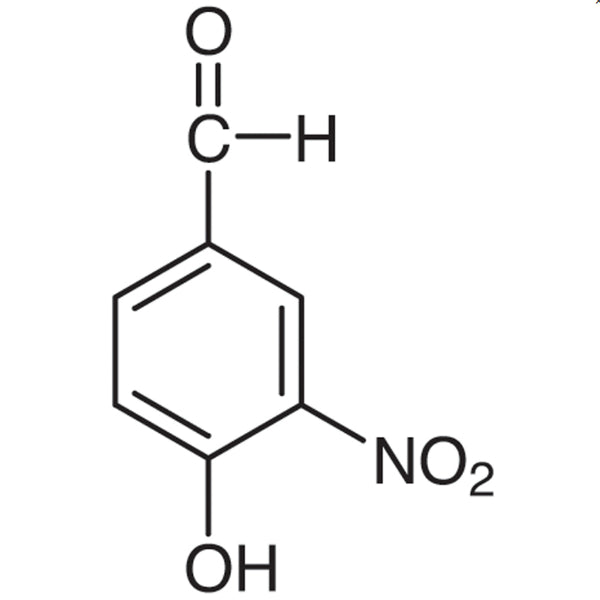
4-Hydroxy-3-nitrobenzaldehyde is an aromatic compound carrying three distinct functional groups on a single benzene ring: an aldehyde group, a phenolic hydroxyl group, and a nitro group. This combination makes it one of the most versatile building blocks in organic synthesis, because each group can be manipulated separately toward a different direction of transformation. In the laboratory, the compound generally serves as a starting point for the preparation of more elaborate molecules, ranging from Schiff bases and heterocyclic compounds through to dyes and fluorescent probes that require a densely functionalised aromatic ring.
The property that makes it so widely chosen is the balance of reactivity between its groups. The strongly electron-withdrawing nitro group activates the ring toward nucleophilic substitution while simultaneously increasing the acidity of the hydroxyl group positioned ortho to it, and the aldehyde group remains available for condensation reactions with amines, hydrazines, or active methylene compounds. The nitro group can also be selectively reduced to an amine, opening a route toward substituted aminophenols and a range of fused heterocycles. This orthogonality allows synthetic chemists to plan multi-step sequences around a single, readily handled intermediate.
The compound is a yellowish solid with good solubility in common organic reaction media, which suits the way it is typically used in Indonesian laboratories. University research groups, pharmaceutical and agrochemical development units, and materials chemistry laboratories generally take it up at the gram scale for exploratory synthesis, method development, and student research projects. Because it arrives as a defined, characterised building block from an established supplier, laboratories can begin condensation or reduction work directly without first preparing the intermediate in house.
Related TCI products
- Schiff base synthesis — the free aldehyde condenses cleanly with primary amines and hydrazines, and the adjacent phenolic hydroxyl provides an additional donor site useful for preparing chelating ligands.
- Heterocyclic construction — the combination of aldehyde and reducible nitro group allows ring-closing sequences toward fused heterocyclic systems that would otherwise demand several separate functionalisation steps.
- Dye and fluorescent probe preparation — the densely functionalised aromatic ring gives researchers a ready platform for building chromophores and probes that require both donor and acceptor substituents.
- Nucleophilic aromatic substitution studies — the strongly electron-withdrawing nitro group activates the ring, making this compound a convenient substrate for investigating substitution mechanisms and reaction conditions.
- Aminophenol intermediate production — selective reduction of the nitro group delivers substituted aminophenols, a class of intermediates frequently required in pharmaceutical and agrochemical discovery chemistry programmes.
| Brand | TCI |
|---|---|
| CAS number | 3011-34-5 |
| Molecular formula | — |
| Purity | — |
| Category | Chemistry > Building Blocks > Non-Heterocyclic Building Blocks |
| Pack sizes | available in standard TCI research-scale pack sizes; please confirm the required size when ordering |
| Physical form | yellowish solid |
| Storage | keep in a cool, dry place in a tightly closed original container |
- Product code: TCI H0924
Store the compound in a cool, dry place, protected from direct sunlight and away from sources of heat and ignition. The original tightly closed container from the manufacturer is the most suitable packaging; if transferring material, use clean, dry amber glass or another chemically compatible container with a well-sealing cap, and label it clearly. Handle in a fume hood using safety glasses, gloves, and a laboratory coat, since nitroaromatic compounds and aldehydes can irritate the skin, eyes, and respiratory tract. Avoid contact with strong oxidising agents and strong bases, keep the container closed when not in use to limit moisture uptake, and consult the manufacturer's safety data sheet before first use and for disposal guidance.
—
Produk Terkait
-
2-Hydroxy-4-nitrobenzaldehyde TCI H1962
Regular price From Rp 1.829.100,00Regular price -
3-Hydroxy-4-nitrobenzaldehyde TCI H1334
Regular price From Rp 1.087.800,00Regular price -
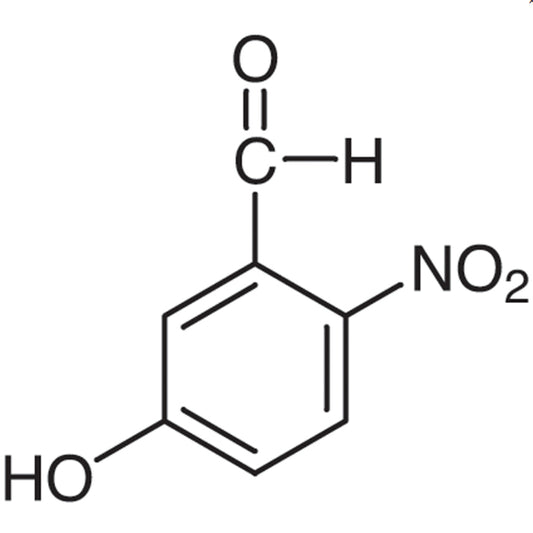
5-Hydroxy-2-nitrobenzaldehyde TCI H1039
Regular price From Rp 2.491.650,00Regular price -
4-Bromo-3-nitrobenzaldehyde TCI B5101
Regular price From Rp 717.150,00Regular price -
3-Bromo-5-nitrobenzaldehyde TCI B4982
Regular price From Rp 637.350,00Regular price -
5-Bromo-2-nitrobenzaldehyde TCI B4192
Regular price From Rp 1.035.300,00Regular price -
4-Bromo-2-nitrobenzaldehyde TCI B4146
Regular price From Rp 1.326.150,00Regular price -
4-Nitrobenzaldehyde TCI N0559
Regular price From Rp 1.167.600,00Regular price