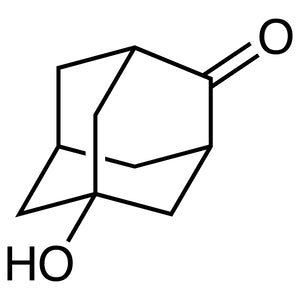
5-Hydroxy-2-adamantanone is a bifunctional adamantane derivative that combines an exceptionally rigid diamondoid cage framework with two distinct functional groups: a ketone at the 2-position and a tertiary hydroxyl at the 5-position. Adamantane itself is a saturated polycyclic hydrocarbon well known for its thermal stability and near-spherical shape. In the laboratory, this compound serves as a high-value non-heterocyclic building block, used whenever researchers need a robust, heat-resistant molecular core that simultaneously provides two reactive handles for further elaboration.
The properties that make it a preferred choice are the combination of structural rigidity and complementary reactivity. The ketone group at the 2-position is ready to undergo reduction, reductive amination, Wittig olefination, or nucleophilic addition with organometallic reagents, while the tertiary hydroxyl at the 5-position reacts more slowly and can therefore be kept intact while the ketone is manipulated, or alternatively esterified to form monomers. The adamantane framework also contributes high lipophilicity and substantial steric bulk, which stabilises the conformation of derivative molecules.
In Indonesian laboratories, this building block is typically found in university and institutional synthetic chemistry groups, medicinal chemistry programmes, and polymer or materials research units. It is generally ordered in research-scale quantities for multi-step synthesis campaigns, method development, and the preparation of adamantane-containing intermediates, where a reliably characterised bifunctional starting material shortens route design and reduces the number of protection and deprotection steps required.
Related TCI products
- TCI B3154 20098-20-8 5-Bromo-2-adamantanone
- TCI A0719 700-58-3 2-Adamantanone
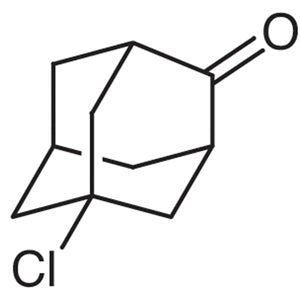
- TCI C2140 20098-17-3 5-Chloro-2-adamantanone
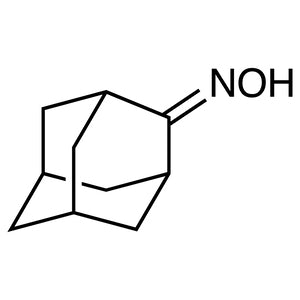
- TCI A2110 4500-12-3 2-Adamantanone Oxime
- TCI T4007 223255-30-9 N,N'-[(Perfluoropropane-2,2-diyl)bis(6-hydroxy-3,1-phenylene)]bis(1,3-dioxo-1,3-dihydroisobenzofuran-5-carboxamide)
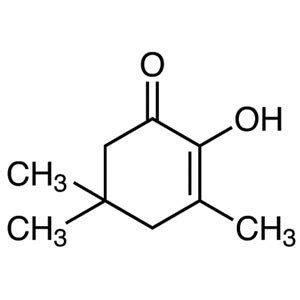
- TCI T2723 4883-60-7 2-Hydroxy-3,5,5-trimethyl-2-cyclohexen-1-one
- Medicinal chemistry scaffold development, where the rigid adamantane cage is introduced to raise lipophilicity and lock the spatial orientation of substituents in candidate molecules.
- Multi-step organic synthesis, since the ketone and tertiary hydroxyl differ enough in reactivity that chemists can transform one position selectively while leaving the other untouched.
- Polymer and monomer preparation, in which the tertiary hydroxyl group is esterified to build adamantane-containing monomers that carry the cage's thermal stability into the resulting material.
- Carbonyl transformation methodology studies, because the 2-ketone readily accepts reduction, reductive amination, Wittig olefination, and organometallic nucleophilic addition under standard conditions.
- Materials research on thermally stable systems, where the saturated polycyclic framework resists thermal degradation and its near-spherical bulk influences packing and conformational behaviour.
| Brand | TCI |
|---|---|
| CAS number | 20098-14-0 |
| Molecular formula | — |
| Purity | — |
| Category | Chemistry > Building Blocks > Non-Heterocyclic Building Blocks |
| Pack sizes | available in standard research-scale pack sizes; please confirm the currently listed options when ordering |
| Physical form | — |
| Storage | store in a cool, dry place in a tightly closed container, following the manufacturer's instructions on the product label |
- Catalogue number: H0962
Store this building block in its original tightly closed container in a cool, dry, well-ventilated area, away from direct sunlight, heat sources, and strong oxidising agents. Keep the container sealed when not in use to limit exposure to atmospheric moisture, and reseal it promptly after each withdrawal. Handle the material in a fume hood using standard personal protective equipment, including safety glasses, a laboratory coat, and chemically resistant gloves. Avoid generating dust, avoid inhalation and skin contact, and transfer the solid with clean, dry spatulas to prevent cross-contamination. Always consult the manufacturer's safety data sheet before use, and follow institutional procedures for chemical waste disposal.
—
Produk Terkait
-
5-Bromo-2-adamantanone TCI B3154
Regular price From Rp 1.565.550,00Regular price -
2-Adamantanone TCI A0719
Regular price From Rp 903.000,00Regular price -
5-Chloro-2-adamantanone TCI C2140
Regular price Rp 1.670.550,00Regular price -
2-AdamantanoneOxime TCI A2110
Regular price Rp 1.565.550,00Regular price -
N,N'-[(Perfluoropropane-2,2-diyl)bis(6-hydroxy-3,1-phenylene)]bis(1,3-dioxo-1,3-dihydroisobenzofuran-5-carboxamide) TCI T4007
Regular price From Rp 1.776.600,00Regular price -
2-Hydroxy-3,5,5-trimethyl-2-cyclohexen-1-one TCI T2723
Regular price Rp 1.273.650,00Regular price -
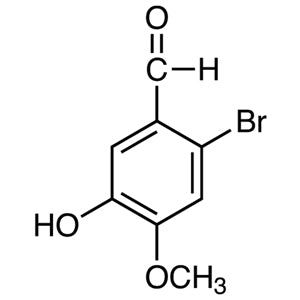
2-Bromo-5-hydroxy-4-methoxybenzaldehyde TCI B4681
Regular price Rp 4.293.450,00Regular price -
5'-Bromo-2'-hydroxy-3'-nitroacetophenone TCI B4556
Regular price From Rp 743.400,00Regular price


![223255-30-9 N,N'-[(Perfluoropropane-2,2-diyl)bis(6-hydroxy-3,1-phenylene)]bis(1,3-dioxo-1,3-dihydroisobenzofuran-5-carboxamide) - AMI Scientific](http://amiscientific.com/cdn/shop/files/TCI2510T4007.jpg?v=1767144592&width=533)