

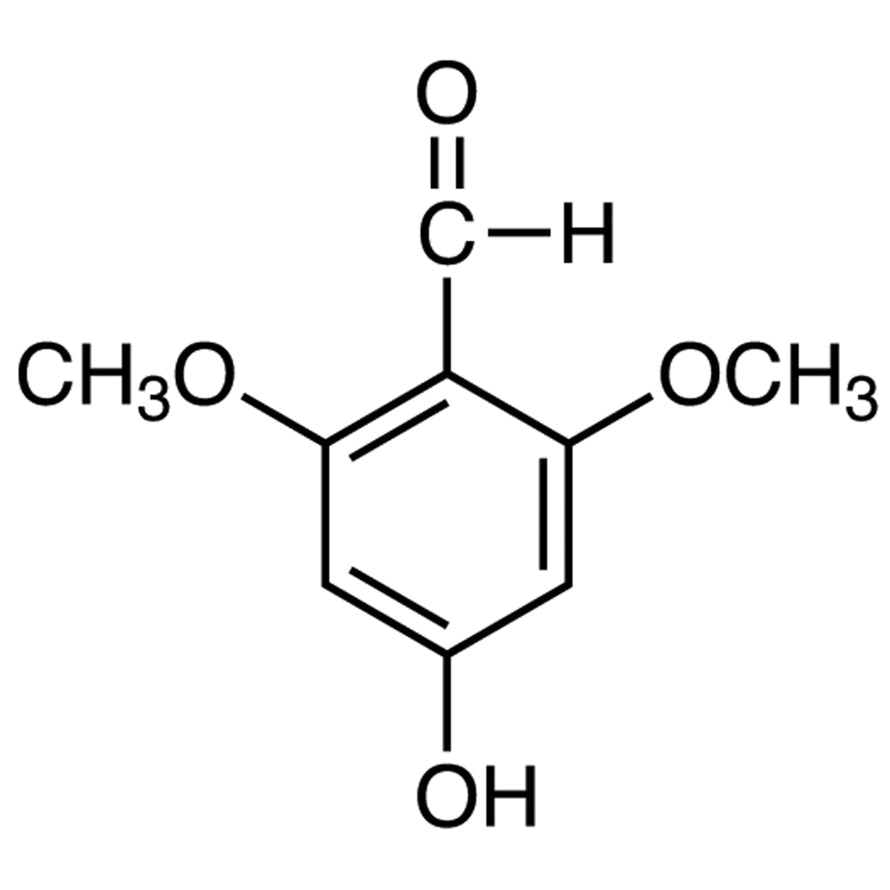
TCI H1326, bearing CAS number 22080-96-2, is 4-Hydroxy-2,6-dimethoxybenzaldehyde, a substituted benzaldehyde carrying one phenolic hydroxy group and two methoxy groups on its aromatic ring. This substitution pattern is of considerable interest to synthetic chemists because it resembles the skeleton found widely in plant secondary metabolites, particularly the phenylpropanoid class and lignin-derived compounds. In the laboratory, the compound serves as an aromatic building block for constructing larger molecules through reactions at the aldehyde group, and equally as a comparison material in natural product research.
The characteristic that makes this compound a preferred choice is the balance between reactivity and selectivity offered by its structure. The aldehyde group acts as a versatile reaction centre for aldol condensation, Wittig reactions, reduction to the corresponding alcohol, oxidation to the carboxylic acid, and reductive amination. The two methoxy groups flanking the ortho positions deliver an electron-donating electronic effect together with steric hindrance that influences the direction of a reaction, while the free hydroxy group at the para position provides a separate point of modification for etherification or glycosylation.
In Indonesian laboratories, this building block is typically encountered in university and institutional research settings where synthetic organic chemistry and natural product work are carried out. It is used by groups preparing target molecules step by step from aromatic precursors, and by analysts who need a structurally defined reference material when studying plant-derived compounds. Because the substitution pattern parallels motifs common in botanical metabolites, it fits research programmes examining locally sourced natural materials.
Related TCI products
- TCI H1179 29865-90-5 3-Hydroxy-4,5-dimethoxybenzaldehyde
- TCI B3130 6948-30-7 3-Bromo-4,5-dimethoxybenzaldehyde
- TCI B2952 31558-40-4 4-Bromo-3,5-dimethoxybenzaldehyde
- TCI B2011 5392-10-9 2-Bromo-4,5-dimethoxybenzaldehyde
- TCI D2778 3392-97-0 2,6-Dimethoxybenzaldehyde
- TCI D1164 7311-34-4 3,5-Dimethoxybenzaldehyde
- Aromatic building block synthesis: the reactive aldehyde centre allows this compound to be elaborated into larger target molecules through standard carbonyl chemistry in multi-step synthetic routes.
- Natural product research: its skeleton resembles plant secondary metabolites, making it a useful comparison material when investigating phenylpropanoid and lignin-derived compounds isolated from botanical sources.
- Aldol condensation and Wittig chemistry: the aldehyde group functions as a versatile electrophilic partner for forming new carbon-carbon bonds with defined regiochemistry in the product.
- Selective functional group transformation: the compound supports reduction to an alcohol, oxidation to a carboxylic acid, or reductive amination, each proceeding at the same aldehyde centre.
- Phenolic derivatisation work: the free para hydroxy group offers a modification point independent of the aldehyde, enabling etherification or glycosylation without disturbing the carbonyl functionality.
| Brand | TCI |
|---|---|
| CAS number | 22080-96-2 |
| Molecular formula | — |
| Purity | — |
| Category | Chemistry > Building Blocks > Non-Heterocyclic Building Blocks |
| Pack sizes | available in the pack sizes listed on this product page |
| Physical form | — |
| Storage | keep in a tightly closed container under the conditions stated on the manufacturer's label |
- Chemical name: 4-Hydroxy-2,6-dimethoxybenzaldehyde
Store the container tightly closed in a cool, dry, well-ventilated area away from direct sunlight, heat sources, and strong oxidising agents, following the storage conditions stated on the manufacturer's label and safety data sheet. Keep the material in its original supplier container, or transfer it to a clean amber glass bottle with a chemically compatible closure to limit exposure to light and moisture. Handle inside a fume hood while wearing safety goggles, a laboratory coat, and suitable chemical-resistant gloves. Avoid raising dust during weighing, close the container immediately after use, and label any secondary container clearly. Consult the safety data sheet before first use and dispose of residues through the laboratory's chemical waste stream.
—
Produk Terkait
-
3-Hydroxy-4,5-dimethoxybenzaldehyde TCI H1179
Regular price From Rp 1.510.950,00Regular price -
3-Bromo-4,5-dimethoxybenzaldehyde TCI B3130
Regular price From Rp 3.419.850,00Regular price -
4-Bromo-3,5-dimethoxybenzaldehyde TCI B2952
Regular price From Rp 2.809.800,00Regular price -
2-Bromo-4,5-dimethoxybenzaldehyde TCI B2011
Regular price From Rp 795.900,00Regular price -
2,6-Dimethoxybenzaldehyde TCI D2778
Regular price From Rp 2.332.050,00Regular price -
3,5-Dimethoxybenzaldehyde TCI D1164
Regular price From Rp 1.298.850,00Regular price -
2,5-Dimethoxybenzaldehyde TCI D1111
Regular price Rp 980.700,00Regular price -
2,4-Dimethoxybenzaldehyde TCI D0626
Regular price From Rp 1.273.650,00Regular price


