

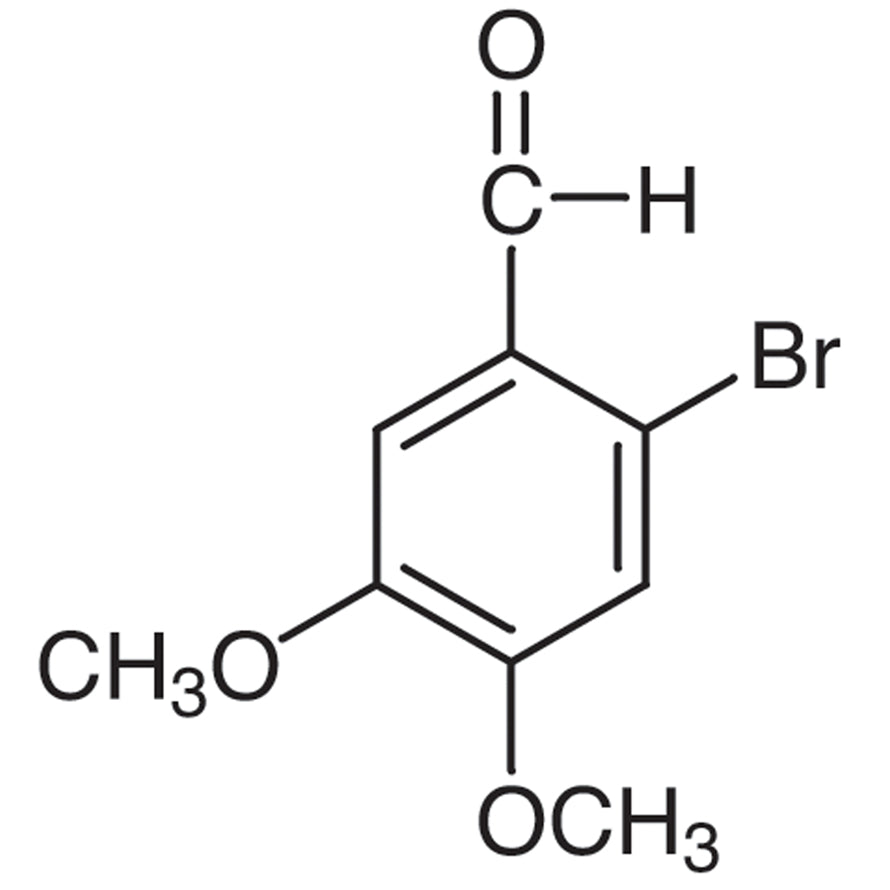
2-Bromo-4,5-dimethoxybenzaldehyde is a chemical compound widely used as a building block in the synthesis of complex organic molecules. Its aromatic structure, combined with bromo and dimethoxy substituents, provides unique reactivity and specificity for targeted chemical reactions. This compound plays a crucial role in various synthetic pathways, particularly in the development of heterocyclic and bioactive compounds. Its versatility makes it an essential tool for chemists working on advanced organic synthesis projects.
The compound's reactivity is enhanced by the presence of bromo and dimethoxy groups, which serve as specific sites for chemical modification. These functional groups allow for precise control over reaction outcomes, making it a preferred choice for researchers aiming for high selectivity in their synthetic processes. Additionally, its solubility in organic solvents such as ethyl acetate and acetone ensures compatibility with a wide range of laboratory techniques. This solubility profile and stability under specific reaction conditions further contribute to its reliability in synthetic applications.
In Indonesian laboratories, 2-Bromo-4,5-dimethoxybenzaldehyde is commonly used in organic chemistry research, particularly in academic institutions and research centers. Its role in the development of pharmaceuticals and industrial compounds highlights its importance in both academic and applied research settings. The compound's structural and reactivity features make it a valuable resource for scientists seeking to create new compounds with specific functional properties.
Related TCI products
- TCI B3130 6948-30-7 3-Bromo-4,5-dimethoxybenzaldehyde
- TCI B2952 31558-40-4 4-Bromo-3,5-dimethoxybenzaldehyde
- TCI H1326 22080-96-2 4-Hydroxy-2,6-dimethoxybenzaldehyde
- TCI H1179 29865-90-5 3-Hydroxy-4,5-dimethoxybenzaldehyde
- TCI D2778 3392-97-0 2,6-Dimethoxybenzaldehyde
- TCI D1164 7311-34-4 3,5-Dimethoxybenzaldehyde
- Organic synthesis of heterocyclic compounds due to its reactive bromo and dimethoxy groups enabling controlled functionalization.
- Development of bioactive molecules as the compound provides a versatile platform for introducing diverse functionalities.
- Coupling reactions where the aromatic structure facilitates efficient bond formation under specific conditions.
- Oxidation processes where the compound's stability and solubility support consistent reaction outcomes.
- Research in pharmaceutical chemistry for the synthesis of compounds with potential therapeutic applications.
| Brand | TCI |
|---|---|
| CAS number | 5392-10-9 |
| Molecular formula | — |
| Purity | — |
| Category | Chemistry > Building Blocks > Non-Heterocyclic Building Blocks |
| Pack sizes | Available in various quantities as per standard laboratory supply specifications |
| Physical form | Solid |
| Storage | Store in a cool, dry place away from light and moisture |
This compound should be stored in a cool, dry environment, away from direct light and moisture to maintain its stability and reactivity. It is recommended to use airtight containers made of materials compatible with organic solvents to prevent contamination and degradation. Due to its bromo substituent, it is important to handle the compound with care, following standard laboratory safety protocols to avoid exposure. Proper ventilation should be ensured when working with the compound to minimize inhalation risks. The compound is not classified as hazardous under standard handling conditions, but standard chemical safety measures should always be observed in a well-equipped laboratory setting.
—
Produk Terkait
-
3-Bromo-4,5-dimethoxybenzaldehyde TCI B3130
Regular price From Rp 3.419.850,00Regular priceRp 2.390.850,00Sale price From Rp 3.419.850,00 -
4-Bromo-3,5-dimethoxybenzaldehyde TCI B2952
Regular price From Rp 2.809.800,00Regular priceRp 1.964.550,00Sale price From Rp 2.809.800,00 -
4-Hydroxy-2,6-dimethoxybenzaldehyde TCI H1326
Regular price From Rp 3.843.000,00Regular priceRp 2.686.950,00Sale price From Rp 3.843.000,00 -
3-Hydroxy-4,5-dimethoxybenzaldehyde TCI H1179
Regular price From Rp 1.510.950,00Regular priceRp 1.056.300,00Sale price From Rp 1.510.950,00 -
2,6-Dimethoxybenzaldehyde TCI D2778
Regular price From Rp 2.332.050,00Regular priceRp 1.630.650,00Sale price From Rp 2.332.050,00 -
3,5-Dimethoxybenzaldehyde TCI D1164
Regular price From Rp 1.298.850,00Regular priceRp 908.250,00Sale price From Rp 1.298.850,00 -
2,5-Dimethoxybenzaldehyde TCI D1111
Regular price Rp 980.700,00Regular priceRp 685.650,00Sale price Rp 980.700,00 -
2,4-Dimethoxybenzaldehyde TCI D0626
Regular price From Rp 1.273.650,00Regular priceRp 890.400,00Sale price From Rp 1.273.650,00


