

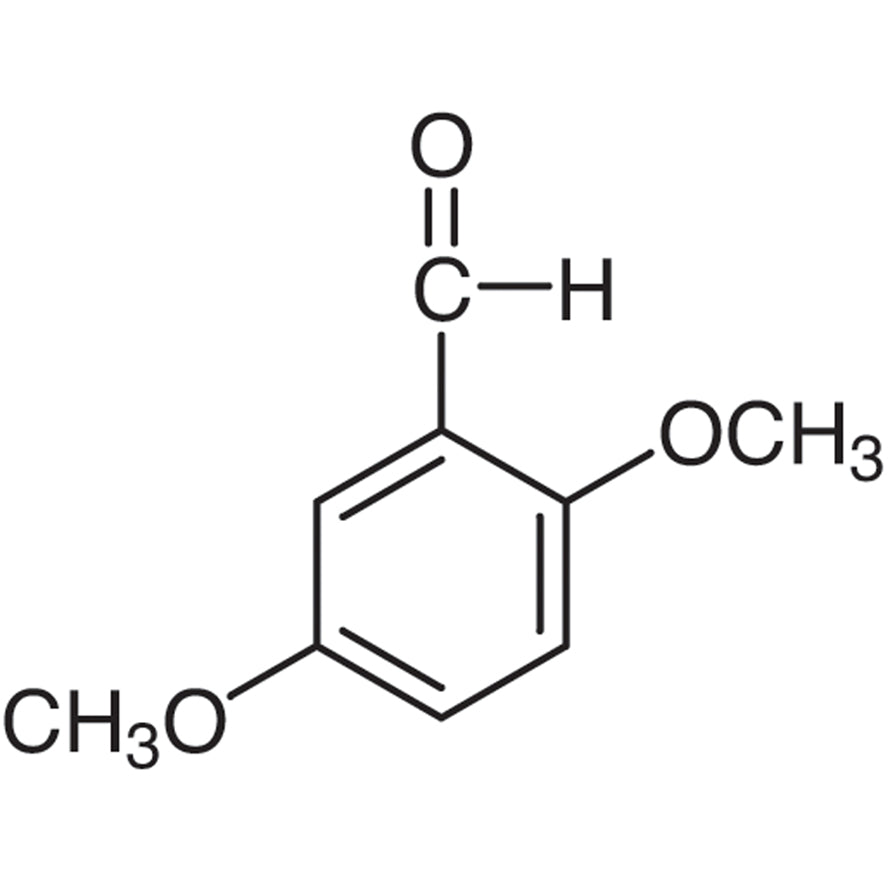
2,5-Dimethoxybenzaldehyde is a chemical compound widely used as a foundational building block in the synthesis of complex organic compounds. It belongs to the class of aldehydes and features two methoxy groups positioned at the 2 and 5 positions on a benzene ring. This structural characteristic makes it a versatile reagent in organic chemistry, enabling the creation of a wide range of functional molecules. In laboratory settings, it plays a crucial role in the development of new chemical entities, particularly in pharmaceutical and materials research. Its presence in the chemical toolbox allows researchers to explore various synthetic pathways and functional group transformations.
The compound's reactivity and stability make it a preferred choice for a variety of chemical reactions. It is polar in nature and exhibits solubility in organic solvents such as ethyl acetate and ethanol. These properties enhance its utility in synthetic processes that require controlled solubility and reactivity. Additionally, its ability to participate in substitution, reduction, and other reaction types contributes to its popularity among chemists. The compound's chemical stability under specific conditions further supports its use in laboratory applications where precision and consistency are essential.
In Indonesian laboratories, 2,5-Dimethoxybenzaldehyde is commonly used in organic chemistry research, particularly in academic and industrial settings. It is a key component in the synthesis of aromatic and heterocyclic compounds, supporting both basic and applied research. Its availability and reliability make it a favored material for chemists working on drug development, material science, and other advanced chemical projects. The compound's role in building complex molecular structures underscores its importance in the chemical research landscape of Indonesia.
Related TCI products
- TCI B3130 6948-30-7 3-Bromo-4,5-dimethoxybenzaldehyde
- TCI B2952 31558-40-4 4-Bromo-3,5-dimethoxybenzaldehyde
- TCI B2011 5392-10-9 2-Bromo-4,5-dimethoxybenzaldehyde
- TCI H1326 22080-96-2 4-Hydroxy-2,6-dimethoxybenzaldehyde
- TCI H1179 29865-90-5 3-Hydroxy-4,5-dimethoxybenzaldehyde
- TCI D2778 3392-97-0 2,6-Dimethoxybenzaldehyde
- Organic synthesis of aromatic and heterocyclic compounds due to its aldehyde functionality and methoxy substituents.
- Pharmaceutical research for the development of new drug molecules requiring aldehyde-based intermediates.
- Material science applications in the creation of functional polymers and organic coatings.
- Analytical chemistry for use as a standard in chromatographic and spectroscopic analyses.
- Teaching and research in academic institutions for demonstrating chemical reactivity and synthetic techniques.
| Brand | TCI |
|---|---|
| CAS number | 93-02-7 |
| Molecular formula | — |
| Purity | — |
| Category | Chemistry > Building Blocks > Non-Heterocyclic Building Blocks |
| Pack sizes | Available in various quantities as per supplier specifications |
| Physical form | Solid or liquid depending on the specific product variant |
| Storage | Store in a cool, dry place away from light and incompatible substances |
2,5-Dimethoxybenzaldehyde should be stored in a cool, dry environment, away from direct sunlight and sources of heat. It is recommended to keep the compound in a tightly sealed container to prevent moisture absorption and contamination. The container should be made of a material compatible with the chemical, such as glass or high-density polyethylene. In laboratory settings, it is important to handle the compound with appropriate personal protective equipment, including gloves and safety goggles. Proper ventilation should be maintained when working with the compound to minimize exposure. Due to its reactivity, it should be stored separately from strong oxidizing agents and incompatible materials to ensure safety and maintain chemical integrity.
—
Produk Terkait
-
3-Bromo-4,5-dimethoxybenzaldehyde TCI B3130
Regular price From Rp 3.419.850,00Regular price -
4-Bromo-3,5-dimethoxybenzaldehyde TCI B2952
Regular price From Rp 2.809.800,00Regular price -
2-Bromo-4,5-dimethoxybenzaldehyde TCI B2011
Regular price From Rp 795.900,00Regular price -
4-Hydroxy-2,6-dimethoxybenzaldehyde TCI H1326
Regular price From Rp 3.843.000,00Regular price -
3-Hydroxy-4,5-dimethoxybenzaldehyde TCI H1179
Regular price From Rp 1.510.950,00Regular price -
2,6-Dimethoxybenzaldehyde TCI D2778
Regular price From Rp 2.332.050,00Regular price -
3,5-Dimethoxybenzaldehyde TCI D1164
Regular price From Rp 1.298.850,00Regular price -
2,4-Dimethoxybenzaldehyde TCI D0626
Regular price From Rp 1.273.650,00Regular price


