1,1,2,3,4,5-Hexaphenylsilole is an organosilicon compound built around a silole ring, a five-membered heterocycle containing a silicon atom, in which every available position carries a phenyl substituent. The material is widely recognised as a reference molecule in the study of aggregation-induced emission, a phenomenon in which a molecule emits light far more strongly in the aggregated or solid state than it does in dilute solution. In the laboratory, this compound serves as an important benchmark for researchers developing luminescent materials, fluorescent probes, and organic electronic devices.
The property that makes this compound distinctive originates in the propeller-like geometry of the phenyl groups arranged around the silole core. In solution, free rotation of these groups dissipates excitation energy through non-radiative pathways, so luminescence remains weak. When the molecules aggregate or are held within a solid matrix, that rotation is restricted and the radiative pathway becomes dominant, so emission intensifies. In addition, the silole ring possesses a comparatively low-lying unoccupied orbital level arising from interaction between the silicon orbitals and the diene system, which makes it attractive as an electron-transporting material in device research.
In Indonesian laboratories, this reagent is typically used within university and institutional research groups working on photophysics, materials chemistry, and organic electronics. It is commonly employed as a positive control or comparison standard when new aggregation-induced emission systems are being characterised, and it supports teaching and thesis work in advanced chemistry programmes. Research centres developing sensing platforms and thin-film devices also keep this compound on hand as a well-documented point of reference.
TCI brochures (PDF)
Related TCI products
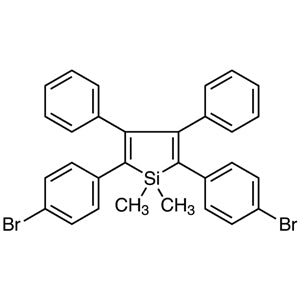
- TCI B4547 866769-99-5 2,5-Bis(4-bromophenyl)-1,1-dimethyl-3,4-diphenylsilole
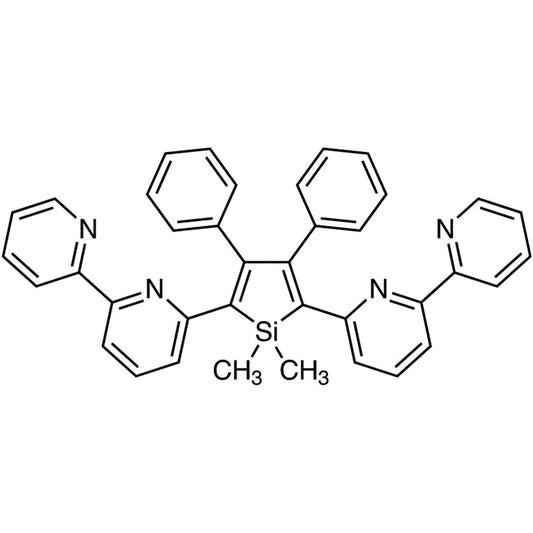
- TCI B4233 350042-00-1 2,5-Bis(2,2'-bipyridin-6-yl)-1,1-dimethyl-3,4-diphenylsilole
- TCI T2238 2085-33-8 Tris(8-quinolinolato)aluminum (purified by sublimation)
- TCI T1527 2085-33-8 Tris(8-quinolinolato)aluminum
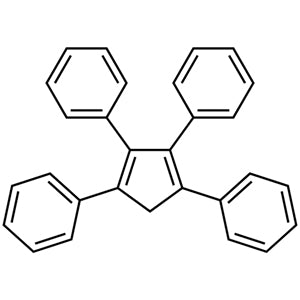
- TCI T1333 15570-45-3 1,2,3,4-Tetraphenyl-1,3-cyclopentadiene
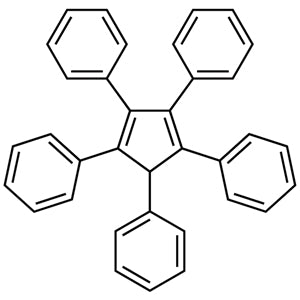
- TCI P1633 2519-10-0 1,2,3,4,5-Pentaphenyl-1,3-cyclopentadiene
- Aggregation-induced emission studies: serves as the classic reference molecule against which the emission behaviour of newly synthesised luminogens can be compared under identical measurement conditions.
- Fluorescent probe development: its strong solid-state and aggregate emission makes it a useful model for designing probes that must report signal in condensed or bound environments.
- Organic electronic device research: the low-lying unoccupied orbital level of the silole ring supports its evaluation as an electron-transporting component in experimental device architectures.
- Photophysical characterisation and method validation: provides a well-documented emission response for calibrating and verifying fluorescence spectrometers and solid-state measurement setups in the laboratory.
- Organosilicon and heterocycle chemistry teaching: offers a concrete example of how silicon incorporation into a five-membered ring alters electronic structure and optical behaviour for advanced coursework.
| Brand | TCI |
|---|---|
| CAS number | 752-28-3 |
| Molecular formula | — |
| Purity | — |
| Category | Chemistry > Organometallic Reagents > Organosilicon [Organometallic Reagents] |
| Pack sizes | available in standard research-scale catalogue pack sizes |
| Physical form | — |
| Storage | keep in a cool, dry place in the original tightly closed container |
- Catalogue code: H1413
Store the container in a cool, dry, well-ventilated area away from direct sunlight, heat sources, and strong oxidising agents. Keep the material in its original tightly closed container, or in a clean amber glass vessel, to limit exposure to moisture and light. Handle the compound in a fume hood using a laboratory coat, chemical-resistant gloves, and safety goggles, and avoid generating dust when weighing. Return the container promptly after use, label any secondary containers clearly, and dispose of residues and contaminated materials through the laboratory's established chemical waste procedures. Always consult the manufacturer's safety data sheet before first use.
—
Product Categories
Produk Terkait
-
2,5-Bis(4-bromophenyl)-1,1-dimethyl-3,4-diphenylsilole TCI B4547
Regular price From Rp 2.650.200,00Regular price -
2,5-Bis(2,2'-bipyridin-6-yl)-1,1-dimethyl-3,4-diphenylsilole TCI B4233
Regular price Rp 4.743.900,00Regular price -
Tris(8-quinolinolato)aluminum(purifiedbysublimation) TCI T2238
Regular price Rp 5.407.500,00Regular price -
Tris(8-quinolinolato)aluminum TCI T1527
Regular price From Rp 769.650,00Regular price -
1,2,3,4-Tetraphenyl-1,3-cyclopentadiene TCI T1333
Regular price From Rp 2.757.300,00Regular price -
1,2,3,4,5-Pentaphenyl-1,3-cyclopentadiene TCI P1633
Regular price Rp 1.115.100,00Regular price -
2,4,6-Tri([1,1'-biphenyl]-3-yl)-1,3,5-triazine TCI T3997
Regular price From Rp 2.254.350,00Regular price -
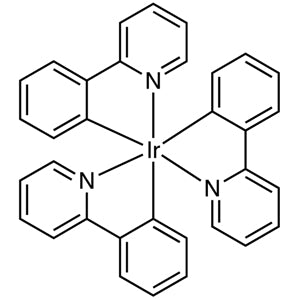
Tris(2-phenylpyridinato)iridium(III) TCI T3716
Regular price From Rp 5.062.050,00Regular price



![1201800-83-0 2,4,6-Tri([1,1'-biphenyl]-3-yl)-1,3,5-triazine - AMI Scientific](http://amiscientific.com/cdn/shop/files/TCI2510T3997.jpg?v=1768819829&width=533)