2,5-Bis(2,2'-bipyridin-6-yl)-1,1-dimethyl-3,4-diphenylsilole is an organic compound widely used in laboratory research for optoelectronic devices, particularly in the development of Organic Light-Emitting Diodes (OLEDs). This material serves as a key component in the emissive layer of OLEDs, where it plays a crucial role in generating light with high efficiency and stable color output. Its molecular structure enables effective interaction with electrons and holes, making it essential for achieving optimal performance in optoelectronic applications.
The compound is favored for its chemical and physical stability, which ensures consistent results during experimental processes. Its ability to withstand specific temperature and environmental conditions simplifies synthesis and characterization procedures. Additionally, its molecular design allows for efficient energy transfer, contributing to the overall efficiency of OLED devices. These properties make it a reliable choice for researchers working on advanced material development.
In Indonesian laboratories, this compound is highly relevant for research in material science and optoelectronic technology. Many research institutions and universities in Indonesia are focusing on developing new materials for display and lighting industries. The compound's role in OLED research aligns with these efforts, supporting innovation in both academic and industrial contexts.
TCI brochures (PDF)
- Siloles 2024-12-02 · p. 1
- Organic Light-Emitting Diode (OLED) Materials 2026-08-18 · p. 6
- Building Blocks for Organic Semiconductor 2026-03-24 · p. 29
- OLED material development for high-efficiency light-emitting devices due to its stable emission properties.
- Research in organic electronics for creating advanced optoelectronic components with improved performance.
- Synthesis of novel organic compounds for use in display technologies and lighting applications.
- Characterization studies to analyze the optical and electronic behavior of organic materials.
- Testing of new material formulations for potential use in next-generation display technologies.
| Brand | TCI |
|---|---|
| CAS number | 350042-00-1 |
| Molecular formula | — |
| Purity | — |
| Category | Materials Science > Electronic Materials > Organic Light-Emitting Diode (OLED) Materials |
| Pack sizes | Available in various quantities as per supplier specifications |
| Physical form | Solid (as per standard product description) |
| Storage | Store in a cool, dry place away from direct sunlight |
This compound should be stored in a cool, dry environment to maintain its chemical stability and prevent degradation. It is recommended to use airtight containers to minimize exposure to moisture and air, which could affect its performance. Proper labeling of storage containers is essential for safety and traceability. Laboratory personnel should handle the material with care, using appropriate personal protective equipment such as gloves and safety goggles. The compound should be kept away from incompatible substances to avoid any potential chemical reactions. Regular monitoring of storage conditions is advised to ensure the material remains in optimal condition for research use.
—
Product Categories
Produk Terkait
-
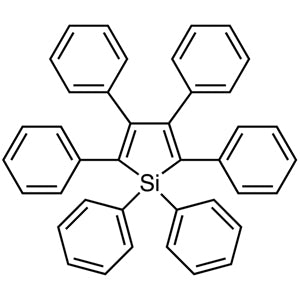
1,1,2,3,4,5-Hexaphenylsilole TCI H1413
Regular price Rp 3.340.050,00Regular priceRp 2.350.950,00Sale price Rp 3.340.050,00 -
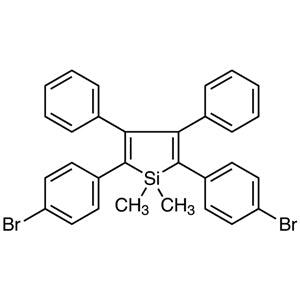
2,5-Bis(4-bromophenyl)-1,1-dimethyl-3,4-diphenylsilole TCI B4547
Regular price From Rp 2.702.700,00Regular priceRp 1.905.750,00Sale price From Rp 2.702.700,00 -
9,9-Dimethyl-9H-9-silafluorene TCI D4308
Regular price From Rp 3.815.700,00Regular priceRp 2.683.800,00Sale price From Rp 3.815.700,00 -
1,3,5-Tris(1-phenyl-1H-benzimidazol-2-yl)benzene TCI T3537
Regular price From Rp 2.121.000,00Regular priceRp 1.498.350,00Sale price From Rp 2.121.000,00