


TCI D4308 9,9-Dimethyl-9H-9-silafluorene is an organosilicon compound of the silafluorene family, supplied by Tokyo Chemical Industry (TCI) as a building block for small molecule semiconductor materials. Its core structure consists of two benzene rings bridged by a silicon atom, producing a rigid framework resembling fluorene but with a tetrahedral silicon centre bearing two methyl groups. In materials research laboratories, this compound serves as a core unit that is subsequently functionalised into emitters, hosts, and charge transport materials for organic optoelectronic devices.
The characteristic that makes silafluorene a preferred choice lies in the interaction between the σ*(Si–C) orbital and the π system of the aromatic rings, which lowers the LUMO energy level without substantially disturbing the HOMO. As a result, silafluorene-based materials generally exhibit a wide band gap, good thermal and morphological stability, and a more favourable electron-accepting ability than their carbon analogues. The two methyl groups on the silicon atom hinder intermolecular aggregation and maintain solubility in common organic solvents, so the compound is convenient to process through synthetic routes.
In Indonesian laboratories, this compound is typically encountered in university and institutional materials science groups working on organic semiconductors and optoelectronic devices. It is handled as a starting material in multi-step synthesis, where it is functionalised before being characterised and incorporated into device fabrication studies. Groups working on emitter design, host materials, and charge transport layers use it as a reliable structural platform, supported by TCI's role as an established supplier of research chemicals for such work.
Related TCI products
- TCI S0983 159-68-2 9,9'-Spirobi[9H-9-silafluorene]
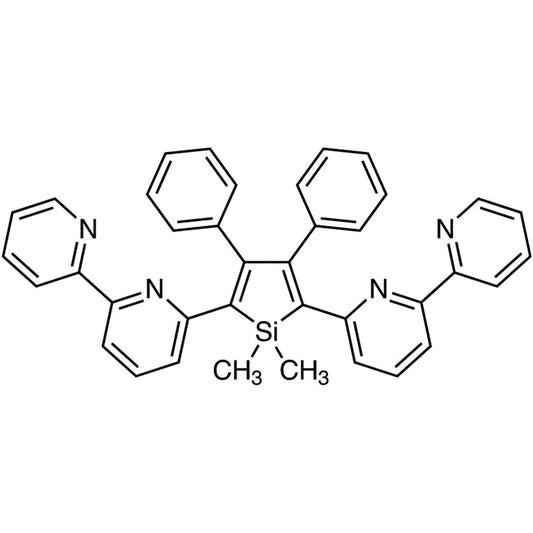
- TCI B4233 350042-00-1 2,5-Bis(2,2'-bipyridin-6-yl)-1,1-dimethyl-3,4-diphenylsilole
- TCI D4799 1160106-14-8 2,6-Dibromo-4,4-di-n-octyldithieno[3,2-b:2',3'-d]silole
- TCI B4668 1196107-73-9 2-Bromo-13,13-dimethyl-6H-indeno[1,2-b]anthracene-6,11(13H)-dione
- TCI M3301 1514864-84-6 2-Methoxy-9,9-dimethyl-9H-fluorene
- TCI D5864 18992-65-9 2,7-Dimethyl-9H-carbazole
- Emitter material synthesis: the rigid silafluorene core provides a wide band gap platform that can be functionalised into light-emitting molecules for organic optoelectronic device research.
- Host material development: good thermal and morphological stability combined with a wide band gap makes this scaffold suitable as a base structure for host materials in emissive layers.
- Charge transport material preparation: the lowered LUMO level arising from σ*(Si–C)–π interaction gives improved electron-accepting behaviour compared with carbon analogues, supporting electron transport material design.
- Small molecule semiconductor building block chemistry: the compound acts as a core unit in multi-step synthetic routes where researchers install further functional groups onto the silafluorene framework.
- Solution-processed material studies: the two methyl groups on silicon hinder intermolecular aggregation and preserve solubility in common organic solvents, making the material convenient for solution-based processing work.
| Brand | TCI (Tokyo Chemical Industry) |
|---|---|
| CAS number | 13688-68-1 |
| Molecular formula | — |
| Purity | — |
| Category | Materials Science > Material Building Blocks > Small Molecule Semiconductor Building Blocks |
| Pack sizes | available in standard research-scale TCI packaging; please confirm the current pack options when ordering |
| Physical form | — |
| Storage | store according to the conditions stated on the manufacturer's label and safety data sheet |
- Product code: D4308
Store the container tightly closed in a cool, dry, well-ventilated area away from direct sunlight, heat sources, and incompatible chemicals, following the storage conditions stated on the manufacturer's label and safety data sheet. Keep the material in its original supplier container, or in a clean, chemically compatible and properly labelled container if transferred. Handle inside a fume hood using standard personal protective equipment, including safety glasses, gloves, and a laboratory coat. Avoid generating dust, avoid contact with skin and eyes, and keep containers closed when not in use. Consult the safety data sheet before use and dispose of residues according to applicable laboratory waste procedures.
—
Produk Terkait
-
9,9'-Spirobi[9H-9-silafluorene] TCI S0983
Regular price From Rp 1.378.650,00Regular price -
2,5-Bis(2,2'-bipyridin-6-yl)-1,1-dimethyl-3,4-diphenylsilole TCI B4233
Regular price Rp 4.743.900,00Regular price -
2,6-Dibromo-4,4-di-n-octyldithieno[3,2-b:2',3'-d]silole TCI D4799
Regular price Rp 6.573.000,00Regular price -
2-Bromo-13,13-dimethyl-6H-indeno[1,2-b]anthracene-6,11(13H)-dione TCI B4668
Regular price Rp 1.856.400,00Regular price -
2-Methoxy-9,9-dimethyl-9H-fluorene TCI M3301
Regular price From Rp 1.035.300,00Regular price -
2,7-Dimethyl-9H-carbazole TCI D5864
Regular price From Rp 2.306.850,00Regular price -
9,9-Dimethyl-N-(naphthalen-2-yl)-9H-fluoren-2-amine TCI D5801
Regular price From Rp 980.700,00Regular price -
2-[3-(9,9-Dimethyl-9H-fluoren-2-yl)phenyl]-4,4,5,5-tetramethyl-1,3,2-dioxaborolane TCI D5800
Regular price From Rp 1.565.550,00Regular price
![159-68-2 9,9'-Spirobi[9H-9-silafluorene] - AMI Scientific](http://amiscientific.com/cdn/shop/files/TCI2510S0983.jpg?v=1769057715&width=533)

![2,6-Dibromo-4,4-di-n-octyldithieno[3,2-b:2',3'-d]silole (CAS 1160106-14-8) - TCI D4799 - AMI Scientific](http://amiscientific.com/cdn/shop/files/TCI2510D4799.jpg?v=1769142045&width=533)
![1196107-73-9 2-Bromo-13,13-dimethyl-6H-indeno[1,2-b]anthracene-6,11(13H)-dione - AMI Scientific](http://amiscientific.com/cdn/shop/files/TCI2510B4668.jpg?v=1768815654&width=533)


![2-[3-(9,9-Dimethyl-9H-fluoren-2-yl)phenyl]-4,4,5,5-tetramethyl-1,3,2-dioxaborolane (CAS 1005771-03-8) - TCI D5800 - AMI Scientific](http://amiscientific.com/cdn/shop/files/TCI2510D5800.jpg?v=1769142139&width=533)