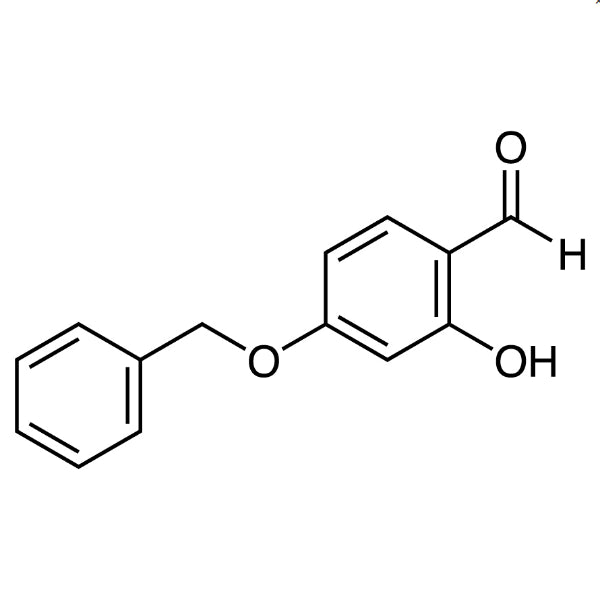
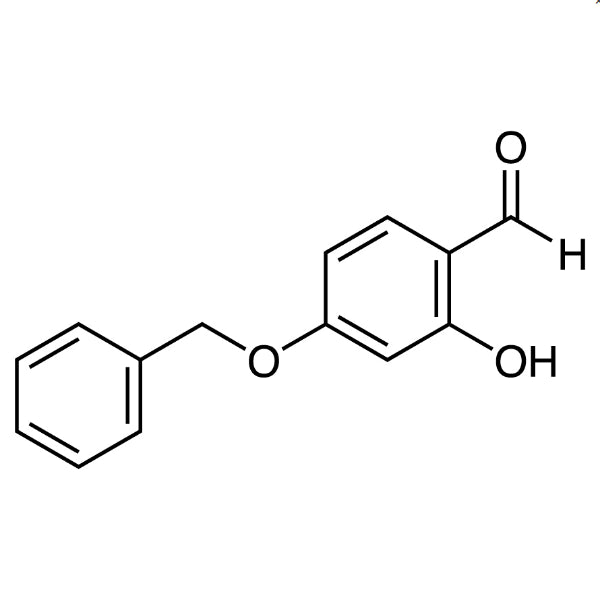
4-(Benzyloxy)-2-hydroxybenzaldehyde is a salicylaldehyde derivative in which the hydroxyl group at the four position has been protected as a benzyl ether, while the hydroxyl group at the two position remains free and adjacent to the aldehyde group. This arrangement makes the compound a highly useful building block in organic synthesis, because it provides three reaction points with distinct reactivity within a single molecule. Chemists can address the aldehyde group, the free phenolic hydroxyl, and the protected benzyl ether in a stepwise manner according to the synthetic plan they have designed.
Its principal advantage lies in the orthogonal protection strategy it offers. The benzyl group can be removed by hydrogenolysis under conditions that generally do not disturb other functional groups, so researchers can unmask the hydroxyl at a late stage of the synthesis without damaging the framework already constructed. Meanwhile, the proximity of the ortho hydroxyl group to the aldehyde allows intramolecular hydrogen bonding to form and opens a route toward cyclization reactions that build coumarin and chromone rings. This pair of groups is also well suited to forming Schiff bases that yield chelating ligands for transition metal ions.
In Indonesian laboratories, this building block is typically used in university and institutional research groups working on multi-step organic synthesis, heterocyclic chemistry, and coordination chemistry. It suits work where a protected intermediate must be carried through several transformations before the hydroxyl is finally released. Research teams preparing coumarin scaffolds, chromone derivatives, or Schiff base ligands commonly rely on reagents of this type as a defined starting point for their synthetic routes.
Related TCI products
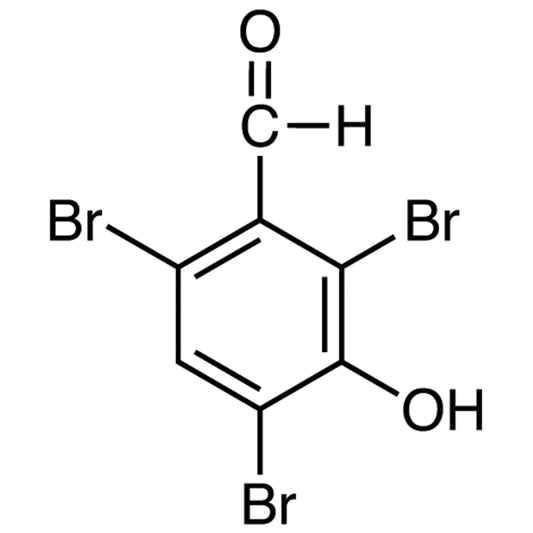
- TCI T3392 2737-22-6 2,4,6-Tribromo-3-hydroxybenzaldehyde
- TCI D6362 41602-56-6 4-(Dimethylamino)-2-hydroxybenzaldehyde
- TCI C3982 23731-06-8 5-(Chloromethyl)-2-hydroxybenzaldehyde
- TCI C3873 56962-11-9 2-Chloro-4-hydroxybenzaldehyde
- TCI C3526 18362-30-6 2-Chloro-6-hydroxybenzaldehyde
- TCI B6598 2725-53-3 5-(tert-Butyl)-2-hydroxybenzaldehyde
- Multi-step organic synthesis: the three differentiated reaction points in one molecule let chemists plan sequential transformations without additional protection steps at each stage.
- Coumarin and chromone ring construction: the ortho relationship between the free phenolic hydroxyl and the aldehyde group provides the geometry required for cyclization into these oxygen heterocyclic systems.
- Schiff base preparation: the aldehyde condenses with primary amines while the adjacent free hydroxyl completes a chelating pocket, giving ligands designed for transition metal ions.
- Coordination chemistry and metal complex studies: Schiff base ligands derived from this aldehyde bind transition metal ions, supporting research into complex structure and metal binding behaviour.
- Protected intermediate chemistry: the benzyl ether is removed by hydrogenolysis under conditions that generally spare other functional groups, allowing late-stage unmasking of the hydroxyl on an assembled framework.
| Brand | TCI |
|---|---|
| CAS number | 52085-14-0 |
| Molecular formula | — |
| Purity | — |
| Category | Chemistry > Building Blocks > Non-Heterocyclic Building Blocks |
| Pack sizes | — |
| Physical form | — |
| Storage | store according to the conditions stated on the manufacturer's label and safety data sheet |
- Product code: H1904
- Chemical name: 4-(Benzyloxy)-2-hydroxybenzaldehyde
Store the container tightly closed in a cool, dry and well ventilated area, away from direct sunlight, heat sources and incompatible materials, following the storage conditions given on the manufacturer's label and safety data sheet. Keep the material in its original supplier container, or in a clean, chemically compatible and clearly labelled container if transfer is necessary. Handle in a fume hood using appropriate personal protective equipment, including safety goggles, a laboratory coat and suitable chemical resistant gloves. Avoid the generation and inhalation of dust, prevent contact with skin and eyes, and close the container immediately after use to limit exposure to air and moisture. Review the safety data sheet before first use and dispose of residues and contaminated materials in accordance with applicable laboratory waste procedures.
—
Produk Terkait
-
2,4,6-Tribromo-3-hydroxybenzaldehyde TCI T3392
Regular price From Rp 2.174.550,00Regular price -
4-(Dimethylamino)-2-hydroxybenzaldehyde TCI D6362
Regular price From Rp 2.545.200,00Regular price -
5-(Chloromethyl)-2-hydroxybenzaldehyde TCI C3982
Regular price From Rp 1.565.550,00Regular price -
2-Chloro-4-hydroxybenzaldehyde TCI C3873
Regular price From Rp 1.961.400,00Regular price -
2-Chloro-6-hydroxybenzaldehyde TCI C3526
Regular price From Rp 1.246.350,00Regular price -
5-(tert-Butyl)-2-hydroxybenzaldehyde TCI B6598
Regular price From Rp 3.419.850,00Regular price -
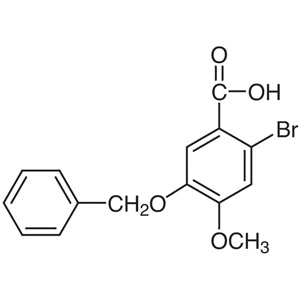
5-Benzyloxy-2-bromo-4-methoxybenzoicAcid TCI B3332
Regular price From Rp 2.386.650,00Regular price -
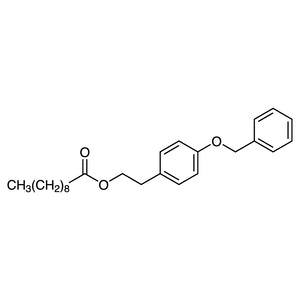
4-(Benzyloxy)phenethylDecanoate TCI D6128
Regular price Rp 1.353.450,00Regular price