2-Chloro-4-hydroxybenzaldehyde from TCI is an aromatic aldehyde with a chlorine atom at the 2-position and a phenolic hydroxyl group at the 4-position of the benzene ring. Because one small ring carries three different functional groups, the compound is a very flexible non-heterocyclic building block. In the laboratory it is a starting point for synthesizing many substituted aromatic compounds, from pharmaceutical intermediates to materials for organic materials research. Chemists who need a compact, multifunctional aromatic core will find it a practical, well-defined entry into many synthetic routes.
Its value comes from how its functional groups behave. The aldehyde group can undergo condensation, reductive amination, Wittig reactions, oxidation and reduction. The phenolic hydroxyl group is easy to alkylate or esterify. The chlorine atom sits ortho to the aldehyde, and its electronic and steric effects shape both the reactivity of the molecule and the conformation of the resulting products. Each of the three groups can be modified on its own, so researchers can arrange the reaction sequence to suit their molecular design. This makes the compound a dependable choice for multistep synthesis planning.
In Indonesian laboratories, this compound is useful for postgraduate students and researchers who synthesize Schiff bases, chalcone derivatives or coumarins for biological activity testing. These topics are very common in chemistry and pharmacy study programs at universities across the country. Research groups working on medicinal chemistry, natural product analogues and structure-activity studies can use it as a consistent precursor. It also fits teaching laboratories that demonstrate selective functional group transformations on a single aromatic scaffold.
Related TCI products
- TCI C3526 18362-30-6 2-Chloro-6-hydroxybenzaldehyde
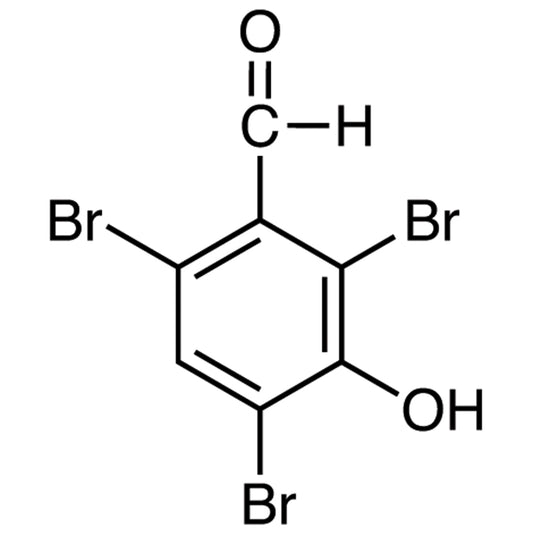
- TCI T3392 2737-22-6 2,4,6-Tribromo-3-hydroxybenzaldehyde
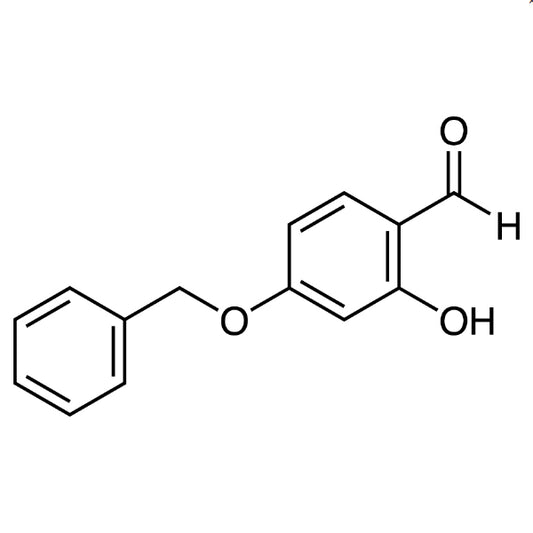
- TCI H1904 52085-14-0 4-(Benzyloxy)-2-hydroxybenzaldehyde
- TCI D6362 41602-56-6 4-(Dimethylamino)-2-hydroxybenzaldehyde
- TCI C3982 23731-06-8 5-(Chloromethyl)-2-hydroxybenzaldehyde
- TCI B6598 2725-53-3 5-(tert-Butyl)-2-hydroxybenzaldehyde
- Schiff base synthesis: the reactive aldehyde group condenses readily with primary amines, so researchers can prepare imine ligands and bioactive Schiff base derivatives for screening studies.
- Chalcone derivative preparation: the aldehyde takes part in condensation reactions with aryl ketones, giving substituted chalcones that are widely studied in Indonesian chemistry and pharmacy research programs.
- Coumarin and related scaffold research: the phenolic hydroxyl and aldehyde functions on one ring give a useful starting point for building coumarin-type structures for biological activity testing.
- Pharmaceutical intermediate development: the three functional groups can be modified independently, so chemists can design flexible reaction sequences toward substituted aromatic intermediates for drug discovery projects.
- Organic materials research: the substituted aromatic core, with its ortho-chlorine electronic and steric effects, lets researchers tune reactivity and product conformation when developing new organic material precursors.
| Brand | TCI (product code C3873) |
|---|---|
| CAS number | 56962-11-9 |
| Molecular formula | — |
| Purity | — |
| Category | Chemistry > Building Blocks > Non-Heterocyclic Building Blocks |
| Pack sizes | as listed on the product page; contact AMI Scientific for the options available |
| Physical form | see the TCI product documentation and certificate of analysis |
| Storage | follow the storage conditions stated on the TCI label and Safety Data Sheet |
Keep 2-Chloro-4-hydroxybenzaldehyde in its original, tightly closed container in a cool, dry, well-ventilated area, away from direct sunlight, heat and moisture. Aldehydes can oxidize slowly in air, so reseal the container promptly after each use, and consider an inert atmosphere for long-term storage. Store it away from strong oxidizing agents and strong bases. Handle the material in a fume hood, and wear suitable gloves, safety glasses and a lab coat. Avoid creating dust, inhaling the material, or letting it touch your skin and eyes. Always check the TCI Safety Data Sheet for specific hazard, first-aid and disposal information before use.
—
Produk Terkait
-
2-Chloro-6-hydroxybenzaldehyde TCI C3526
Regular price From Rp 1.246.350,00Regular priceRp 871.500,00Sale price From Rp 1.246.350,00 -
2,4,6-Tribromo-3-hydroxybenzaldehyde TCI T3392
Regular price From Rp 2.174.550,00Regular priceRp 1.520.400,00Sale price From Rp 2.174.550,00 -
4-(Benzyloxy)-2-hydroxybenzaldehyde TCI H1904
Regular price From Rp 955.500,00Regular priceRp 667.800,00Sale price From Rp 955.500,00 -
4-(Dimethylamino)-2-hydroxybenzaldehyde TCI D6362
Regular price From Rp 2.597.700,00Regular priceRp 1.832.250,00Sale price From Rp 2.597.700,00 -
5-(Chloromethyl)-2-hydroxybenzaldehyde TCI C3982
Regular price From Rp 1.565.550,00Regular priceRp 1.094.100,00Sale price From Rp 1.565.550,00 -
5-(tert-Butyl)-2-hydroxybenzaldehyde TCI B6598
Regular price From Rp 3.419.850,00Regular priceRp 2.390.850,00Sale price From Rp 3.419.850,00 -
3-Chloro-4-hydroxybenzaldehyde TCI C2183
Regular price From Rp 7.366.800,00Regular priceRp 5.151.300,00Sale price From Rp 7.366.800,00 -
Methyl3-Chloro-4-hydroxybenzoate TCI M3513
Regular price From Rp 1.510.950,00Regular priceRp 1.072.050,00Sale price From Rp 1.510.950,00