

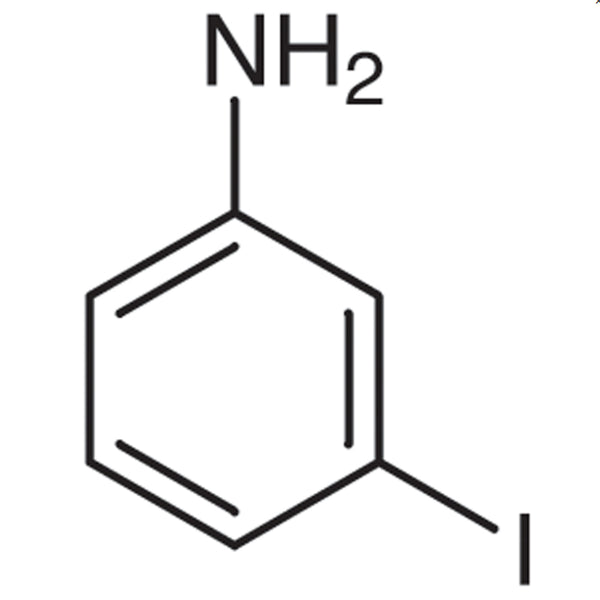
3-Iodoaniline from TCI is the meta isomer of iodoaniline, in which the amino group and the iodine atom are separated by one ring position. This difference in placement looks simple, yet it has a decisive effect on the direction of synthesis: the amino group and the iodine are not close enough to cyclize with one another, so both can be developed into two independent structural branches. In the laboratory, the compound serves as a base framework for constructing molecules that branch in three directions, and it becomes an essential tool whenever researchers need to control the meta substitution pattern of their final product.
The property that makes this material sought after is the high reactivity of the C–I bond in transition-metal-catalyzed cross-coupling reactions, combined with an amino group that can be acylated, sulfonylated, alkylated, or diazotized into a wide range of other functional groups. Because the two groups do not interfere with one another sterically, the order of reactions can be chosen freely according to the chosen synthetic strategy. This flexibility allows a single starting material to serve several different routes, and it lets chemists decide which handle to elaborate first without being constrained by the geometry of the ring.
In Indonesian laboratories, 3-Iodoaniline is typically used in research and development work on organic synthesis, where meta-substituted aromatic intermediates are needed as building blocks. Like other anilines, the material is sensitive to light and oxygen and tends to change color over time; TCI supplies it in packaging that minimizes exposure, and each lot is accompanied by analytical data that provides the basis for evaluating the material before it enters a reaction sequence.
- Transition-metal-catalyzed cross-coupling reactions, where the highly reactive C–I bond provides a dependable handle for forming new carbon–carbon or carbon–heteroatom bonds under standard catalytic conditions.
- Construction of three-way branched molecules, since the meta arrangement keeps the amino group and iodine independent and allows two separate structural arms to be built from one aromatic core.
- Preparation of meta-substituted target compounds, giving researchers direct control over the substitution pattern of the final product without relying on difficult directing-group strategies.
- Amino group derivatization through acylation, sulfonylation, or alkylation, converting the aniline nitrogen into amides, sulfonamides, or secondary and tertiary amines as the synthetic route requires.
- Diazotization chemistry for converting the amino group into a broad range of other functional groups, expanding one starting material into many possible downstream intermediates.
| Brand | TCI |
|---|---|
| CAS number | 626-01-7 |
| Molecular formula | — |
| Purity | — |
| Category | Chemistry > Building Blocks > Non-Heterocyclic Building Blocks |
| Pack sizes | available in the standard TCI catalogue pack sizes; please confirm the option required for your work |
| Physical form | — |
| Storage | sensitive to light and oxygen; supplied in packaging that minimizes exposure |
- Supplied with analytical data for each lot, which serves as the basis for material evaluation
Store 3-Iodoaniline protected from light and air, keeping the container tightly closed in a cool, well-ventilated location away from oxidizing agents. The original TCI packaging is designed to minimize exposure and should be retained for as long as possible; where transfer is necessary, use opaque or amber containers with well-sealed closures and consider blanketing the headspace with inert gas. Some color change over time is characteristic of anilines in general and should be assessed against the lot analytical data. Handle in a fume hood using gloves, safety glasses, and a laboratory coat, and follow the safety data sheet supplied with the material.
—
Produk Terkait
-
4-Bromo-2-iodoaniline TCI B3164
Regular price From Rp 795.900,00Regular price -
4-Iodoaniline TCI I0048
Regular price Rp 1.644.300,00Regular price -
2-Iodoaniline TCI I0046
Regular price From Rp 1.087.800,00Regular price -
5-Chloro-2-iodoaniline TCI C2239
Regular price Rp 1.856.400,00Regular price -
3-Chloro-4-iodoaniline TCI C2167
Regular price From Rp 1.115.100,00Regular price -
2-Chloro-4-iodoaniline TCI C1781
Regular price Rp 1.115.100,00Regular price -
4-Fluoro-2-iodoaniline TCI F0706
Regular price From Rp 980.700,00Regular price -
2-Fluoro-4-iodoaniline TCI F0417
Regular price From Rp 795.900,00Regular price


