

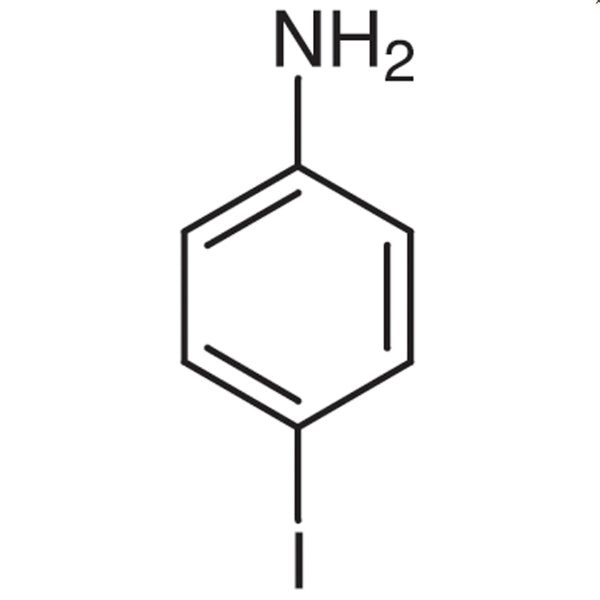
4-Iodoaniline from TCI is the para isomer of iodoaniline, in which the amino group and the iodine atom sit directly opposite one another on the axis of the benzene ring. This symmetry makes it one of the most widely used building blocks for assembling linear molecules, because substituents introduced at either end are arranged along a single line. In the laboratory, the compound frequently serves as the starting point for bifunctional linkers, labelling reagents, and target molecules that require a 1,4-substitution pattern on their aromatic framework, giving it a role that spans organic synthesis, materials chemistry, and bioconjugation.
The properties that make it a preferred choice are the combination of a C–I bond that is highly reactive toward palladium and copper catalysts with a para amino group that is a strong electron donor. This electron push does not impede the oxidative addition step, but it does impart distinctive electronic character to the final product, which is useful when designing chromophores and optoelectronic materials. The amino group is likewise ready to be converted into amides, sulfonamides, ureas, isocyanates, or diazonium salts, so a single reagent opens two independent and complementary routes for elaboration.
Like other anilines, this material is sensitive to light and air and may darken if stored improperly, so disciplined handling is part of routine practice for it. In Indonesian laboratories it is typically used in university and institutional research groups working on coupling chemistry, functional materials, and linker preparation, where the reliability of a para-substituted aryl iodide matters more than the scale of the work. Analytical and method-development groups also draw on it when a defined 1,4-aromatic scaffold is required.
- Palladium-catalysed cross-coupling, where the activated C–I bond undergoes oxidative addition readily and the free amino group survives to allow further elaboration afterwards.
- Copper-mediated coupling chemistry, in which aryl iodides are the substrate class of choice and the para geometry keeps the resulting products linear and predictable.
- Bifunctional linker synthesis, because the iodine and amino termini react through entirely different mechanisms and can therefore be addressed sequentially without protecting group juggling.
- Preparation of labelling reagents, where the amino group is converted to amides, sulfonamides, ureas, isocyanates, or diazonium salts to attach the aromatic core to a partner molecule.
- Chromophore and optoelectronic material design, since the strongly electron-donating para amino group gives coupled products the distinctive electronic character such materials require.
| Brand | TCI |
|---|---|
| CAS number | 540-37-4 |
| Molecular formula | — |
| Purity | — |
| Category | Chemistry > Building Blocks > Non-Heterocyclic Building Blocks |
| Pack sizes | available in the standard TCI research pack sizes; please confirm the size required when ordering |
| Physical form | — |
| Storage | light- and air-sensitive; store protected from light and air to prevent darkening |
- Product code: I0048
Store the material in a tightly closed container, protected from light and air, since like other anilines it may darken when storage conditions are inadequate. Amber glass or an equivalent light-excluding container is appropriate, and containers should be closed promptly after each use to limit air exposure. Handle in a fume hood using gloves, safety glasses, and a laboratory coat, and avoid contact with skin and eyes as well as inhalation of dust. Keep the container clearly labelled, weigh out only what is required for the work at hand, and follow the supplier safety data sheet together with your institution's chemical waste procedures for disposal of residues.
—
Produk Terkait
-
4-Bromo-2-iodoaniline TCI B3164
Regular price From Rp 795.900,00Regular price -
3-Iodoaniline TCI I0047
Regular price From Rp 955.500,00Regular price -
2-Iodoaniline TCI I0046
Regular price From Rp 1.087.800,00Regular price -
5-Chloro-2-iodoaniline TCI C2239
Regular price Rp 1.856.400,00Regular price -
3-Chloro-4-iodoaniline TCI C2167
Regular price From Rp 1.115.100,00Regular price -
2-Chloro-4-iodoaniline TCI C1781
Regular price Rp 1.115.100,00Regular price -
4-Fluoro-2-iodoaniline TCI F0706
Regular price From Rp 980.700,00Regular price -
2-Fluoro-4-iodoaniline TCI F0417
Regular price From Rp 795.900,00Regular price


