

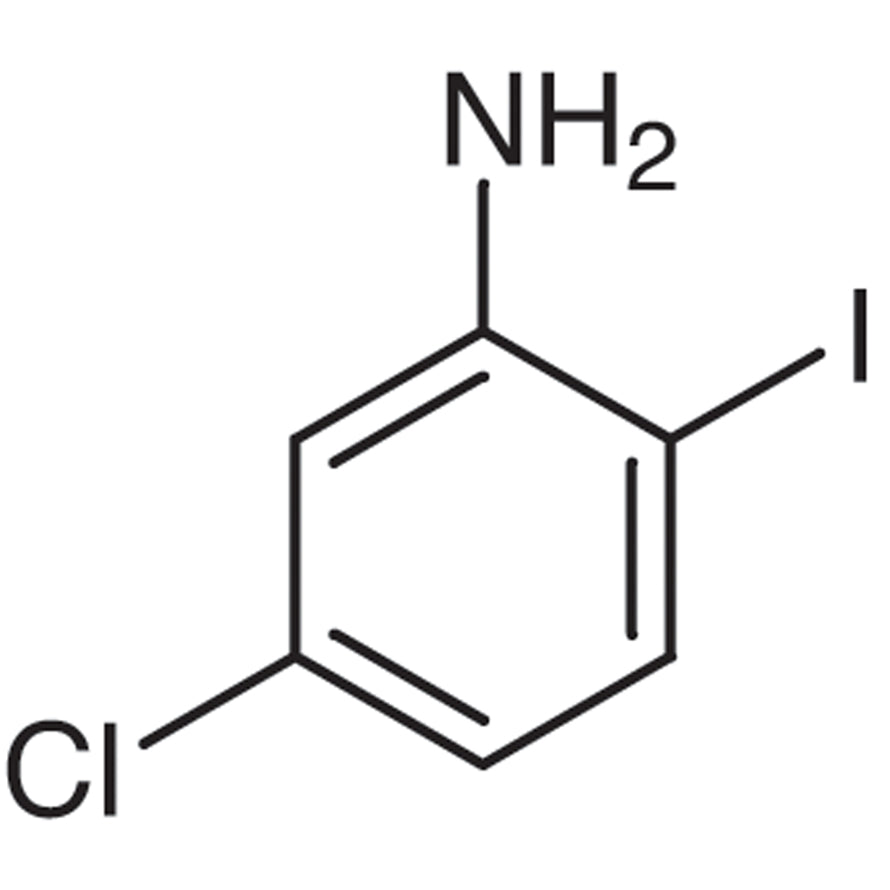
5-Chloro-2-iodoaniline, CAS 6828-35-9, is an organic compound from the substituted aniline family that serves as a building block in organic synthesis within the chemistry laboratory. It belongs to the Non-Heterocyclic Building Blocks segment of the TCI Building Blocks line, meaning it is used as a starting material for assembling far more complex molecules through various catalytic reactions. The presence of an amino group (–NH₂) together with two halogen atoms—chlorine at position 5 and iodine at position 2—makes the compound versatile for stepwise structural modification. In the laboratory, it is commonly employed as a substrate in transition-metal-catalyzed cross-coupling reactions such as Buchwald–Hartwig, Suzuki, and Sonogashira couplings. Its primary role is therefore as an intermediate for building target compounds for research, drug candidate development, and the synthesis of specialty chemicals.
The main characteristic that makes 5-Chloro-2-iodoaniline a preferred choice in the laboratory is the difference in reactivity between its two halogen atoms, which enables chemoselective transformations. Because iodine is more reactive than chlorine in oxidative addition steps, the iodine position can be functionalized first while the chlorine position remains available for a later, distinct reaction. This differential reactivity allows researchers to build molecular complexity in a controlled, stepwise manner without unwanted side reactions. As an intermediate, the compound supports the construction of target molecules for research purposes, drug candidate development, and the synthesis of specialty chemicals. Its amino group also offers a convenient handle for further derivatization, such as amide formation or reductive amination, expanding the range of accessible structures.
In Indonesian laboratories, particularly in university research groups, pharmaceutical R&D facilities, and chemical industry laboratories, this compound is typically stocked as a routine building block for organic synthesis projects. Researchers use it to prepare biaryl scaffolds, pharmaceutical intermediates, and functionalized aromatic amines that are difficult to obtain through other routes. It is frequently handled in fume hoods as part of small-scale reaction screening and process development work. As a TCI product distributed through AMI Scientific, it offers Indonesian chemists a dependable, well-documented reagent that fits standard synthetic workflows, helping bridge the gap between basic chemical research and applied product development in the region.
- Buchwald–Hartwig amination: The compound's aryl iodide position undergoes oxidative addition readily, making it an ideal electrophilic partner for palladium-catalyzed C–N bond formation with amines.
- Suzuki–Miyaura coupling: The iodine atom at position 2 acts as a highly reactive leaving group in palladium-catalyzed coupling with aryl boronic acids, enabling rapid construction of biaryl structures.
- Sonogashira coupling: The reactive C–I bond allows efficient palladium/copper-catalyzed coupling with terminal alkynes, producing functionalized alkynyl anilines for further elaboration.
- Chemoselective sequential functionalization: The greater reactivity of iodine over chlorine lets chemists modify the 2-position first and the 5-position later, enabling staged synthesis of multi-substituted aromatic targets.
- Intermediate for drug candidate synthesis: As a non-heterocyclic building block, it serves as a reliable starting material for assembling pharmaceutically relevant molecules and specialty chemicals in research and development settings.
| Brand | TCI |
|---|---|
| CAS number | 6828-35-9 |
| Molecular formula | — |
| Purity | — |
| Category | Chemistry > Building Blocks > Non-Heterocyclic Building Blocks |
| Pack sizes | — |
| Physical form | — |
| Storage | — |
- Product name: TCI C2239 5-Chloro-2-iodoaniline
Store 5-Chloro-2-iodoaniline in a cool, dry, and well-ventilated area, protected from direct sunlight and moisture. Keep the container tightly closed when not in use and store it away from strong oxidizing agents and other incompatible substances. Use suitable laboratory containers, preferably the original packaging or chemically resistant glassware, and label them clearly. Always handle the compound in a fume hood while wearing appropriate personal protective equipment, including safety goggles, gloves, and a laboratory coat. Avoid inhalation of dust or vapors, avoid skin contact, and wash hands thoroughly after handling. Follow standard chemical hygiene practices and dispose of any waste in accordance with local regulations.
—
Produk Terkait
-
3-Chloro-4-iodoaniline TCI C2167
Regular price From Rp 1.115.100,00Regular price -
2-Chloro-4-iodoaniline TCI C1781
Regular price Rp 1.115.100,00Regular price -
4-Bromo-2-iodoaniline TCI B3164
Regular price From Rp 795.900,00Regular price -
4-Iodoaniline TCI I0048
Regular price Rp 1.644.300,00Regular price -
3-Iodoaniline TCI I0047
Regular price From Rp 955.500,00Regular price -
2-Iodoaniline TCI I0046
Regular price From Rp 1.087.800,00Regular price -
1-Bromo-2-chloro-4-nitrobenzene TCI B5348
Regular price From Rp 1.298.850,00Regular price -
4-Bromo-1-chloro-2-nitrobenzene TCI B4374
Regular price From Rp 1.246.350,00Regular price


