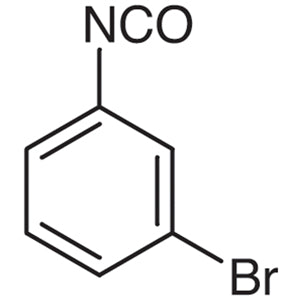
3-Bromophenyl Isocyanate is an aryl isocyanate bearing a bromine atom at the meta position relative to the isocyanate group. In organic synthesis laboratories it plays a dual role: it acts as a reagent for forming urea and carbamate linkages, and at the same time it carries a ready-to-use aryl bromide handle for palladium-catalysed cross-coupling reactions. The isocyanate group reacts rapidly with amines and alcohols without any additional coupling reagent, while the bromine atom remains intact throughout those reactions and can therefore be functionalised in a subsequent step. This combination of two reactive sites that operate in sequence is what makes the compound a high-value building block.
Its principal advantage lies in that orthogonality of reactivity. Researchers can first construct a urea framework with an amine of their choice, and then install a new aryl, alkenyl, alkynyl, or amino group at the bromine position through Suzuki coupling, Sonogashira coupling, or Buchwald–Hartwig amination. The bromine atom is also heavy enough to assist structure determination by single-crystal X-ray diffraction, a practical benefit when the configuration of a product must be confirmed. The bromo substituent at the meta position contributes its own electronic influence on the aromatic ring, which shapes how the molecule behaves in subsequent transformations.
In Indonesian laboratories, this building block is typically found in university and institutional research groups working on medicinal chemistry, materials chemistry, and methodology development, where urea and carbamate scaffolds are assembled and then elaborated further. It suits workflows in which a small library of analogues is prepared from a common intermediate, and it is used under the standard anhydrous handling practices already established in most synthetic chemistry laboratories.
- Urea synthesis — the isocyanate group reacts directly and rapidly with primary and secondary amines, giving substituted ureas without any additional coupling reagent or activation step.
- Carbamate synthesis — reaction with alcohols proceeds under the same reagent-free conditions, making this a straightforward route to aryl carbamates bearing a retained bromine handle.
- Suzuki cross-coupling — the intact aryl bromide serves as the electrophilic partner for palladium-catalysed installation of aryl groups after the urea or carbamate core has been assembled.
- Sonogashira coupling — the meta-bromine position accepts alkynyl groups under palladium catalysis, allowing rigid linear extensions to be added to an already-formed urea scaffold.
- Buchwald–Hartwig amination — the bromine site can be converted into a new carbon–nitrogen bond, letting researchers introduce a second, different amine independently of the first.
| Brand | TCI |
|---|---|
| CAS number | 23138-55-8 |
| Molecular formula | — |
| Purity | — |
| Category | Chemistry > Building Blocks > Non-Heterocyclic Building Blocks |
| Pack sizes | available in TCI standard catalogue pack sizes; please confirm the currently offered options when ordering |
| Physical form | — |
| Storage | keep tightly closed and protected from moisture |
- Catalogue code: I0553
Store the container tightly sealed in a cool, dry, well-ventilated place away from direct sunlight and from any source of water or humidity. Isocyanates react readily with moisture and with alcohols and amines, so containers should be kept closed and, where practical, handled under a dry inert atmosphere using dry glassware and anhydrous solvents. Use only compatible, tightly closing containers and keep the material separated from water, aqueous reagents, alcohols, amines, bases, and oxidising agents. All transfers and reactions should be carried out in a functioning fume hood, wearing safety goggles, chemically resistant gloves, and a laboratory coat, since vapours are irritating to the eyes and respiratory tract. Keep the original label intact and consult the manufacturer's safety data sheet before use, and dispose of residues and contaminated materials as chemical waste according to institutional procedure.
—
Produk Terkait
-
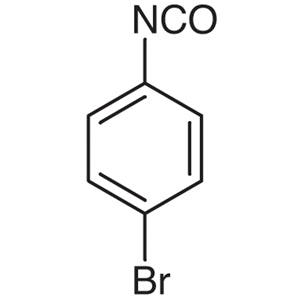
4-BromophenylIsocyanate TCI B0636
Regular price From Rp 2.279.550,00Regular price -
4-ButylphenylIsocyanate TCI B3205
Regular price From Rp 1.087.800,00Regular price -
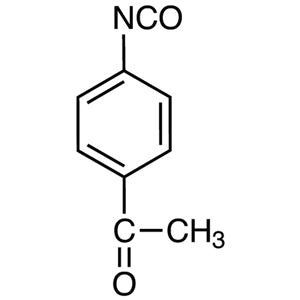
4-AcetylphenylIsocyanate TCI A2933
Regular price From Rp 2.094.750,00Regular price -
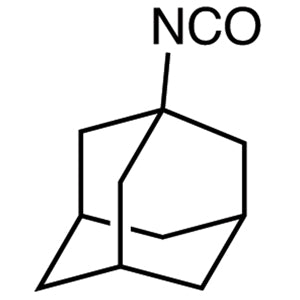
1-AdamantylIsocyanate TCI A1706
Regular price From Rp 1.298.850,00Regular price -
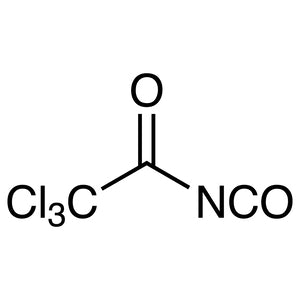
TrichloroacetylIsocyanate TCI T1047
Regular price From Rp 769.650,00Regular price -
p-ToluenesulfonylIsocyanate TCI T0998
Regular price Rp 530.250,00Regular price -
m-TolylIsocyanate TCI T0721
Regular price From Rp 1.776.600,00Regular price -
p-TolylIsocyanate TCI T0321
Regular price From Rp 2.254.350,00Regular price