

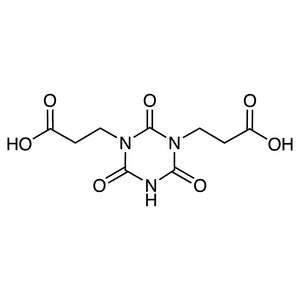
TCI I0584 Bis(2-carboxyethyl) Isocyanurate is a heterocyclic building block built around an isocyanurate core, with two propionic acid (2-carboxyethyl) arms bonded to two of the ring nitrogen atoms while the remaining nitrogen stays as a free N–H group. This arrangement makes the compound a dicarboxylic acid and, at the same time, a provider of one additional reaction point of a different character. In the laboratory it serves as a monomer and linker for constructing polyesters, polyamides, and coordination frameworks, and as a core group in molecular designs that call for a heat-resistant triazine-trione ring.
The characteristic that leads researchers to select this compound is the presence of three types of functional groups with distinguishable reactivity within a single compact molecule. The two carboxylate groups are ready to be esterified, amidated, or activated into acid chlorides and active esters, while the free N–H can be alkylated separately so that asymmetric architectures can also be designed. The isocyanurate core itself is known to be rigid, nitrogen-rich, and thermally stable — properties that are widely sought in heat-resistant materials and in flame-retardant formulation research. The ethylene arms position the carboxyl groups at a defined distance from the ring.
In Indonesian laboratories, this building block is typically used in university and institutional research settings working on polymer synthesis, materials chemistry, and organic methodology development. It is normally purchased in small research quantities for exploratory synthesis, structure–property studies, and the preparation of intermediates that are later carried forward into larger sequences. Groups working on thermally stable resins, coordination chemistry, and flame-retardant formulations are the most frequent users of material of this type.
Related TCI products
- TCI T0675 2904-41-8 Tris(2-carboxyethyl) Isocyanurate
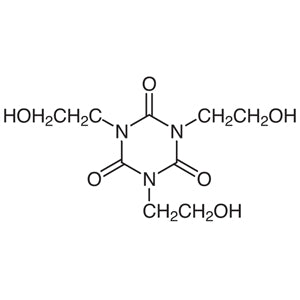
- TCI T0674 839-90-7 Tris(2-hydroxyethyl) Isocyanurate
- TCI I0304 6294-79-7 Diallyl Isocyanurate
- TCI I0279 1025-15-6 Triallyl Isocyanurate (stabilized with BHT)
- TCI I0428 2451-62-9 Triglycidyl Isocyanurate
- TCI I0409 5320-25-2 Diallyl Propyl Isocyanurate (stabilized with BHT)
- Polyester and polyamide synthesis — the two carboxylic acid arms act as the diacid component in step-growth polymerisation, while the rigid isocyanurate core raises the thermal character of the resulting chain.
- Coordination framework construction — the dicarboxylic acid functionality provides defined binding points for metal centres, and the fixed geometry of the triazine-trione ring helps direct the assembly of the framework.
- Asymmetric molecular design — the free N–H group can be alkylated independently of the carboxyl groups, allowing chemists to build non-symmetric architectures from one compact and readily available starting material.
- Flame-retardant formulation research — the nitrogen-rich, thermally stable isocyanurate ring is a structural motif widely investigated in this field, and the carboxyl arms allow it to be bound covalently into a matrix.
- Preparation of activated intermediates — the carboxylate groups are readily converted into acid chlorides or active esters, giving a versatile platform for subsequent amidation and esterification steps in multi-step synthesis.
| Brand | TCI (Tokyo Chemical Industry) |
|---|---|
| CAS number | 2904-40-7 |
| Molecular formula | — |
| Purity | — |
| Category | Chemistry > Building Blocks > Heterocyclic Building Blocks |
| Pack sizes | available in standard research pack sizes as offered by TCI; please confirm the current packaging option when ordering |
| Physical form | — |
| Storage | keep in a tightly closed container in a cool, dry place away from moisture |
- Catalogue number: I0584
Store the container tightly closed in a cool, dry, and well-ventilated area, away from direct sunlight, heat sources, and incompatible materials such as strong bases and strong oxidising agents. The original supplier container is the most suitable primary packaging; if transfer is required, use a clean, dry, chemically compatible container that is clearly labelled with the substance name and CAS number. Handle the solid in a fume hood or a well-ventilated workspace to limit dust generation, and wear a laboratory coat, safety goggles, and chemically resistant gloves. Avoid contact with skin and eyes and avoid inhaling dust. Use a dry spatula and reclose the container promptly to limit moisture uptake, since carboxylic acid solids are commonly hygroscopic-sensitive in humid conditions. Always consult the manufacturer's Safety Data Sheet before use, and dispose of residues and contaminated materials in accordance with applicable chemical waste procedures.
—
Produk Terkait
-
Tris(2-carboxyethyl)Isocyanurate TCI T0675
Regular price Rp 689.850,00Regular price -
Tris(2-hydroxyethyl)Isocyanurate TCI T0674
Regular price From Rp 477.750,00Regular price -
DiallylIsocyanurate TCI I0304
Regular price Rp 5.539.800,00Regular price -
TriallylIsocyanurate(stabilizedwithBHT) TCI I0279
Regular price From Rp 689.850,00Regular price -
TriglycidylIsocyanurate TCI I0428
Regular price From Rp 795.900,00Regular price -
DiallylPropylIsocyanurate(stabilizedwithBHT) TCI I0409
Regular price Rp 5.672.100,00Regular price -
Tris[2-(3-mercaptopropionyloxy)ethyl]Isocyanurate TCI T3484
Regular price From Rp 955.500,00Regular price -
Tris[3-(trimethoxysilyl)propyl]Isocyanurate TCI I0602
Regular price From Rp 505.050,00Regular price



![36196-44-8 Tris[2-(3-mercaptopropionyloxy)ethyl] Isocyanurate - AMI Scientific](http://amiscientific.com/cdn/shop/files/TCI2510T3484.jpg?v=1767144153&width=533)
![26115-70-8 Tris[3-(trimethoxysilyl)propyl] Isocyanurate - AMI Scientific](http://amiscientific.com/cdn/shop/files/TCI2510I0602.jpg?v=1771058097&width=533)
![26115-70-8 Tris[3-(trimethoxysilyl)propyl] Isocyanurate - AMI Scientific](http://amiscientific.com/cdn/shop/files/TCI2510I0602_1b29689f-a6b8-4f3f-a0f8-96e4b0c9fc4f.jpg?v=1771058653&width=533)