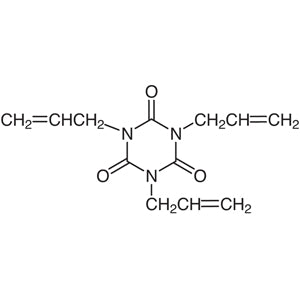
Triallyl Isocyanurate (TAI) is a chemical compound widely used in laboratory settings for constructing complex molecular structures. As a key building block in organic chemistry, it plays a crucial role in the synthesis of heterocyclic compounds, which are essential in pharmaceutical and material science research. Its unique chemical structure allows for versatile reactivity, making it a valuable tool for creating new chemical entities through various reaction mechanisms. TAI is particularly useful in radical and cross-linking reactions, enabling the development of advanced functional materials and drug candidates.
The stability and reactivity of TAI make it a preferred choice for chemists working in both academic and industrial environments. Its stabilization with BHT (butylated hydroxytoluene) enhances its resistance to oxidation and degradation, ensuring a longer shelf life and consistent performance. This makes it ideal for use in experiments requiring high chemical stability and reproducibility. The compound's compatibility with a wide range of functional groups further expands its applicability in synthetic pathways.
In Indonesian laboratories, TAI is commonly used in chemical synthesis and research focused on organic compounds and new material development. Its availability in various packaging options facilitates its use across different experimental scales, from small-scale research to larger production processes. It is particularly relevant for institutions engaged in pharmaceutical and chemical innovation, supporting the development of novel compounds and advanced technologies.
- Synthesis of heterocyclic compounds for pharmaceutical development due to its reactivity and structural versatility.
- Radical reaction studies where TAI's stability and functional group compatibility are essential for successful outcomes.
- Cross-linking applications in polymer science to create advanced functional materials with enhanced properties.
- Organic chemistry research in academic institutions for the development of new chemical entities and drug candidates.
- Material science experiments requiring stable and reactive building blocks for the creation of novel chemical structures.
| Brand | TCI |
|---|---|
| CAS number | 1025-15-6 |
| Molecular formula | — |
| Purity | — |
| Category | Chemistry > Building Blocks > Heterocyclic Building Blocks |
| Pack sizes | Available in various quantities to suit different experimental needs |
| Physical form | Solid (exact form may vary based on packaging) |
| Storage | Store in a cool, dry place away from light and potential contaminants |
Triallyl Isocyanurate should be stored in a cool, dry environment to maintain its chemical stability and prevent degradation. It is recommended to keep the compound in airtight containers to minimize exposure to moisture and air. Due to its potential reactivity, it should be handled in a well-ventilated laboratory setting, with appropriate personal protective equipment such as gloves and safety goggles. Avoid direct contact with skin and eyes, and ensure proper disposal procedures are followed to comply with safety regulations. Regular monitoring of storage conditions is advised to ensure the compound remains in optimal condition for use in laboratory applications.
—
Produk Terkait
-
Tris(2-carboxyethyl)Isocyanurate TCI T0675
Regular price Rp 689.850,00Regular price -
TriglycidylIsocyanurate TCI I0428
Regular price From Rp 795.900,00Regular price -
Triallyl1,3,5-Benzenetricarboxylate TCI T1203
Regular price Rp 4.479.300,00Regular price -
TriallylCyanurate TCI T0333
Regular price From Rp 505.050,00Regular price -
TriallylPhosphate TCI P0264
Regular price From Rp 4.877.250,00Regular price -
TriallylCitrate TCI C1038
Regular price Rp 1.908.900,00Regular price -
Tris(2-hydroxyethyl)Isocyanurate TCI T0674
Regular price From Rp 477.750,00Regular price -
Bis(2-carboxyethyl)Isocyanurate TCI I0584
Regular price From Rp 1.140.300,00Regular price