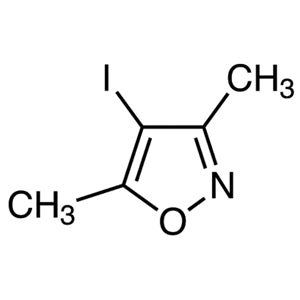
TCI I0727 4-Iodo-3,5-dimethylisoxazole is a heterocyclic building block built around a five-membered isoxazole ring carrying two methyl groups and a single iodine atom at the 4-position. The isoxazole ring contains adjacent nitrogen and oxygen atoms, a feature that makes it a recurring motif in pharmacologically active molecules. In medicinal chemistry laboratories, this compound serves as an entry point for attaching the 3,5-dimethylisoxazole group onto a wide range of molecular scaffolds through cross-coupling reactions, allowing researchers to explore structure-activity relationships systematically across series of test compounds.
The advantage that leads chemists to select this reagent lies in the iodine position, which is highly reactive toward oxidative addition by palladium catalysts, while the two methyl groups stabilise the ring and modulate the electron density of the heteroaromatic system. This combination allows Suzuki, Stille, Negishi and Sonogashira reactions to proceed under relatively mild conditions without damaging the isoxazole ring, which is sensitive to harsh reduction. The 3,5-dimethylisoxazole motif itself is widely recognised in medicinal chemistry as an acetyl-lysine mimic, making the compound a sought-after intermediate in research programmes targeting that interaction.
In Indonesian laboratories, this building block is typically used in university and institutional research groups working on synthetic organic and medicinal chemistry, as well as in method development for heterocyclic coupling chemistry. It is normally handled on a small scale at the bench, weighed out for milligram-to-gram coupling experiments, and stored alongside other halogenated heteroaromatic intermediates in a dedicated reagent inventory so that reaction series can be repeated consistently over the course of a project.
Related TCI products
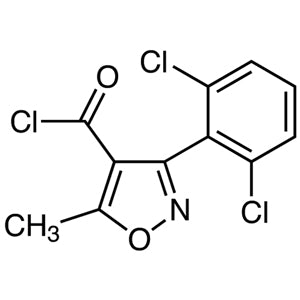
- TCI D4776 4462-55-9 3-(2,6-Dichlorophenyl)-5-methylisoxazole-4-carbonyl Chloride
- TCI C2282 19788-37-5 4-(Chloromethyl)-3,5-dimethylisoxazole
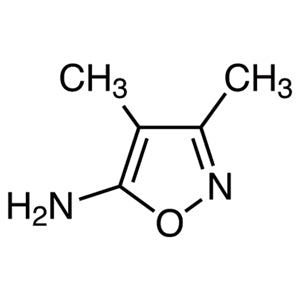
- TCI A3179 19947-75-2 5-Amino-3,4-dimethylisoxazole
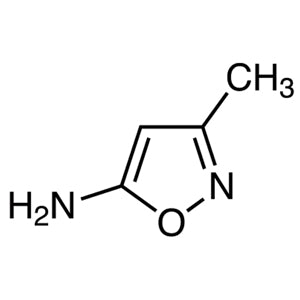
- TCI A2867 14678-02-5 5-Amino-3-methylisoxazole
- TCI A0980 1072-67-9 3-Amino-5-methylisoxazole
- TCI M2953 4857-42-5 3-Methylisoxazole-5-carboxylic Acid
- Suzuki coupling: the reactive carbon-iodine bond undergoes oxidative addition readily, letting researchers join aryl and heteroaryl boronic acids to the isoxazole core under mild palladium catalysis.
- Stille and Negishi coupling: the iodinated position accepts organostannane and organozinc partners, giving an alternative route when boronic acid coupling partners are unstable or unavailable for a target series.
- Sonogashira coupling: the compound allows direct installation of alkynyl substituents onto the isoxazole ring, opening access to rigid linear linkers used in probe and fragment design work.
- Medicinal chemistry scaffold construction: the 3,5-dimethylisoxazole motif acts as an acetyl-lysine mimic, so the reagent supports the preparation of compound series aimed at that recognition interaction.
- Structure-activity relationship studies: the single defined reaction site makes it straightforward to prepare systematic analogue sets in which only the coupled fragment is varied between experiments.
| Brand | TCI (Tokyo Chemical Industry) |
|---|---|
| CAS number | 10557-85-4 |
| Molecular formula | — |
| Purity | — |
| Category | Chemistry > Building Blocks > Heterocyclic Building Blocks |
| Pack sizes | available in standard TCI research-scale packaging; please confirm the required size when ordering |
| Physical form | — |
| Storage | keep in a cool, dark place in a tightly sealed container |
- Chemical name: 4-Iodo-3,5-dimethylisoxazole
Store the container tightly closed in a cool, dark and well-ventilated place, away from heat sources, direct sunlight and incompatible oxidising agents. Like many organoiodine compounds, the material is best protected from prolonged light exposure, so amber glass or an opaque secondary container is preferred. Handle in a fume hood using nitrile gloves, safety goggles and a laboratory coat, and avoid generating dust or inhaling vapour. Weigh out portions promptly and reseal the original container to limit moisture uptake. Dispose of residues and contaminated consumables as halogenated organic chemical waste in accordance with institutional procedures, and consult the manufacturer's safety data sheet before first use.
—
Produk Terkait
-
3-(2,6-Dichlorophenyl)-5-methylisoxazole-4-carbonylChloride TCI D4776
Regular price From Rp 1.140.300,00Regular price -
4-(Chloromethyl)-3,5-dimethylisoxazole TCI C2282
Regular price From Rp 875.700,00Regular price -
5-Amino-3,4-dimethylisoxazole TCI A3179
Regular price From Rp 1.193.850,00Regular price -
5-Amino-3-methylisoxazole TCI A2867
Regular price From Rp 1.008.000,00Regular price -
3-Amino-5-methylisoxazole TCI A0980
Regular price Rp 2.518.950,00Regular price -
3-Methylisoxazole-5-carboxylicAcid TCI M2953
Regular price Rp 2.916.900,00Regular price -
5-Methylisoxazole-3-carboxylicAcid TCI M2405
Regular price From Rp 1.298.850,00Regular price -
5-Methylisoxazole-4-carboxylicAcid TCI M1740
Regular price From Rp 769.650,00Regular price