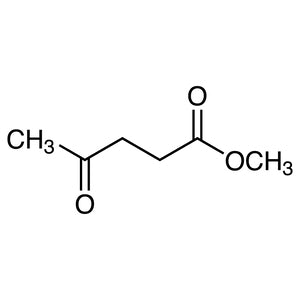
TCI L0044 Methyl Levulinate is the methyl ester of levulinic acid, a compound that retains the ketone group along its chain and therefore still carries two reactive centres even though the acid function has been capped in ester form. The material is supplied as a liquid and belongs to the family of biomass-derived derivatives that are widely studied in renewable chemistry research. In the laboratory it serves as a building block for organic synthesis, as an alternative solvent with a gentler profile, and as a reference compound in esterification studies of biomass-derived products.
Compared with its parent acid, methyl levulinate offers clear practical advantages: it is liquid at room temperature, it is far less acidic, and it mixes well with a broad range of organic solvents. These properties make it easier to pipette, to measure accurately, and to introduce into a reaction system without any preliminary warming step. The free ketone group remains available for reduction, aldol condensation, and ring-forming reactions, while the ester group can be transesterified, hydrolysed, or reduced according to the requirements of the synthesis. Its moderate odour and volatility also mean it can be separated by distillation during work-up.
In Indonesian laboratories, this ester is a familiar choice for academic and institutional research groups working on renewable chemistry and biomass valorisation, where levulinic acid derivatives are a recurring subject. Its handling convenience suits teaching laboratories and small-scale synthetic work equally well, since it can be dispensed with ordinary volumetric glassware. Research groups examining esterification routes from biomass feedstocks commonly keep it on hand as a reference material for comparison with their own reaction products.
- Organic synthesis building block: the compound presents two independent reactive centres, a free ketone and an ester, allowing a single starting material to be elaborated along several different synthetic routes.
- Alternative solvent applications: methyl levulinate mixes readily with many organic solvents and offers a gentler profile, making it useful where a less aggressive medium is preferred for dissolution.
- Esterification research on biomass derivatives: it functions as a reference compound against which reaction products from levulinic acid esterification studies can be compared and identified.
- Reduction and condensation chemistry: the ketone group remains entirely free, so reduction, aldol condensation, and ring-forming reactions can be carried out without first deprotecting the molecule.
- Transesterification and hydrolysis studies: the ester function can be transesterified, hydrolysed, or reduced as the synthesis requires, giving researchers flexible access to related levulinate derivatives.
| Brand | TCI |
|---|---|
| CAS number | 624-45-3 |
| Molecular formula | — |
| Purity | — |
| Category | Chemistry > Building Blocks > Non-Heterocyclic Building Blocks |
| Pack sizes | available in the pack sizes listed on this product page |
| Physical form | liquid |
| Storage | store in a closed container under the conditions stated on the manufacturer's label |
Store the container tightly closed in a cool, dry, well-ventilated area away from direct sunlight, heat sources, and strong oxidising agents. Because the material is a liquid of moderate volatility, glass bottles with chemically resistant closures are appropriate, and containers should be resealed promptly after dispensing to limit evaporation and moisture uptake. Handle the compound in a fume hood and wear safety glasses, gloves, and a laboratory coat. Transfer using clean, dry glassware, keep the working area free of ignition sources, and consult the manufacturer's safety data sheet before first use.
—
Produk Terkait
-
PropylLevulinate TCI P2631
Regular price From Rp 1.670.550,00Regular price -
ButylLevulinate TCI L0138
Regular price From Rp 557.550,00Regular price -
EthylLevulinate TCI L0120
Regular price From Rp 505.050,00Regular price -
Methyl5-AminolevulinateHydrochloride TCI A1411
Regular price From Rp 584.850,00Regular price