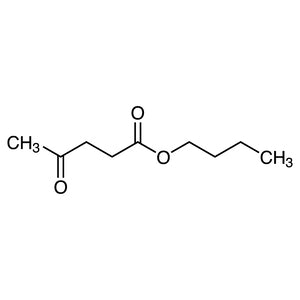
Butyl Levulinate is the butyl ester of levulinic acid, a keto-ester compound that has attracted attention because it can be obtained from the processing of carbohydrate-based biomass. Its molecule carries both a ketone group and an ester group at the same time, which is why this material serves in the laboratory both as a synthetic building block and as a target compound in renewable chemistry research. Catalysis researchers frequently employ it as a reference product for assessing the success of biomass conversion, while organic chemists take advantage of its two functional groups to construct more elaborate molecular frameworks.
The property that makes this compound a preferred choice is the balance between polarity and the hydrophobic character contributed by the butyl chain, so that it mixes well with many organic solvents and offers solvation behaviour that is useful in formulation work. The ketone group provides a site for nucleophilic addition, condensation, and reduction reactions, while the ester group allows transesterification as well as controlled hydrolysis. As a medium-chain ester liquid, the material is relatively stable at room temperature when protected from moisture, with lower volatility than shorter-chain levulinate esters.
In Indonesian laboratories this dual reactivity places Butyl Levulinate in a practical middle ground between a reagent and a reference material. University and institutional research groups working on carbohydrate-based biomass valorisation use it to benchmark conversion experiments, while synthetic organic laboratories keep it on hand as a starting material for multi-step routes. Its handling profile as a stable, moderately volatile ester makes it suitable for ordinary bench-scale work under standard laboratory conditions.
- Biomass conversion benchmarking — used as a reference product against which the yield and success of carbohydrate-based biomass processing runs are evaluated in catalysis research.
- Synthetic building block chemistry — the combination of ketone and ester groups in one molecule allows chemists to assemble more complex molecular frameworks through sequential transformations.
- Nucleophilic addition and condensation studies — the ketone group offers a well-defined reactive site for addition, condensation, and reduction reactions in methodology development work.
- Transesterification and controlled hydrolysis experiments — the ester group can be exchanged or hydrolysed under controlled conditions, making the compound useful for studying ester reactivity.
- Formulation and solvation studies — its balance of polarity and butyl-chain hydrophobicity gives good miscibility with many organic solvents and useful dissolving properties in formulation work.
| Brand | TCI |
|---|---|
| CAS number | 2052-15-5 |
| Molecular formula | — |
| Purity | — |
| Category | Chemistry > Building Blocks > Non-Heterocyclic Building Blocks |
| Pack sizes | — |
| Physical form | liquid ester (medium-chain) |
| Storage | keep at room temperature, protected from moisture |
- Catalogue code: L0138
Store Butyl Levulinate at room temperature in a tightly closed container, protected from moisture, since the ester group is susceptible to hydrolysis when exposed to humid air. Chemically compatible glass or amber glass bottles with well-sealing caps are appropriate, and containers should be reclosed promptly after each withdrawal. Although its volatility is lower than that of shorter-chain levulinate esters, dispensing and transfer should still be carried out in a fume hood. Standard laboratory personal protective equipment — safety glasses, gloves, and a laboratory coat — should be worn, and the material kept away from heat sources and strong oxidising agents. Always consult the manufacturer's safety data sheet before use.
—
Produk Terkait
-
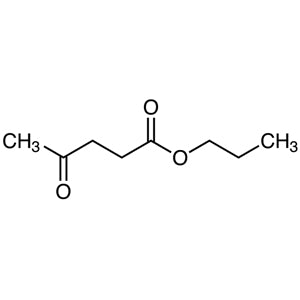
PropylLevulinate TCI P2631
Regular price From Rp 1.670.550,00Regular price -
EthylLevulinate TCI L0120
Regular price From Rp 505.050,00Regular price -
MethylLevulinate TCI L0044
Regular price From Rp 928.200,00Regular price -
Methyl5-AminolevulinateHydrochloride TCI A1411
Regular price From Rp 584.850,00Regular price