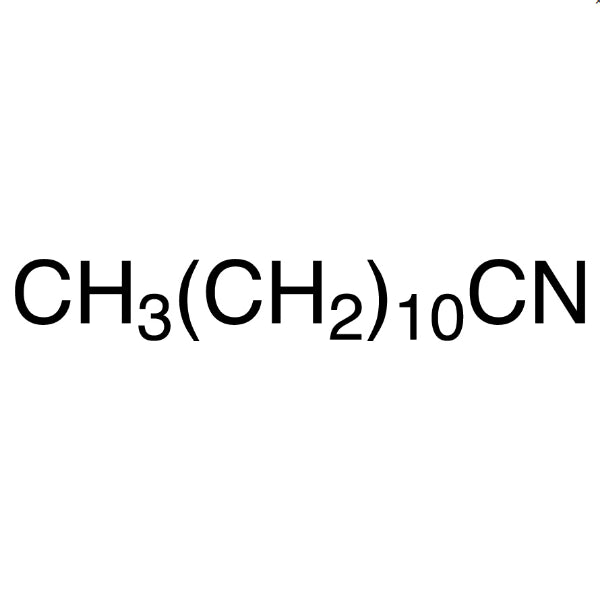
Lauronitrile, also known as dodecanenitrile, is a straight-chain aliphatic nitrile containing twelve carbon atoms. The cyano group at the end of its chain is one of the most versatile functional groups in organic chemistry, as it can be converted into a primary amine through reduction, into a carboxylic acid or amide through hydrolysis, and into a ketone through reaction with organometallic reagents. As a non-heterocyclic building block, this compound serves as an important precursor for the synthesis of laurylamine and a range of long-chain surfactant derivatives at laboratory research scale.
The property that makes Lauronitrile a widely preferred choice is the balance between its long hydrophobic alkyl chain and its cyano group, which is both polar and reactive. This combination yields a liquid with a relatively high boiling point, low vapour pressure, and good solubility in common organic solvents, making it easy to handle in elevated-temperature reactions without excessive evaporation. The nitrile group also provides a sharp and characteristic infrared absorption, so the progress of a reaction can be monitored spectroscopically with little difficulty. Its good stability under neutral conditions means that medium-term storage does not present unusual demands.
In Indonesian laboratories, Lauronitrile is typically used in university and institutional organic synthesis work, in surfactant and oleochemical research groups, and in analytical settings where a well-defined long-chain nitrile is needed as a reference material. Supplied under the TCI brand through AMI Scientific, it suits research teams that require a consistent non-heterocyclic building block for functional group transformation studies, method development, and the preparation of longer-chain intermediates on a bench scale.
- Synthesis of primary amines: reduction of the terminal cyano group gives laurylamine directly, making this a convenient single-step entry point to long-chain amine intermediates in research work.
- Surfactant derivative research: the twelve-carbon hydrophobic chain paired with a convertible polar head group makes it a natural starting material for preparing and studying long-chain surfactant analogues.
- Carboxylic acid and amide preparation: controlled hydrolysis of the nitrile function yields the corresponding acid or amide, allowing laboratories to access several related derivatives from one starting material.
- Ketone synthesis via organometallic addition: reaction with Grignard or organolithium reagents converts the cyano group into a ketone, supporting carbon-carbon bond formation studies in teaching and research laboratories.
- Spectroscopic reference and reaction monitoring: the sharp, characteristic infrared absorption of the nitrile group allows reaction progress and functional group identity to be followed clearly by spectroscopic methods.
| Brand | TCI |
|---|---|
| CAS number | 2437-25-4 |
| Molecular formula | — |
| Purity | — |
| Category | Chemistry > Building Blocks > Non-Heterocyclic Building Blocks |
| Pack sizes | — |
| Physical form | liquid, soluble in common organic solvents |
| Storage | stable under neutral conditions; suitable for medium-term storage without special demands |
- Catalogue number: L0110
Store Lauronitrile in a tightly closed original container in a cool, dry, and well-ventilated area, away from strong acids, strong bases, strong oxidising agents, and sources of heat or ignition. Containers of glass or other chemically compatible material with well-sealing caps are appropriate, and bottles should be reclosed promptly after each use to limit moisture ingress. All handling, transfer, and reaction work should be carried out in a fume hood using suitable gloves, safety goggles, and a laboratory coat. Consult the manufacturer's safety data sheet before use, and follow institutional procedures for waste collection and disposal of organic nitrile residues.
—
Produk Terkait
-
Valeronitrile TCI V0008
Regular price From Rp 743.400,00Regular price -
2-Bromo-2-(bromomethyl)glutaronitrile TCI B5387
Regular price From Rp 875.700,00Regular price -
5-Bromovaleronitrile TCI B1453
Regular price From Rp 1.087.800,00Regular price -
3-Bromobutyronitrile TCI B1452
Regular price From Rp 1.961.400,00Regular price -
4-Bromo-2,2-diphenylbutyronitrile TCI B1331
Regular price From Rp 875.700,00Regular price -
Butyronitrile TCI B0768
Regular price From Rp 610.050,00Regular price -
4-Bromobutyronitrile TCI B0565
Regular price From Rp 1.060.500,00Regular price -
Suberonitrile TCI S0298
Regular price From Rp 980.700,00Regular price