

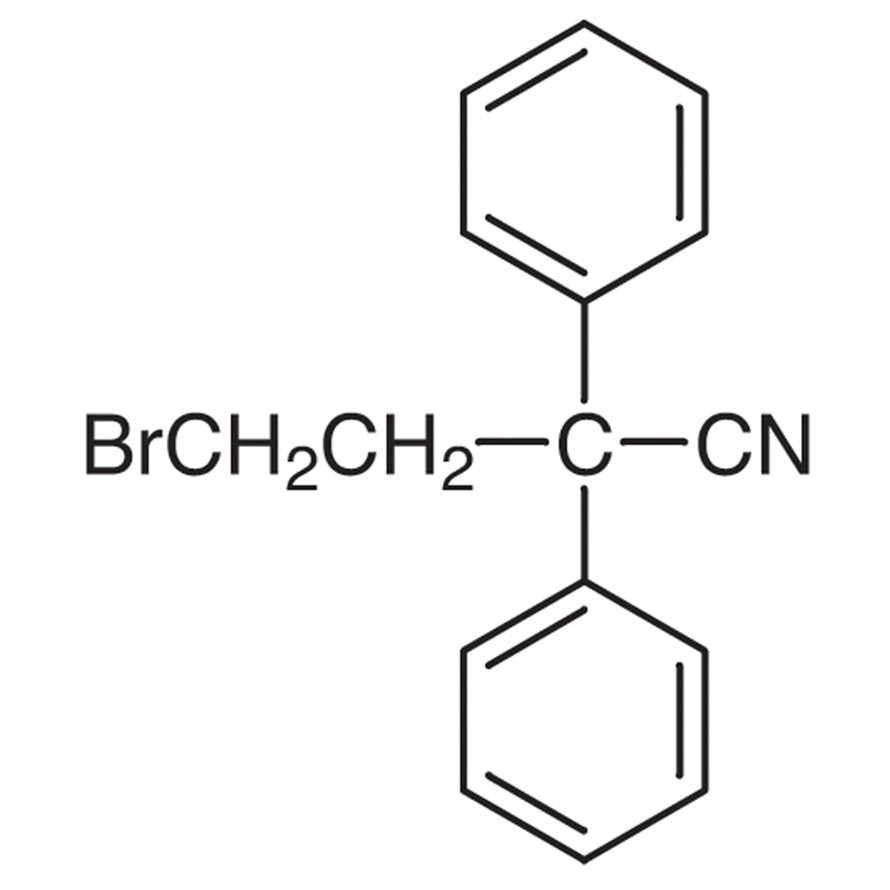
4-Bromo-2,2-diphenylbutyronitrile is a chemical compound widely used in organic synthesis reactions, particularly in the formation of heterocyclic and complex aromatic compounds. This building block is commonly found in chemical laboratories as a foundational material for substitution reactions, coupling reactions, and chain-joining processes. Its versatility makes it a valuable tool for researchers aiming to develop new compounds with applications in pharmaceuticals, materials science, and chemical industries.
The compound's molecular structure, featuring both a nitrile group and a bromo group, contributes to its high reactivity. The bromo group at position 4 enables substitution or electrophilic reactions, while the nitrile group provides stability and reactivity necessary for various chemical transformations. These characteristics make it an ideal choice for researchers requiring materials with high reactivity and modification potential.
In Indonesian laboratories, 4-Bromo-2,2-diphenylbutyronitrile is frequently used by chemists, students, and growing industries. Its relevance in organic chemistry research, especially in the development of new compounds, makes it a sought-after material for both academic and industrial applications. Its availability and chemical properties support its use in a wide range of experimental setups.
- Organic synthesis for creating heterocyclic and aromatic compounds due to its reactive nitrile and bromo groups.
- Substitution reactions where the bromo group facilitates electrophilic attack and structural modification.
- Coupling reactions to form complex molecules by linking different functional groups efficiently.
- Chain-joining processes in polymer and material science applications for building molecular frameworks.
- Research in pharmaceutical development for designing new drug molecules with specific functional groups.
| Brand | TCI |
|---|---|
| CAS number | 39186-58-8 |
| Molecular formula | — |
| Purity | — |
| Category | Chemistry > Building Blocks > Non-Heterocyclic Building Blocks |
| Pack sizes | Available in standard laboratory quantities |
| Physical form | Solid |
| Storage | Store in a cool, dry, and well-ventilated area away from light |
This compound should be stored in a cool, dry, and well-ventilated area, away from direct light. It is recommended to use airtight containers made of glass or polyethylene to prevent moisture absorption and contamination. Due to its reactivity, it should be handled with appropriate personal protective equipment such as gloves and safety goggles. Ensure proper ventilation when working with this material to minimize exposure. Keep it away from incompatible substances like strong oxidizers and acids. Regularly inspect storage conditions to maintain the integrity of the compound.
—
Produk Terkait
-
Butyronitrile TCI B0768
Regular price From Rp 662.550,00Regular priceRp 478.800,00Sale price From Rp 662.550,00 -
4-Phenylbutyronitrile TCI P1025
Regular price Rp 1.643.250,00Regular priceRp 1.164.450,00Sale price Rp 1.643.250,00 -
2-Methylbutyronitrile TCI M0706
Regular price Rp 1.351.350,00Regular priceRp 960.750,00Sale price Rp 1.351.350,00 -
Isobutyronitrile TCI I0112
Regular price From Rp 637.350,00Regular priceRp 460.950,00Sale price From Rp 637.350,00 -
3-Bromobutyronitrile TCI B1452
Regular price From Rp 2.013.900,00Regular priceRp 1.423.800,00Sale price From Rp 2.013.900,00 -
4-Bromobutyronitrile TCI B0565
Regular price From Rp 1.113.000,00Regular priceRp 793.800,00Sale price From Rp 1.113.000,00 -
4-Chlorobutyronitrile TCI C0925
Regular price From Rp 1.060.500,00Regular priceRp 757.050,00Sale price From Rp 1.060.500,00 -
2-Bromo-2-(bromomethyl)glutaronitrile TCI B5387
Regular price From Rp 928.200,00Regular priceRp 664.650,00Sale price From Rp 928.200,00


