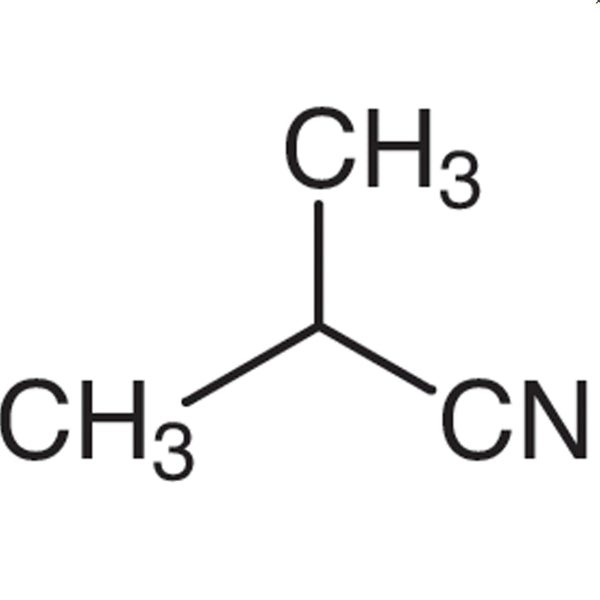
Isobutyronitrile is a chemical compound widely used in laboratory settings for the synthesis of complex molecules. As a key building block in organic chemistry, it plays a crucial role in various chemical reactions, particularly in substitution reactions involving nitriles. Its versatility allows it to participate in multiple reaction types, including hydrolysis, reduction, and nucleophilic reactions, making it an essential component in synthetic pathways. This compound is favored for its reactivity and simplicity, enabling chemists to modify its structure into more complex compounds with relative ease.
The compound's high boiling point facilitates heating processes during chemical reactions, ensuring efficient reaction conditions. Its stability and ease of handling further enhance its appeal in laboratory environments. Additionally, isobutyronitrile's predictable chemical behavior allows for precise control in synthetic procedures, which is vital for achieving desired outcomes in research. These properties make it a reliable and preferred choice for chemists working in both academic and industrial settings.
In Indonesian laboratories, isobutyronitrile is commonly used in research and development projects, especially in the fields of pharmaceuticals and organic chemistry. It is frequently found in studies aimed at synthesizing new compounds and exploring chemical transformations. Its availability and performance make it a popular choice among researchers seeking to advance their work in chemical synthesis and innovation.
- Organic synthesis is a primary application where isobutyronitrile is used as a versatile building block for creating complex molecules through various reaction pathways.
- Pharmaceutical research benefits from its reactivity, enabling the development of new drug compounds and derivatives through targeted chemical modifications.
- Nucleophilic substitution reactions are effectively supported by isobutyronitrile due to its ability to participate in such reactions with predictable outcomes.
- Industrial chemical processes utilize its stability and reactivity to produce a range of organic compounds efficiently.
- Analytical chemistry applications take advantage of its predictable behavior during hydrolysis and reduction reactions for compound characterization.
| Brand | TCI |
|---|---|
| CAS number | 78-82-0 |
| Molecular formula | — |
| Purity | — |
| Category | Chemistry > Building Blocks > Non-Heterocyclic Building Blocks |
| Pack sizes | Available in various quantities as per standard laboratory supply options |
| Physical form | Liquid |
| Storage | Store in a cool, dry place away from direct sunlight and incompatible materials |
Isobutyronitrile should be stored in a cool, dry environment, away from direct sunlight and sources of heat. It is recommended to keep it in a sealed container to prevent evaporation and contamination. Due to its chemical nature, it should be stored separately from strong oxidizers and acids to avoid potential reactions. Proper ventilation is essential when handling this compound to ensure safe working conditions. Always use appropriate personal protective equipment, including gloves and safety goggles, when working with isobutyronitrile. It is important to follow standard laboratory safety protocols to minimize risks associated with its use and storage.
—
Produk Terkait
-
Butyronitrile TCI B0768
Regular price From Rp 610.050,00Regular price -
3-Bromobutyronitrile TCI B1452
Regular price From Rp 1.961.400,00Regular price -
4-Bromobutyronitrile TCI B0565
Regular price From Rp 1.060.500,00Regular price -
4-Chlorobutyronitrile TCI C0925
Regular price From Rp 1.008.000,00Regular price -
4-Bromo-2,2-diphenylbutyronitrile TCI B1331
Regular price From Rp 875.700,00Regular price -
4-Phenylbutyronitrile TCI P1025
Regular price Rp 1.590.750,00Regular price -
2-Methylbutyronitrile TCI M0706
Regular price Rp 1.298.850,00Regular price -
Valeronitrile TCI V0008
Regular price From Rp 743.400,00Regular price