

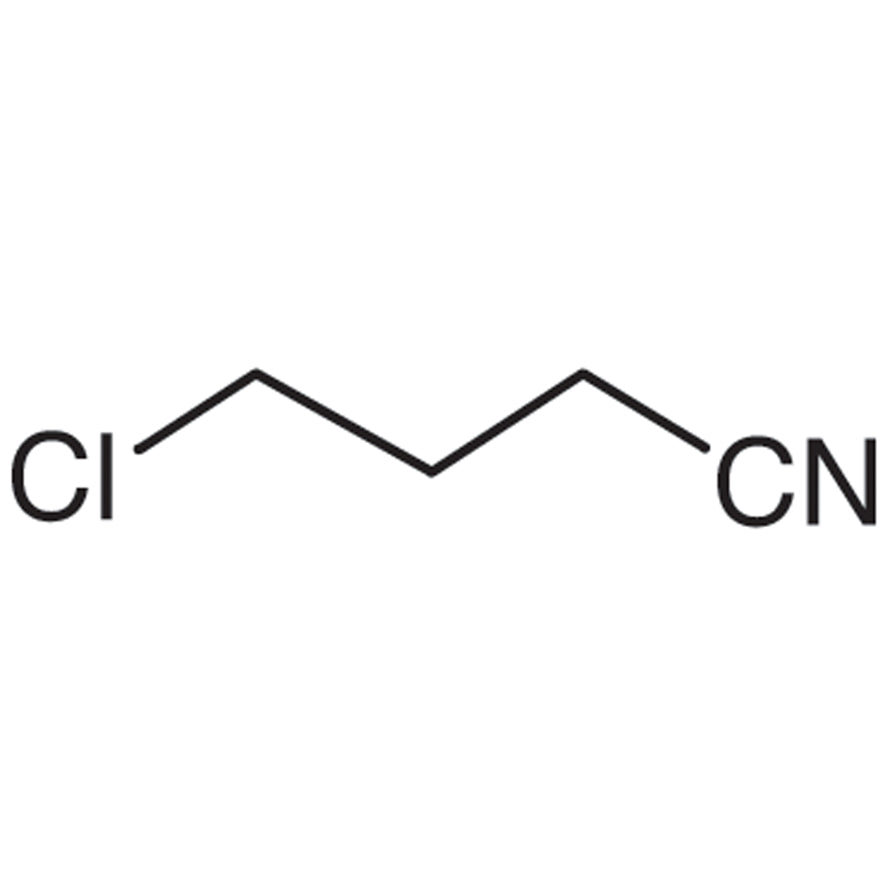
4-Chlorobutyronitrile (TCI product C0925, CAS 628-20-6) is a bifunctional aliphatic compound with two reactive groups: a chlorine atom at one end of the chain and a nitrile group at the other, separated by three carbon atoms. This arrangement makes it a highly versatile non-heterocyclic building block for organic synthesis. Chemists use it to attach a four-carbon nitrile-bearing chain to other molecules, or to form small rings through intramolecular reactions. For this reason it often serves as an intermediate in pharmaceutical and agrochemical synthesis routes.
The main value of 4-Chlorobutyronitrile comes from the different reactivity of its two functional groups. Nucleophiles such as amines, thiolates, alkoxides, or carbon anions can displace the primary chlorine atom through substitution reactions. The nitrile group stays intact and can be converted later into a carboxylic acid, an amide, a primary amine, or certain heterocycles. Under strong base, the compound is known to cyclize intramolecularly to cyclopropanecarbonitrile, a classic route to cyclopropane derivatives. Because it is a liquid, it can also be measured out conveniently by volume, which simplifies routine weighing and dosing at the bench.
In Indonesian laboratories, 4-Chlorobutyronitrile is useful to research groups in synthetic organic chemistry, medicinal chemistry, and agrochemical development. University chemistry departments can use it in teaching and research projects on nucleophilic substitution, chain extension, and ring formation. Industrial R&D teams working on new active ingredients can use it as a dependable intermediate when designing multistep routes. Its predictable, stepwise reactivity also makes it a convenient model substrate for students and researchers learning to plan selective transformations on molecules with more than one functional group.
- Chain extension in organic synthesis: the primary chlorine can be displaced by many nucleophiles, so a four-carbon nitrile-bearing chain can be attached to amines, thiols, alcohols, or carbon nucleophiles.
- Synthesis of cyclopropane derivatives: treatment with strong base gives intramolecular cyclization to cyclopropanecarbonitrile, a classic and well-known entry point to cyclopropane-containing building blocks.
- Pharmaceutical intermediate preparation: the two functional groups can be modified one after the other, which lets medicinal chemists build more complex drug-like scaffolds in a controlled, stepwise way.
- Agrochemical research and development: it serves as an intermediate in synthetic routes toward new active compounds, giving a flexible aliphatic linker that can be functionalized further.
- Nitrile functional group conversion: after the chlorine end has been substituted, the nitrile group can be converted into carboxylic acids, amides, primary amines, or certain heterocycles, depending on the target molecule.
| Brand | TCI (product code C0925) |
|---|---|
| CAS number | 628-20-6 |
| Molecular formula | — |
| Purity | — |
| Category | Chemistry > Building Blocks > Non-Heterocyclic Building Blocks |
| Pack sizes | see the product listing for available packaging options |
| Physical form | liquid |
| Storage | keep tightly closed in a cool, dry, well-ventilated place and follow the manufacturer's label and Safety Data Sheet |
Store 4-Chlorobutyronitrile in its original tightly sealed container, or in a compatible, clearly labeled glass container, in a cool, dry, well-ventilated chemical storage area. Keep it away from heat sources, direct sunlight, and incompatible materials such as strong bases and strong oxidizing agents. Handle it only in a properly functioning fume hood, and wear chemical-resistant gloves, safety goggles, and a laboratory coat. Avoid inhaling vapors and avoid contact with skin and eyes. Read the manufacturer's Safety Data Sheet before use, keep spill-control materials nearby, and dispose of waste according to institutional and local chemical waste regulations.
—
Produk Terkait
-
Butyronitrile TCI B0768
Regular price From Rp 662.550,00Regular priceRp 478.800,00Sale price From Rp 662.550,00 -
Isobutyronitrile TCI I0112
Regular price From Rp 637.350,00Regular priceRp 460.950,00Sale price From Rp 637.350,00 -
3-Bromobutyronitrile TCI B1452
Regular price From Rp 2.013.900,00Regular priceRp 1.423.800,00Sale price From Rp 2.013.900,00 -
4-Bromobutyronitrile TCI B0565
Regular price From Rp 1.113.000,00Regular priceRp 793.800,00Sale price From Rp 1.113.000,00 -
2-Methylbutyronitrile TCI M0706
Regular price Rp 1.351.350,00Regular priceRp 960.750,00Sale price Rp 1.351.350,00 -
4-Bromo-2,2-diphenylbutyronitrile TCI B1331
Regular price From Rp 928.200,00Regular priceRp 664.650,00Sale price From Rp 928.200,00 -
4-Phenylbutyronitrile TCI P1025
Regular price Rp 1.643.250,00Regular priceRp 1.164.450,00Sale price Rp 1.643.250,00 -
4-ChlorobutylBenzoate TCI B1399
Regular price From Rp 822.150,00Regular priceRp 590.100,00Sale price From Rp 822.150,00


