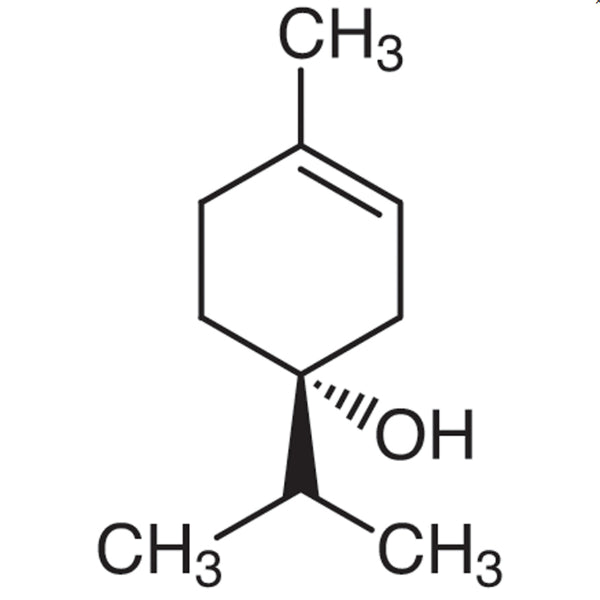
TCI M0319 (-)-Terpinen-4-ol, bearing CAS number 20126-76-5, is a cyclic terpenoid alcohol widely recognised as the principal component of tea tree oil. The product is supplied as the levorotatory enantiomer containing at most thirty percent of the (+)-form, as stated explicitly in the product name. Classified within the chiral building blocks category for asymmetric synthesis, this compound plays an important role for researchers who require a starting material that already carries defined stereochemical information, allowing that spatial configuration to be transferred into more complex target molecules.
The key structural feature that determines its value is the tertiary hydroxyl group positioned on a ring that also carries a double bond and an isopropyl substituent. The hydroxyl group provides a reactive handle for esterification, etherification and oxidation, while the unsaturated ring opens the way to further transformations. In parallel, the compound is known as the main active constituent responsible for the antimicrobial activity of tea tree oil, which is why it is so frequently employed as a reference standard in the testing of natural active ingredients. The clearly stated chiral purity and enantiomeric composition help researchers interpret their experimental results with confidence.
In Indonesian laboratories, this material is typically encountered in university and institutional research groups working on natural product chemistry, essential oil characterisation and asymmetric synthesis. It serves both as a synthetic starting material and as a comparison standard against locally sourced essential oils. Because the enantiomeric composition is declared on the label, analysts can relate their chromatographic and spectroscopic observations directly to the specification of the material in hand rather than to an assumed composition.
TCI brochures (PDF)
- Terpenes 2025-09-22 · p. 4
- Chiral Building Blocks 2025-04-14 · p. 9
Related TCI products
- TCI T2581 2438-10-0 (+)-Terpinen-4-ol (contains 35% (-)-Terpinen-4-ol at maximum)
- TCI U0141 2055540-61-7 UltraCat (contains 5% Nitromethane at maximum)
- TCI B0395 117-61-3 2,2'-Benzidinedisulfonic Acid (contains 20% Water at maximum)
- TCI A1107 2623-23-6 (-)-Menthyl Acetate
- TCI T0984 98-55-5 alpha-Terpineol
- TCI T0022 98-55-5 alpha-Terpineol
- Asymmetric synthesis starting material: the defined levorotatory configuration allows inherent stereochemical information to be carried forward into more complex chiral target molecules during multi-step preparative work.
- Chiral building block chemistry: the tertiary hydroxyl group offers a direct point of attack for esterification, etherification and oxidation reactions that extend the molecular framework in a controlled manner.
- Antimicrobial activity studies: as the constituent chiefly responsible for the antimicrobial behaviour of tea tree oil, it supports investigations into the mechanism behind that documented biological activity.
- Reference standard for natural active ingredient testing: the stated enantiomeric composition makes it suitable for benchmarking essential oil samples and verifying the identity of extracted terpenoid fractions.
- Further ring functionalisation research: the unsaturated ring bearing an isopropyl substituent provides an additional reactive site for downstream transformation and derivatisation studies in synthetic programmes.
| Brand | TCI |
|---|---|
| CAS number | 20126-76-5 |
| Molecular formula | — |
| Purity | — |
| Category | Chemistry > Asymmetric Synthesis > Chiral Building Blocks |
| Pack sizes | please refer to the TCI catalogue listing for this product code |
| Physical form | — |
| Storage | keep in a tightly closed original container in a cool, well ventilated place away from light |
- Product code: M0319
- Enantiomeric composition: levorotatory (-)-form containing at maximum 30% of the (+)-enantiomer
Store the product in its original tightly closed container in a cool, dry and well ventilated area, protected from direct sunlight and away from sources of heat or ignition. Amber glass containers with chemically resistant closures are appropriate, since terpenoid alcohols are sensitive to light and to prolonged exposure to air. Handle the material inside a fume hood and wear a laboratory coat, chemical splash goggles and suitable chemical resistant gloves. Avoid inhalation of vapour and contact with skin or eyes. Transfer only the quantity required for immediate work, reseal the container promptly to limit evaporation and oxidation, and always consult the manufacturer's safety data sheet before first use.
—
Produk Terkait
-
(+)-Terpinen-4-ol(contains35%(-)-Terpinen-4-olatmaximum) TCI T2581
Regular price Rp 4.373.250,00Regular price -
UltraCat(contains5%Nitromethaneatmaximum) TCI U0141
Regular price Rp 3.630.900,00Regular price -
2,2'-BenzidinedisulfonicAcid(contains20%Wateratmaximum) TCI B0395
Regular price From Rp 848.400,00Regular price -
(-)-MenthylAcetate TCI A1107
Regular price Rp 823.200,00Regular price -
alpha-Terpineol TCI T0984
Regular price From Rp 637.350,00Regular price -
alpha-Terpineol TCI T0022
Regular price From Rp 505.050,00Regular price -
Ru-MACHO(regR)(contains5%Tolueneatmaximum) TCI R0136
Regular price From Rp 1.246.350,00Regular price -
(+)-Pulegone TCI P2331
Regular price From Rp 530.250,00Regular price