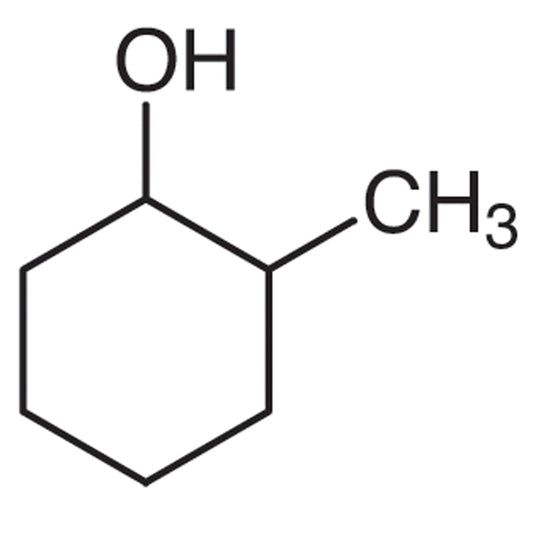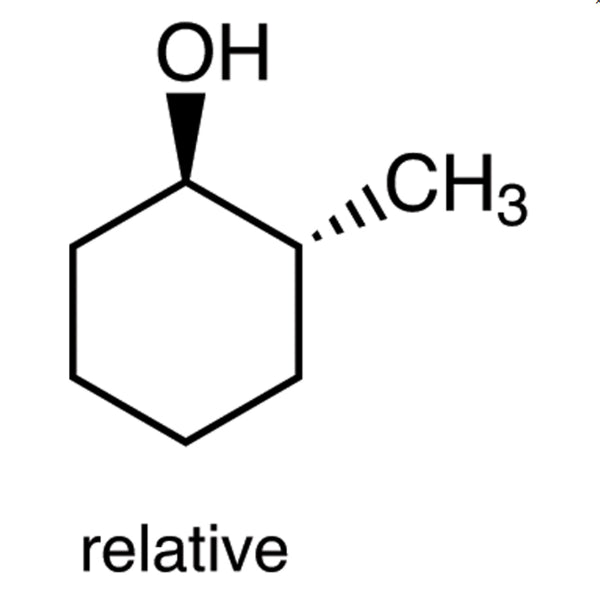
TCI M0352 trans-2-Methylcyclohexanol is the diastereomeric partner of the *cis* isomer, supplied with a defined *trans* configuration in which the hydroxyl group and the methyl group sit on opposite faces of the cyclohexane ring plane. The compound serves as a non-heterocyclic building block, a model reaction substrate, and a chromatographic reference standard. Because it is supplied as a single isomer, researchers can place the two diastereomers side by side and compare their behaviour directly — something that is simply not possible when only an ordinary commercial isomer mixture is available.
The property that makes this isomer interesting is its ability to place both substituents in equatorial positions simultaneously in one of its chair conformations. That diequatorial conformation is considerably lower in energy, so the *trans* isomer is generally the more stable of the pair and displays reaction behaviour distinct from the *cis* isomer, particularly in reactions that require an axial orientation of the leaving group. For this reason the isomer pair has become a textbook example for teaching the relationship between conformation, stability, and reaction rate.
In Indonesian laboratories, trans-2-Methylcyclohexanol is most often encountered in university organic chemistry teaching laboratories, in synthetic research groups that build substituted cyclohexane frameworks, and in analytical laboratories that need a defined stereoisomer as a comparison peak. It is a liquid at room temperature and is packaged in unit sizes suited to bench-scale work, which fits the way most academic and institutional laboratories here purchase and consume specialty organic reagents.
Related TCI products
- TCI M0194 583-59-5 2-Methylcyclohexanol (cis- and trans- mixture)
- TCI M0354 7731-29-5 trans-4-Methylcyclohexanol
- TCI M0196 589-91-3 4-Methylcyclohexanol (cis- and trans- mixture)
- TCI M0195 591-23-1 3-Methylcyclohexanol (cis- and trans- mixture)
- TCI T2693 116-02-9 cis-3,3,5-Trimethylcyclohexanol (contains ca. 20% trans- isomer)
- TCI B5367 167081-25-6 cis-4-(tert-Butoxycarbonylamino)cyclohexanol
- Non-heterocyclic building block for organic synthesis, providing a stereochemically defined cyclohexane scaffold that lets chemists carry a known *trans* relationship through subsequent transformations.
- Model substrate for elimination and substitution studies, since the defined *trans* geometry determines whether a leaving group can reach the axial orientation that many of these reactions demand.
- Chromatographic reference standard, where the single isomer supplies an unambiguous comparison peak that allows analysts to assign and separate *cis* and *trans* signals with confidence.
- Conformational analysis teaching material, because the diequatorial chair conformation makes it the classic worked example for linking conformation to relative stability in undergraduate courses.
- Side-by-side diastereomer comparison work, in which having the pure *trans* isomer alongside the *cis* isomer reveals reactivity differences that an ordinary isomer mixture would completely obscure.
| Brand | TCI |
|---|---|
| CAS number | 7443-52-9 |
| Molecular formula | — |
| Purity | — |
| Category | Chemistry > Building Blocks > Non-Heterocyclic Building Blocks |
| Pack sizes | supplied in standard TCI catalogue unit sizes |
| Physical form | liquid at room temperature |
| Storage | keep in a cool, well-ventilated chemical store in the tightly closed original container |
Store the product in its tightly closed original container in a cool, dry, well-ventilated chemical storage area, away from heat sources, direct sunlight, and incompatible materials such as strong oxidising agents. Glass bottles with chemically resistant closures are appropriate for both storage and dispensing; avoid leaving the container open longer than necessary. Handle the material in a fume hood, wearing safety goggles, a laboratory coat, and suitable chemical-resistant gloves. Keep containers clearly labelled to distinguish the *trans* isomer from the *cis* isomer, and consult the manufacturer's safety data sheet before use and disposal.
—
Produk Terkait
-
2-Methylcyclohexanol(cis-andtrans-mixture) TCI M0194
Regular price From Rp 505.050,00Regular price -
trans-4-Methylcyclohexanol TCI M0354
Regular price Rp 2.359.350,00Regular price -
4-Methylcyclohexanol(cis-andtrans-mixture) TCI M0196
Regular price From Rp 530.250,00Regular price -
3-Methylcyclohexanol(cis-andtrans-mixture) TCI M0195
Regular price From Rp 769.650,00Regular price -
cis-3,3,5-Trimethylcyclohexanol(containsca.20%trans-isomer) TCI T2693
Regular price From Rp 584.850,00Regular price -
cis-4-(tert-Butoxycarbonylamino)cyclohexanol TCI B5367
Regular price Rp 2.147.250,00Regular price -
4-(tert-Butoxycarbonylamino)cyclohexanol TCI B4714
Regular price From Rp 557.550,00Regular price -
trans-4-(tert-Butoxycarbonylamino)cyclohexanol TCI B3564
Regular price From Rp 1.829.100,00Regular price