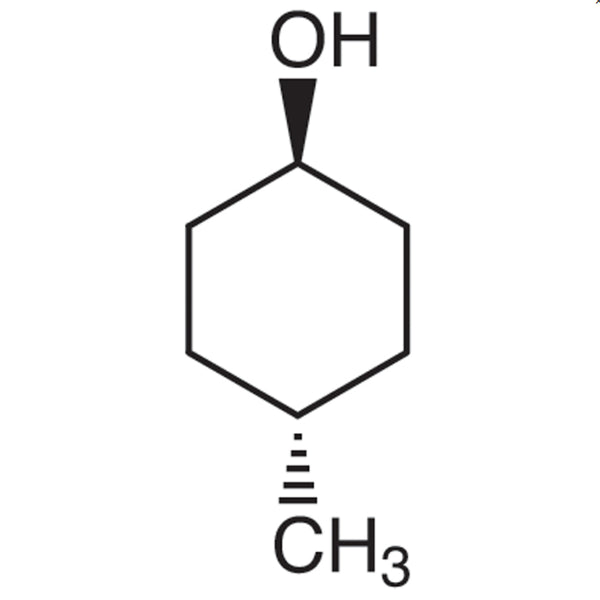
TCI M0354 trans-4-Methylcyclohexanol is the *trans* diastereomer of 4-methylcyclohexanol, supplied with a defined configuration in which the hydroxyl group and the methyl group sit on opposite faces of the ring plane. In everyday laboratory practice this compound serves as a non-heterocyclic building block, as a model substrate for stereochemical and conformational studies, and as a comparison standard that confirms an isomer separation method is genuinely performing as the analyst designed it. Its defined stereochemistry is what makes it useful rather than interchangeable with the unresolved material.
The distinguishing feature of this isomer lies in its ability to place both the methyl group and the hydroxyl group in equatorial positions within a single chair conformation. That diequatorial arrangement is the lowest-energy form available to the molecule, leaving the hydroxyl group in a more open environment that is more readily approached by reagents. As a consequence, this isomer frequently shows esterification and substitution rates that differ from those of its *cis* counterpart, and that difference stands as neat experimental evidence of how substituent orientation governs reactivity. The same property explains why it is often chosen as a reference substrate when new reagents or catalysts are being evaluated.
In Indonesian laboratories, material of this kind is typically used in university and institutional organic chemistry teaching, in postgraduate research on stereochemistry and reaction mechanisms, and in analytical development groups building or validating chromatographic methods that must resolve closely related isomers. It is also drawn on in synthesis groups that require a stereochemically defined alcohol as a starting fragment rather than a mixture whose composition would complicate interpretation of the results.
Related TCI products
- TCI M0194 583-59-5 2-Methylcyclohexanol (cis- and trans- mixture)
- TCI M0352 7443-52-9 trans-2-Methylcyclohexanol
- TCI M0196 589-91-3 4-Methylcyclohexanol (cis- and trans- mixture)
- TCI M0195 591-23-1 3-Methylcyclohexanol (cis- and trans- mixture)
- TCI T2693 116-02-9 cis-3,3,5-Trimethylcyclohexanol (contains ca. 20% trans- isomer)
- TCI B5367 167081-25-6 cis-4-(tert-Butoxycarbonylamino)cyclohexanol
- Non-heterocyclic building block in organic synthesis, supplying a stereochemically defined secondary alcohol that can be carried forward without the ambiguity introduced by an isomeric mixture.
- Model substrate for conformational analysis teaching and research, because its diequatorial chair conformation makes the link between ring geometry and substituent orientation unusually clear to demonstrate.
- Reference standard for isomer separation method development, allowing analysts to confirm that a chromatographic system genuinely resolves the *trans* form from its *cis* counterpart.
- Comparative substrate in reactivity studies, where the differing esterification and substitution rates relative to the *cis* isomer provide clean experimental evidence of orientation effects.
- Test substrate for evaluating new reagents or catalysts, since its well-characterised and accessible hydroxyl environment gives a predictable baseline against which novel systems can be judged.
| Brand | TCI |
|---|---|
| CAS number | 7731-29-5 |
| Molecular formula | — |
| Purity | — |
| Category | Chemistry > Building Blocks > Non-Heterocyclic Building Blocks |
| Pack sizes | available in the standard TCI catalogue pack sizes; please confirm the required size when ordering. |
| Physical form | — |
| Storage | store in a tightly closed container under the conditions stated on the manufacturer's label and safety data sheet. |
- Product code: M0354
Store the container tightly closed in a cool, dry and well-ventilated area, away from heat sources, direct sunlight, ignition sources and incompatible materials such as strong oxidising agents. Keep the material in its original manufacturer's container wherever possible, or in a clean, chemically compatible and clearly labelled alternative if transfer is necessary. Handle in a fume hood using appropriate personal protective equipment, including safety glasses, gloves and a laboratory coat. Close the container promptly after use, avoid unnecessary exposure to air and moisture, and always consult the manufacturer's safety data sheet for the authoritative handling, first aid and disposal instructions before beginning work.
—
Produk Terkait
-
2-Methylcyclohexanol(cis-andtrans-mixture) TCI M0194
Regular price From Rp 505.050,00Regular price -
trans-2-Methylcyclohexanol TCI M0352
Regular price Rp 4.108.650,00Regular price -
4-Methylcyclohexanol(cis-andtrans-mixture) TCI M0196
Regular price From Rp 530.250,00Regular price -
3-Methylcyclohexanol(cis-andtrans-mixture) TCI M0195
Regular price From Rp 769.650,00Regular price -
cis-3,3,5-Trimethylcyclohexanol(containsca.20%trans-isomer) TCI T2693
Regular price From Rp 584.850,00Regular price -
cis-4-(tert-Butoxycarbonylamino)cyclohexanol TCI B5367
Regular price Rp 2.147.250,00Regular price -
4-(tert-Butoxycarbonylamino)cyclohexanol TCI B4714
Regular price From Rp 557.550,00Regular price -
trans-4-(tert-Butoxycarbonylamino)cyclohexanol TCI B3564
Regular price From Rp 1.829.100,00Regular price