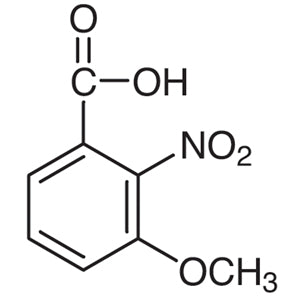
TCI M1036 3-Methoxy-2-nitrobenzoic Acid, carrying CAS number 4920-80-3, is a doubly substituted benzoic acid bearing a methoxy group at the three position and a nitro group at the two position of its aromatic ring. This adjacent substitution pattern makes the compound a highly specific non-heterocyclic building block, because it presents three distinct functional groups on a single ring with their placement already fixed. In synthetic laboratories, an arrangement of this kind is sought after because it saves several aromatic substitution steps whose regioselectivity is normally difficult to control when the ring has to be assembled from simpler starting materials.
The principal value of this compound lies in the nitro group, which can be reduced to an amine to give a methoxy-substituted anthranilic acid derivative — a direct precursor to many heterocyclic systems such as benzimidazoles, quinazolinones, and benzoxazines. At the same time, the carboxyl group is ready to be converted into an ester, an amide, or an acyl chloride, so combining the two transformations enables efficient intramolecular cyclisation. Its nature as a crystalline solid at room temperature makes accurate weighing straightforward and allows recrystallisation to be repeated where needed.
In Indonesian laboratories, materials of this class are typically drawn on by university organic synthesis groups, pharmaceutical research units, and contract laboratories developing routes toward heterocyclic intermediates. Because the substitution pattern is already established, working groups can move directly to the reduction and cyclisation stages rather than spending time constructing the ring themselves. The crystalline form also suits the weighing and storage practices commonly used in teaching and research laboratories across the country.
Related TCI products
- Heterocycle construction — the nitro group reduces cleanly to an amine, giving a methoxy-substituted anthranilic acid that feeds directly into benzimidazole, quinazolinone, and benzoxazine ring-forming sequences.
- Intramolecular cyclisation studies — combining reduction of the nitro group with activation of the carboxyl function as an ester, amide, or acyl chloride enables efficient ring closure in a single planned route.
- Multi-step organic synthesis — the fixed three-functional-group arrangement on one aromatic ring removes several aromatic substitution steps whose regioselectivity is otherwise difficult to control reliably.
- Pharmaceutical intermediate research — substituted anthranilic acid derivatives obtained from this compound serve as recognised precursor scaffolds in medicinal chemistry route development and analogue preparation work.
- Amide and ester derivatisation — the carboxyl group is readily converted into esters, amides, or acyl chlorides, supporting systematic preparation of derivative series for structure comparison.
| Brand | TCI |
|---|---|
| CAS number | 4920-80-3 |
| Molecular formula | — |
| Purity | — |
| Category | Chemistry > Building Blocks > Non-Heterocyclic Building Blocks |
| Pack sizes | available in the standard catalogue pack sizes offered for this item |
| Physical form | crystalline solid at room temperature |
| Storage | keep in a tightly closed original container, protected from moisture and light |
Store this material in its tightly closed original container in a cool, dry area away from direct sunlight and sources of heat or ignition. Amber glass or the supplied manufacturer packaging is suitable, since protection from moisture and light helps preserve the crystalline solid in a free-flowing, accurately weighable condition. Handle the compound inside a fume hood using safety glasses, a laboratory coat, and chemically resistant gloves, and avoid generating or inhaling dust during weighing and transfer. Keep it separated from strong oxidising agents, strong bases, and reducing agents. Close containers promptly after use, label all working solutions clearly, and consult the manufacturer safety data sheet before first handling.
—
Produk Terkait
-
4-Methoxy-2-nitrobenzoicAcid TCI M2828
Regular price From Rp 928.200,00Regular price -
5-Methoxy-2-nitrobenzoicAcid TCI M2245
Regular price From Rp 795.900,00Regular price -
3-Methoxy-4-nitrobenzoicAcid TCI M2083
Regular price From Rp 875.700,00Regular price -
4-Methoxy-3-nitrobenzoicAcid TCI M1092
Regular price Rp 505.050,00Regular price -
3-Bromo-4-nitrobenzoicAcid TCI B4786
Regular price From Rp 1.618.050,00Regular price -
2-Bromo-5-nitrobenzoicAcid TCI B3841
Regular price From Rp 1.565.550,00Regular price -
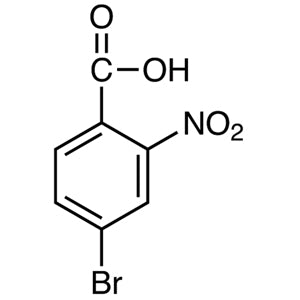
4-Bromo-2-nitrobenzoicAcid TCI B3810
Regular price From Rp 1.298.850,00Regular price -
4-Bromo-3-nitrobenzoicAcid TCI B3689
Regular price Rp 1.829.100,00Regular price