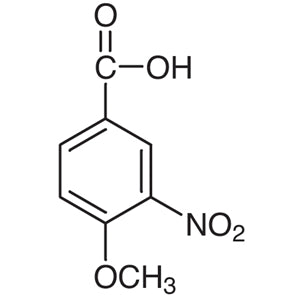
TCI M1092 4-Methoxy-3-nitrobenzoic Acid is a substituted benzoic acid that carries a methoxy group at the four position and a nitro group at the three position relative to the carboxylic acid group. All three functional groups sit on a single aromatic ring, and each one plays a distinct role in a synthetic plan. As a non-heterocyclic building block, this compound serves as a starting material used very frequently in organic chemistry and medicinal chemistry laboratories, because it supplies a coupling point, a reduction point, and a reaction-directing point all at once within a single molecule that is straightforward to handle.
Its main appeal lies in the orthogonal relationship between the nitro group and the carboxylate group. The carboxylic acid can be activated into an acyl chloride or coupled directly with amines using standard coupling reagents to form amides, while the nitro group can be reduced to an aromatic amine in a separate step. The amine produced by that reduction sits adjacent to the methoxy group and at the right distance to close the ring into benzimidazoles, quinazolinones, or benzoxazoles. Its character as a crystalline solid that is stable at room temperature also makes weighing and purification easier.
In Indonesian laboratories, this building block is typically found in university organic synthesis groups, medicinal chemistry research programmes, and development work where multi-step routes toward nitrogen-containing scaffolds are being assembled. Researchers value a reagent that can be weighed out on an ordinary analytical balance and stored without special infrastructure, since it fits the practical realities of teaching and research facilities that run many parallel syntheses with shared equipment.
Related TCI products
- Amide bond formation: the carboxylic acid group couples directly with amines using standard coupling reagents, giving researchers a reliable handle for building amide linkages without first modifying the aromatic ring.
- Acyl chloride preparation: the carboxylate can be activated to the corresponding acyl chloride, providing a more reactive intermediate for acylations where direct coupling proves sluggish or incomplete.
- Selective nitro reduction: the nitro group is reduced to an aromatic amine in a step separate from carboxylate chemistry, which is exactly what orthogonal functional group strategies in multi-step synthesis require.
- Heterocycle ring closure: the amine formed after reduction sits at the correct distance from neighbouring groups to close rings into benzimidazoles, quinazolinones, or benzoxazoles.
- Medicinal chemistry scaffold assembly: three differentiated functional groups on one handleable aromatic ring let chemists build substituted scaffolds efficiently from a single commercially sourced starting material.
| Brand | TCI |
|---|---|
| CAS number | 89-41-8 |
| Molecular formula | — |
| Purity | — |
| Category | Chemistry > Building Blocks > Non-Heterocyclic Building Blocks |
| Pack sizes | available in standard TCI catalogue pack sizes; please confirm the required quantity when ordering |
| Physical form | crystalline solid, stable at room temperature |
| Storage | keep in a cool, dry place in a tightly closed container |
- Chemical name: 4-Methoxy-3-nitrobenzoic Acid
Store the container tightly closed in a cool, dry, well-ventilated place away from moisture and direct sunlight, and keep it separated from strong oxidising agents and strong bases. The original supplier container is the most suitable primary packaging; if transferring material, use clean, dry, chemically compatible glass or amber glass vessels with secure closures and clear labelling that records the chemical name and CAS number. Handle the solid inside a fume hood to avoid generating or inhaling dust, and wear safety glasses, a laboratory coat, and chemically resistant gloves throughout weighing and transfer. Allow cold containers to reach room temperature before opening to prevent condensation on the solid, and close the container immediately after use. Consult the manufacturer safety data sheet before first use and follow institutional procedures for chemical waste disposal.
—
Produk Terkait
-
4-Methoxy-2-nitrobenzoicAcid TCI M2828
Regular price From Rp 928.200,00Regular price -
5-Methoxy-2-nitrobenzoicAcid TCI M2245
Regular price From Rp 795.900,00Regular price -
3-Methoxy-4-nitrobenzoicAcid TCI M2083
Regular price From Rp 875.700,00Regular price -
3-Methoxy-2-nitrobenzoicAcid TCI M1036
Regular price From Rp 610.050,00Regular price -
3-Bromo-4-nitrobenzoicAcid TCI B4786
Regular price From Rp 1.618.050,00Regular price -
2-Bromo-5-nitrobenzoicAcid TCI B3841
Regular price From Rp 1.565.550,00Regular price -
4-Bromo-2-nitrobenzoicAcid TCI B3810
Regular price From Rp 1.298.850,00Regular price -
4-Bromo-3-nitrobenzoicAcid TCI B3689
Regular price Rp 1.829.100,00Regular price