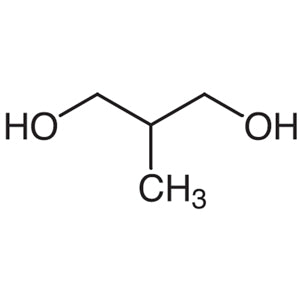
TCI M1114 is 2-Methyl-1,3-propanediol, an aliphatic diol carrying two primary hydroxyl groups on a three-carbon chain with a single methyl group at the central position. The compound belongs to the family of versatile non-heterocyclic building blocks and is widely used both in laboratory-scale organic synthesis and in polymer research. On the researcher's bench, this material serves as an acetal-forming reagent for the protection of carbonyl groups, as a diol monomer in the preparation of polyesters and polyurethanes, and as a hygroscopic co-solvent in certain experimental formulations.
The characteristic that makes this diol a frequent choice is the presence of two primary hydroxyl groups of equivalent reactivity, so that esterification and etherification reactions proceed in a more directed manner than with diols bearing secondary hydroxyl groups. The one-carbon spacing between the two hydroxyl groups is well suited to forming a stable 1,3-dioxane ring when the compound is reacted with aldehydes or ketones, a principle exploited as a protecting-group strategy. The methyl group at the centre of the chain interrupts structural regularity, which lowers the tendency of the resulting polymer products to crystallise.
In Indonesian laboratories, this building block is typically found in academic and industrial research settings where organic synthesis and polymer work are carried out side by side. It is drawn on for carbonyl protection steps in multi-step synthetic routes, for preparing polyester and polyurethane samples on a research scale, and as a supporting solvent component in formulation trials. Because it is supplied under the TCI brand, it fits laboratories that require a consistent building block for repeated synthetic and materials work.
- Carbonyl protection in multi-step synthesis: the one-carbon spacing between the two hydroxyl groups forms a stable 1,3-dioxane ring with aldehydes and ketones, shielding the carbonyl while other transformations are performed.
- Polyester preparation: as a diol monomer it condenses with dicarboxylic acids or their derivatives, with both primary hydroxyl groups reacting at comparable rates for predictable chain building.
- Polyurethane research: the diol functions as a chain extender or soft-segment component, and the central methyl group reduces the crystallisation tendency of the resulting polymer product.
- Directed esterification and etherification: the two equivalent primary hydroxyl groups make these reactions more directed than with diols carrying secondary hydroxyl groups, simplifying product profiles.
- Co-solvent in experimental formulations: its hygroscopic character allows it to act as a supporting solvent where water affinity is useful in trial formulation work.
| Brand | TCI |
|---|---|
| CAS number | 2163-42-0 |
| Molecular formula | — |
| Purity | — |
| Category | Chemistry > Building Blocks > Non-Heterocyclic Building Blocks |
| Pack sizes | available in the standard TCI catalogue pack sizes; please confirm the size required when ordering |
| Physical form | — |
| Storage | keep the container tightly closed in a cool, dry place, as the material is hygroscopic |
- Chemical name: 2-Methyl-1,3-propanediol
Store this material in its original tightly closed container in a cool, dry and well-ventilated area, away from moisture, since the compound is hygroscopic and will take up water from the atmosphere if the container is left open. Glass bottles with tight-sealing caps are suitable for storage and for laboratory dispensing. Handle the product in a fume hood or in an area with adequate ventilation, and wear standard personal protective equipment including safety goggles, chemical-resistant gloves and a laboratory coat. Keep the compound away from strong oxidising agents and from sources of ignition. Reseal the container immediately after use to limit moisture pick-up, label any aliquots clearly, and consult the manufacturer's safety data sheet before first use for full handling guidance.
—
Produk Terkait
-
2-(Bromomethyl)-2-(hydroxymethyl)-1,3-propanediol TCI B4057
Regular price From Rp 1.644.300,00Regular price -
2-Bromo-2-nitro-1,3-propanediol TCI B1247
Regular price From Rp 1.008.000,00Regular price -
2-Butyl-2-ethyl-1,3-propanediol TCI B0922
Regular price From Rp 477.750,00Regular price -
3-Phenoxy-1,2-propanediol TCI P1335
Regular price From Rp 3.287.550,00Regular price -
2-Phenyl-1,3-propanediol TCI P1249
Regular price From Rp 1.485.750,00Regular price -
1,3-Propanediol TCI P0486
Regular price From Rp 477.750,00Regular price -
2-Methylene-1,3-propanediol TCI M2473
Regular price From Rp 1.060.500,00Regular price -
2-Methyl-2-nitro-1,3-propanediol TCI M0639
Regular price From Rp 2.121.000,00Regular price