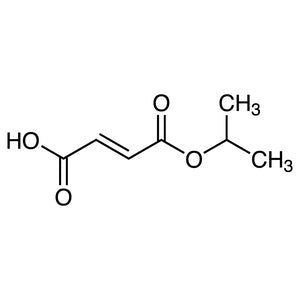
Monoisopropyl Fumarate (TCI M1784) is a monoester of fumaric acid, an unsaturated dicarboxylic acid with a trans configuration, in which only one of the two carboxyl groups has been esterified with isopropanol. This half-esterified structure gives the compound two distinct faces at once: one side is a neutral, lipophilic ester, while the other remains a free acid that can still be carried forward into further reactions. In the laboratory, the compound is used as a building block toward asymmetric diesters, as a monomer, and as a reference material in research on the fumarate ester class of compounds.
What makes this compound useful is its conjugated double bond flanked by two electron-withdrawing groups. This arrangement turns the double bond into a good Michael acceptor, readily attacked by nucleophiles such as thiols and amines, a property that underpins many studies of reactivity as well as crosslink formation. The trans geometry inherent to the fumarate skeleton gives the molecule an elongated, rigid shape that stands in clear contrast to its maleate isomer. The free acid group allows the formation of salts, amides, or a second ester with a different alcohol, opening routes toward mixed diesters that are otherwise difficult to access.
In Indonesian laboratories, Monoisopropyl Fumarate is typically found in university and institutional research settings working on organic synthesis, polymer chemistry, and materials development. It is generally handled in small quantities on the bench scale, where the researcher needs a fumarate derivative with one reactive position already protected and the other still available. Supplied by TCI under catalogue number M1784, it reaches the user through the usual academic and industrial research supply channels.
- Asymmetric diester synthesis — the free carboxyl group can be esterified with a second, different alcohol, giving access to mixed fumarate diesters that are difficult to prepare by direct routes.
- Michael addition studies — the conjugated double bond flanked by two electron-withdrawing groups acts as a good acceptor, making the compound a convenient substrate for probing nucleophilic addition by thiols and amines.
- Monomer for polymerisation work — the unsaturated trans backbone participates in chain-growth chemistry while the pendant free acid provides a site for later functionalisation or property modification of the resulting polymer.
- Crosslinking chemistry — its reactivity toward thiol and amine nucleophiles allows the compound to serve as a crosslinking component in studies of network formation and cured material systems.
- Reference material for fumarate ester research — as a defined monoester of fumaric acid, it supports comparative and analytical work on the wider fumarate ester class of compounds.
| Brand | TCI (catalogue number M1784) |
|---|---|
| CAS number | 7529-87-5 |
| Molecular formula | — |
| Purity | — |
| Category | Chemistry > Building Blocks > Non-Heterocyclic Building Blocks |
| Pack sizes | available in the standard research-scale pack sizes offered by TCI; please confirm the current options when ordering |
| Physical form | — |
| Storage | store according to the conditions stated on the manufacturer's label and safety data sheet |
- Chemical class: monoester of fumaric acid (trans-configured unsaturated dicarboxylic acid), isopropyl ester
Store the container tightly closed in a cool, dry, well-ventilated place, away from heat, direct sunlight, and incompatible materials, following the conditions given on the manufacturer's label and safety data sheet. Keep the material in its original supplier packaging or in a clean, chemically compatible, tightly sealed container that is clearly labelled with the compound name and CAS number. As the compound carries a free carboxylic acid group and a reactive Michael-acceptor double bond, keep it separated from strong bases and from nucleophilic reagents such as amines and thiols. Handle it in a fume hood using appropriate personal protective equipment, including safety goggles, chemical-resistant gloves, and a laboratory coat. Consult the current safety data sheet before use, and dispose of residues and contaminated packaging in accordance with applicable laboratory waste regulations.
—
Produk Terkait
-
SodiumStearylFumarate TCI S0879
Regular price From Rp 1.246.350,00Regular price -
MonomethylFumarate TCI M2413
Regular price From Rp 1.961.400,00Regular price -
MonoethylFumarate TCI F0359
Regular price Rp 1.908.900,00Regular price -
SodiumHydrogenFumarate TCI F0071
Regular price From Rp 875.700,00Regular price -
DisodiumFumarate TCI F0070
Regular price From Rp 610.050,00Regular price -
DimethylFumarate TCI F0069
Regular price From Rp 1.087.800,00Regular price -
DiethylFumarate TCI F0068
Regular price From Rp 505.050,00Regular price -
DiisopropylFumarate TCI D3916
Regular price From Rp 505.050,00Regular price