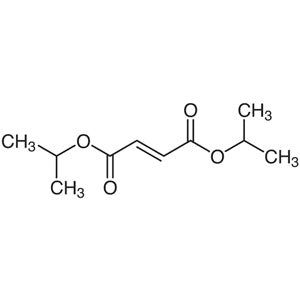
TCI D3916 Diisopropyl Fumarate is the diisopropyl ester of fumaric acid, a non-heterocyclic building block featuring a trans alkene conjugated to two ester groups. In the laboratory, this compound serves both as a monomer for polymer research and as a reagent for organic synthesis. Researchers turn to it whenever they need a fumarate unit carrying short branched ester groups — for example, when studying how the steric bulk of the side groups influences polymerization behaviour and the final properties of the material that is formed.
The properties behind its selection are the combination of an electron-deficient alkene with sterically substantial isopropyl groups, which is why this compound is well known in studies of fumarate ester polymerization that yield chains with high rigidity. The ester substituents also lower the electron density of the double bond, making it reactive towards nucleophiles and radicals. The trans geometry distinguishes its behaviour from that of the maleate isomer, and the consistent quality of TCI reagents makes the outcomes of both polymerization and synthesis experiments easier for user laboratories to reproduce.
In Indonesian laboratories, this compound is used in polymer and materials science research at universities, in postgraduate work, and in institutional research programmes where a well-defined fumarate ester building block is required. It supports method development and comparative studies in which the geometry and steric profile of the monomer must be controlled, and it fits routine synthetic work in which a reliable, consistently supplied trans-configured diester is preferred over locally prepared material.
- Radical polymerization studies — the electron-deficient trans alkene undergoes radical addition readily, making this a suitable monomer for investigating fumarate ester polymer chain formation.
- Rigid polymer chain research — the bulky isopropyl side groups restrict backbone rotation, allowing researchers to examine how steric hindrance produces chains of high rigidity.
- Steric effect investigations — comparing short branched esters against other fumarate esters lets researchers isolate the contribution of side-group bulk to polymerization rate and material behaviour.
- Michael-type and nucleophilic addition chemistry — the conjugated ester groups lower double bond electron density, so the alkene reacts with nucleophiles in organic synthesis routes.
- Geometric isomer comparison work — the fixed trans configuration provides a direct counterpart to maleate esters when studying how alkene geometry governs reactivity and polymer structure.
| Brand | TCI |
|---|---|
| CAS number | 7283-70-7 |
| Molecular formula | — |
| Purity | — |
| Category | Chemistry > Building Blocks > Non-Heterocyclic Building Blocks |
| Pack sizes | available in standard TCI research-scale packaging; please confirm the size required when ordering. |
| Physical form | — |
| Storage | store according to the conditions stated on the manufacturer label and accompanying safety data sheet. |
- Product Code: D3916
Store the container tightly closed in a cool, dry, well-ventilated area away from direct sunlight, heat sources, and ignition sources, following the conditions specified on the manufacturer label and safety data sheet. Keep the material in its original tightly sealed container, or in a chemically compatible, clearly labelled glass container if transferred. As a polymerizable ester, it should be kept away from strong oxidizing agents, strong bases, radical initiators, and other incompatible substances. Handle in a fume hood using safety goggles, gloves, and a laboratory coat, avoid contact with skin and eyes and inhalation of vapours, and dispose of residues and empty containers in accordance with applicable institutional and local chemical waste regulations.
—
Produk Terkait
-
DiisopropylAdipate TCI A0654
Regular price From Rp 903.000,00Regular price -
DiisopropylSuccinate TCI S0269
Regular price From Rp 1.273.650,00Regular price -
DiisopropylPhthalate TCI P0301
Regular price From Rp 2.227.050,00Regular price -
DiisopropylMalonate TCI M0648
Regular price From Rp 743.400,00Regular price -
DiisopropylDecanedioate TCI D6183
Regular price From Rp 2.625.000,00Regular price -
SodiumStearylFumarate TCI S0879
Regular price From Rp 1.246.350,00Regular price -
MonomethylFumarate TCI M2413
Regular price From Rp 1.961.400,00Regular price -
MonoisopropylFumarate TCI M1784
Regular price Rp 4.213.650,00Regular price