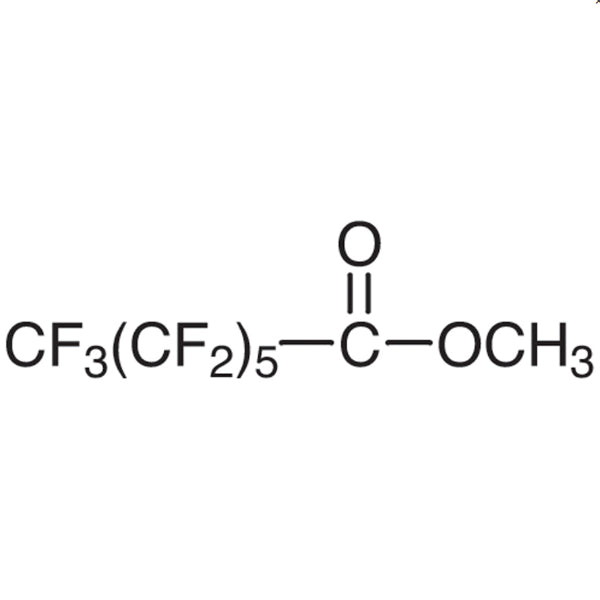
Methyl Tridecafluoroheptanoate from TCI, supplied under catalogue code M1914, is a seven-carbon methyl ester whose alkyl portion is fully fluorinated. The compound belongs to the perfluoroalkyl ester family and carries the longest fluorous chain among comparable homologues that are commonly available at laboratory scale. As a fluorinated building block, it supplies a perfluoroheptyl fragment that can be transferred into target molecules through transformations of the ester group, giving researchers rapid access to long fluorous-chain derivatives without having to construct them from scratch.
The property that drives its selection is the influence of the perfluorinated chain, which becomes progressively stronger as chain length increases. The longer the fluorous segment, the lower the surface energy of the resulting material, the greater the tendency of the molecule to orient itself at interfaces, and the higher its affinity for fluorine-rich solvents. This combination makes the compound particularly valuable for research into protective coatings, high-performance surfactants, and fluorous separation strategies. Its methyl ester group remains reactive because it is activated by the electron-withdrawing effect of the fluorinated chain, so reduction to the alcohol and related conversions proceed readily.
In Indonesian laboratories the material is typically handled within university and institutional research groups working on fluorine chemistry, surface science, and specialty materials development. It is normally ordered in small research quantities for exploratory synthesis, method development, and the preparation of derivative libraries rather than for routine bulk processing. Users generally work with it inside a fume hood as part of a planned synthetic sequence, drawing on it as a ready-made source of a long fluorous chain.
TCI brochures (PDF)
- Fluorous Chemistry 2025-01-21 · p. 8
- Fluorous building block synthesis, where the perfluoroheptyl fragment is transferred into target molecules through ester group transformations, shortening routes that would otherwise require building the fluorinated chain step by step.
- Low surface energy coating research, because the extended perfluorinated segment lowers the surface energy of derived materials and supports the study of protective and repellent surface layers in the laboratory.
- High-performance surfactant development, since the long fluorous tail combined with a convertible ester head group allows researchers to prepare and compare amphiphiles with strong interfacial orientation behaviour.
- Fluorous phase separation studies, where the pronounced affinity of the long perfluorinated chain for fluorine-rich solvents makes the compound a useful model substrate for partitioning and tagging experiments.
- Ester derivatisation chemistry, as the electron-withdrawing fluorinated chain activates the methyl ester toward reduction to the alcohol and related conversions that generate further fluorinated intermediates.
| Brand | TCI, catalogue code M1914 |
|---|---|
| CAS number | 14312-89-1 |
| Molecular formula | — |
| Purity | — |
| Category | Chemistry > Building Blocks > Fluorinated Building Blocks |
| Pack sizes | available in laboratory research pack sizes; please confirm the current packaging option when ordering |
| Physical form | — |
| Storage | keep in the tightly closed original container as indicated on the manufacturer label |
- Product type: perfluoroalkyl methyl ester, fluorinated building block for synthesis
Store the container tightly closed in a cool, dry, well-ventilated place away from direct sunlight, heat sources, and incompatible materials, following the storage conditions stated on the manufacturer label and safety data sheet. Keep the material in its original supplier container, or in a chemically compatible closed vessel that is clearly labelled with the product name and catalogue code. Handle inside a fume hood, wear safety glasses, gloves, and a laboratory coat, and avoid inhalation of vapour or contact with skin and eyes. Close the container promptly after dispensing, and dispose of residues and contaminated materials in accordance with institutional chemical waste procedures.
—
Produk Terkait
-
TridecafluorohexylBromide TCI T2479
Regular price From Rp 1.458.450,00Regular price -
TridecafluorohexylIodide TCI T1098
Regular price From Rp 795.900,00Regular price -
1H-Tridecafluorohexane TCI T2496
Regular price Rp 2.969.400,00Regular price -
Hexadecafluoroheptane(mixtureofisomers) TCI P0851
Regular price Rp 955.500,00Regular price -
1H,1H-Undecafluoro-1-hexanol TCI U0074
Regular price Rp 3.207.750,00Regular price -
Decafluorobenzophenone TCI D1631
Regular price From Rp 1.246.350,00Regular price -
1H,1H,7H-Dodecafluoro-1-heptanol TCI D1101
Regular price From Rp 1.167.600,00Regular price -
UndecafluorohexanoicAcid TCI U0067
Regular price From Rp 2.227.050,00Regular price