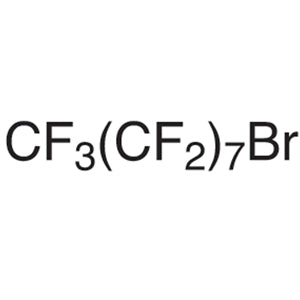
TCI T1098 is Tridecafluorohexyl Iodide, CAS number 355-43-1, an organofluorine compound consisting of a six-carbon chain in which every carbon position is bonded to fluorine, terminated by a single iodine atom. It belongs to the fluorinated building block category, meaning it serves as a starting material for introducing a perfluorohexyl group into other molecules. In the laboratory, the carbon-iodine bond is the reactive handle that makes this reagent useful for synthetic chemists working with fluorinated targets.
The carbon-iodine bond in this compound can be exploited in radical reactions and addition reactions, allowing the perfluoroalkyl chain to be attached to alkenes, alkynes, or other molecular frameworks. The perfluoroalkyl group imparts distinctive characteristics to the target molecule, including a pronounced tendency to repel both water and ordinary oils, as well as high chemical stability. Researchers therefore choose this reagent when they want to modify surfaces, assemble fluorinated surfactants, or prepare model compounds that carry a long fluorine chain. Physical properties and purity should be confirmed against the manufacturer's data sheet so that reaction planning relies on official figures.
In Indonesian laboratories, this reagent is most relevant to research groups working in materials chemistry, polymer chemistry, and organofluorine synthesis. Pack sizes of 5 g and 25 g suit small-scale exploratory work and repeated experiments in research settings. Because it is a specialty building block, it is usually ordered for a defined project rather than kept as a general-purpose solvent or reagent, and researchers typically consult the technical documentation before planning a synthesis route.
TCI brochures (PDF)
- Fluorous Chemistry 2025-01-21 · p. 8
- Building Blocks for Organic Semiconductor 2026-03-24 · p. 45
Related TCI products
- TCI T2479 335-56-8 Tridecafluorohexyl Bromide
- TCI U0074 423-46-1 1H,1H-Undecafluoro-1-hexanol
- TCI T3258 80806-68-4 1H,1H,2H,2H,3H,3H-Tridecafluoro-1-nonanol
- TCI T2528 647-42-7 1H,1H,2H,2H-Tridecafluoro-1-n-octanol
- TCI T1701 375-82-6 1H,1H-Tridecafluoro-1-heptanol
- TCI H0946 423-55-2 Heptadecafluoro-n-octyl Bromide
- Perfluoroalkylation of alkenes and alkynes: the reactive carbon-iodine bond allows the perfluorohexyl chain to be added across double and triple bonds through radical or addition pathways, making this reagent a practical choice.
- Surface modification research: the perfluorohexyl group lends strong water- and oil-repelling character, so this building block is suitable for chemists designing coatings or treatments that change how a surface interacts with liquids.
- Synthesis of fluorinated surfactants: because the compound supplies a long fluorinated chain on a reactive iodide handle, it can serve as the starting point for building amphiphilic molecules with a fluorine-rich tail.
- Preparation of model compounds: researchers who need molecules carrying a defined, long fluorine chain can use this reagent to install that chain cleanly, which helps when studying how fluorination influences behavior.
- Polymer and materials chemistry: the perfluoroalkyl group contributes high chemical stability, so this reagent is relevant to groups developing fluorinated monomers, additives, or functional materials in a research setting.
| Brand | TCI |
|---|---|
| CAS number | 355-43-1 |
| Molecular formula | — |
| Purity | refer to the manufacturer's data sheet for official values |
| Category | Chemistry > Building Blocks > Fluorinated Building Blocks |
| Pack sizes | 5 g and 25 g |
| Physical form | — |
| Storage | — |
- Product code: T1098
Store the container tightly closed in a cool, dry, well-ventilated place, following the storage instructions on the manufacturer's label and safety data sheet. Because organoiodine compounds can be sensitive to light, keeping the original container protected from direct light is a sensible general precaution. Use the supplied bottle or a chemically compatible container, and avoid storing it near strong oxidizers or heat sources. During handling, work in a fume hood and wear gloves, safety glasses, and a laboratory coat. Avoid inhalation and skin contact, keep the container away from ignition sources, and dispose of waste according to your institution's procedures for halogenated organic compounds. Always read the safety data sheet before first use.
—
Produk Terkait
-
TridecafluorohexylBromide TCI T2479
Regular price From Rp 1.458.450,00Regular priceRp 1.019.550,00Sale price From Rp 1.458.450,00 -
1H,1H-Undecafluoro-1-hexanol TCI U0074
Regular price Rp 3.207.750,00Regular priceRp 2.242.800,00Sale price Rp 3.207.750,00 -
1H,1H,2H,2H,3H,3H-Tridecafluoro-1-nonanol TCI T3258
Regular price From Rp 1.961.400,00Regular priceRp 1.371.300,00Sale price From Rp 1.961.400,00 -
1H,1H,2H,2H-Tridecafluoro-1-n-octanol TCI T2528
Regular price From Rp 875.700,00Regular priceRp 612.150,00Sale price From Rp 875.700,00 -
1H,1H-Tridecafluoro-1-heptanol TCI T1701
Regular price From Rp 1.087.800,00Regular priceRp 760.200,00Sale price From Rp 1.087.800,00 -
Heptadecafluoro-n-octylBromide TCI H0946
Regular price From Rp 980.700,00Regular priceRp 685.650,00Sale price From Rp 980.700,00 -
1H-Tridecafluorohexane TCI T2496
Regular price Rp 2.969.400,00Regular priceRp 2.075.850,00Sale price Rp 2.969.400,00 -
MethylTridecafluoroheptanoate TCI M1914
Regular price From Rp 1.563.450,00Regular priceRp 1.108.800,00Sale price From Rp 1.563.450,00