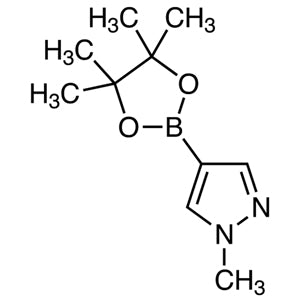
1-Methyl-4-(4,4,5,5-tetramethyl-1,3,2-dioxaborolan-2-yl)pyrazole is the pinacol boronate ester of 1-methylpyrazole-4-boronic acid, an organoboron reagent that has become highly popular in modern organic synthesis. In the laboratory, this compound is used as the nucleophilic partner in palladium-catalysed Suzuki-Miyaura cross-coupling reactions, allowing a pyrazole fragment to be installed onto aromatic or heteroaromatic cores. The 1-methylpyrazol-4-yl motif is a fragment that appears frequently in bioactive compounds, so this reagent is often a standard starting material for researchers building series of analogues within compound discovery programmes.
The characteristic that makes it preferable to the free boronic acid is the stability of its pinacol ester. The dioxaborolane group protects the boron centre from hydrolysis and protodeboronation, giving a solid that is easy to weigh out, keeps well in storage, and does not form the anhydride mixtures that obscure stoichiometry. Its solubility is good in organic solvents such as dioxane, toluene, and tetrahydrofuran, as well as in the aqueous mixtures commonly used for coupling reactions. The methyl group on nitrogen removes the NH proton, which simplifies the handling of base and reduces side reactions.
In Indonesian laboratories, this reagent is typically used by synthetic chemistry groups in universities, research institutes, and pharmaceutical development units that run medicinal chemistry programmes. It suits workflows where a pyrazole fragment must be coupled reproducibly across a series of substrates, and where a stable, easily weighed solid is preferred over a boronic acid whose assay drifts during storage. The reliability of the pinacol ester makes it a practical choice for teaching laboratories and for method development work that must be repeated over long project timelines.
TCI brochures (PDF)
- Suzuki-Miyaura Cross Coupling Reaction 2025-12-01 · p. 17
- Boron Compounds 2025-10-07 · p. 19
Related TCI products
- TCI T3829 844501-71-9 3-(4,4,5,5-Tetramethyl-1,3,2-dioxaborolan-2-yl)-1H-pyrazole
- TCI T3668 1040377-03-4 1-(Tetrahydro-2H-pyran-4-yl)-4-(4,4,5,5-tetramethyl-1,3,2-dioxaborolan-2-yl)-1H-pyrazole
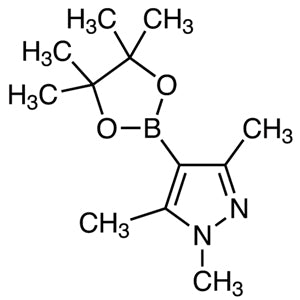
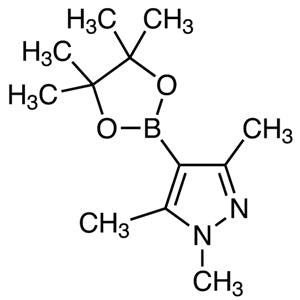
- TCI T3409 844891-04-9 1,3,5-Trimethyl-4-(4,4,5,5-tetramethyl-1,3,2-dioxaborolan-2-yl)pyrazole
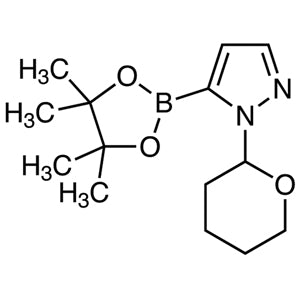
- TCI T3215 903550-26-5 1-(Tetrahydropyran-2-yl)-5-(4,4,5,5-tetramethyl-1,3,2-dioxaborolan-2-yl)pyrazole
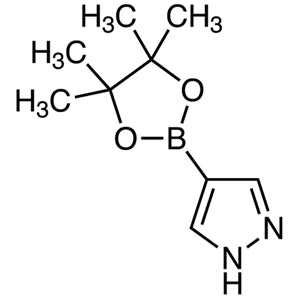
- TCI T2756 269410-08-4 4-(4,4,5,5-Tetramethyl-1,3,2-dioxaborolan-2-yl)pyrazole
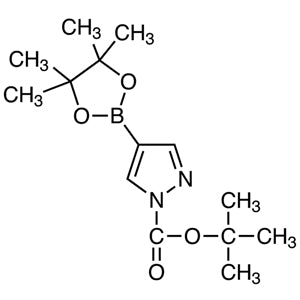
- TCI B5203 552846-17-0 1-(tert-Butoxycarbonyl)-4-(4,4,5,5-tetramethyl-1,3,2-dioxaborolan-2-yl)pyrazole
- Suzuki-Miyaura cross-coupling: serves as the nucleophilic boron partner under palladium catalysis, transferring the 1-methylpyrazol-4-yl group cleanly onto aryl and heteroaryl halides.
- Medicinal chemistry analogue synthesis: installs the 1-methylpyrazol-4-yl motif, a fragment common in bioactive compounds, allowing rapid construction of structure-activity series from a shared core.
- Heteroaromatic scaffold assembly: couples a pyrazole unit onto heteroaromatic cores, giving access to biaryl-type architectures that are difficult to build by direct substitution chemistry.
- Compound discovery library preparation: its storage stability and accurate weighing behaviour make it suitable for parallel synthesis campaigns where consistent stoichiometry across many reactions is essential.
- Synthetic methodology development: the stable pinacol ester avoids protodeboronation artefacts, making it a dependable substrate when evaluating new catalysts, ligands, bases, or solvent systems for coupling.
| Brand | TCI |
|---|---|
| CAS number | 761446-44-0 |
| Molecular formula | — |
| Purity | — |
| Category | Chemistry > Organometallic Reagents > Organoboron [Organometallic Reagents] |
| Pack sizes | available in standard TCI research pack sizes — please confirm the option required when ordering |
| Physical form | solid, readily weighed; soluble in dioxane, toluene, tetrahydrofuran, and common aqueous coupling mixtures |
| Storage | keep in a tightly closed container in a cool, dry place |
- Product code: M2339
Store the reagent in a cool, dry place inside a tightly closed original container, protected from moisture, since prolonged exposure to humid air can promote hydrolysis of the boronate ester. Amber glass or the supplier's own container is suitable; transfer weighed portions promptly and reseal after each use. Handle the solid in a fume hood or well-ventilated area, wearing a laboratory coat, safety glasses, and chemically resistant gloves, and avoid generating dust during weighing. Keep the material away from strong oxidising agents and ignition sources, and consult the manufacturer's safety data sheet before first use and prior to disposal of residues.
—
Produk Terkait
-
3-(4,4,5,5-Tetramethyl-1,3,2-dioxaborolan-2-yl)-1H-pyrazole TCI T3829
Regular price From Rp 1.936.200,00Regular price -
1-(Tetrahydro-2H-pyran-4-yl)-4-(4,4,5,5-tetramethyl-1,3,2-dioxaborolan-2-yl)-1H-pyrazole TCI T3668
Regular price From Rp 769.650,00Regular price -
1,3,5-Trimethyl-4-(4,4,5,5-tetramethyl-1,3,2-dioxaborolan-2-yl)pyrazole TCI T3409
Regular price From Rp 955.500,00Regular price -
1-(Tetrahydropyran-2-yl)-5-(4,4,5,5-tetramethyl-1,3,2-dioxaborolan-2-yl)pyrazole TCI T3215
Regular price From Rp 928.200,00Regular price -
4-(4,4,5,5-Tetramethyl-1,3,2-dioxaborolan-2-yl)pyrazole TCI T2756
Regular price From Rp 1.776.600,00Regular price -
1-(tert-Butoxycarbonyl)-4-(4,4,5,5-tetramethyl-1,3,2-dioxaborolan-2-yl)pyrazole TCI B5203
Regular price From Rp 1.273.650,00Regular price -
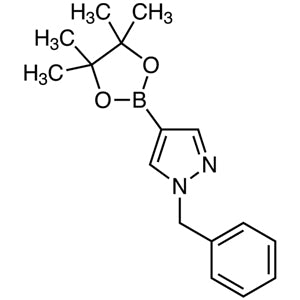
1-Benzyl-4-(4,4,5,5-tetramethyl-1,3,2-dioxaborolan-2-yl)pyrazole TCI B4364
Regular price From Rp 1.670.550,00Regular price -
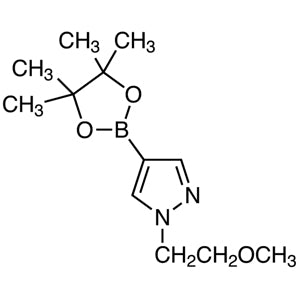
1-(2-Methoxyethyl)-4-(4,4,5,5-tetramethyl-1,3,2-dioxaborolan-2-yl)-1H-pyrazole TCI M3232
Regular price From Rp 928.200,00Regular price