1-(tert-Butoxycarbonyl)-4-(4,4,5,5-tetramethyl-1,3,2-dioxaborolan-2-yl)pyrazole is a specialized organic compound used in advanced chemical research, particularly in the synthesis of complex molecules involving boron-based reactions. This compound plays a crucial role in laboratories where precision and reactivity are essential. It is widely utilized in the development of heterocyclic compounds and other organic structures that require controlled chemical transformations. Its unique molecular structure enables it to participate in various coupling reactions, making it an indispensable tool for chemists working on innovative synthetic pathways.
The compound’s high reactivity and stability under specific conditions make it a preferred choice for researchers. Its organoboron nature allows it to act as an electron-donating group, enhancing the efficiency of reactions such as S-N coupling and Suzuki reactions. These properties contribute to its effectiveness in creating complex molecular architectures. Additionally, its structural complexity ensures that it can be tailored for various synthetic applications, offering versatility in experimental design.
In Indonesian laboratories, this compound is commonly used in organic chemistry research, especially in the synthesis of heterocyclic compounds and boron-containing molecules. Its role in facilitating efficient and selective chemical transformations makes it a valuable asset for academic and industrial research. The compound’s stability and reactivity ensure that it remains a reliable reagent for advanced chemical investigations.
TCI brochures (PDF)
- Suzuki-Miyaura Cross Coupling Reaction 2025-12-01 · p. 18
- Boron Compounds 2025-10-07 · p. 19
Related TCI products
- TCI T3829 844501-71-9 3-(4,4,5,5-Tetramethyl-1,3,2-dioxaborolan-2-yl)-1H-pyrazole
- TCI T3668 1040377-03-4 1-(Tetrahydro-2H-pyran-4-yl)-4-(4,4,5,5-tetramethyl-1,3,2-dioxaborolan-2-yl)-1H-pyrazole
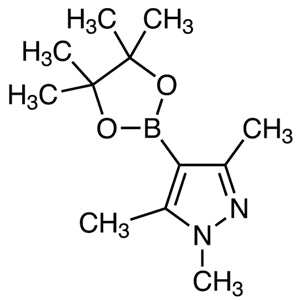
- TCI T3409 844891-04-9 1,3,5-Trimethyl-4-(4,4,5,5-tetramethyl-1,3,2-dioxaborolan-2-yl)pyrazole
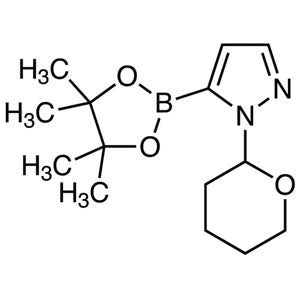
- TCI T3215 903550-26-5 1-(Tetrahydropyran-2-yl)-5-(4,4,5,5-tetramethyl-1,3,2-dioxaborolan-2-yl)pyrazole
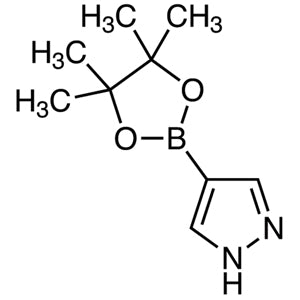
- TCI T2756 269410-08-4 4-(4,4,5,5-Tetramethyl-1,3,2-dioxaborolan-2-yl)pyrazole
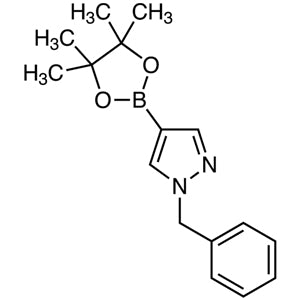
- TCI B4364 761446-45-1 1-Benzyl-4-(4,4,5,5-tetramethyl-1,3,2-dioxaborolan-2-yl)pyrazole
- S-N Coupling Reactions: This compound is ideal for S-N coupling due to its ability to act as an electron-donor, facilitating efficient bond formation in complex molecule synthesis.
- Suzuki Coupling Reactions: Its organoboron structure makes it a suitable reagent for Suzuki reactions, which are widely used in the synthesis of aromatic compounds and heterocycles.
- Heterocyclic Compound Synthesis: The compound’s reactivity supports the creation of diverse heterocyclic structures, which are essential in pharmaceutical and materials research.
- Boron-Containing Molecule Development: Its unique structure enables the synthesis of boron-containing compounds, which are important in medicinal chemistry and catalysis.
- Organic Chemistry Research: It is frequently used in Indonesian laboratories for advanced organic synthesis, contributing to the development of new compounds and chemical processes.
| Brand | TCI |
|---|---|
| CAS number | 552846-17-0 |
| Molecular formula | — |
| Purity | — |
| Category | Chemistry > Organometallic Reagents > Organoboron |
| Pack sizes | Available in various quantities as per supplier specifications |
| Physical form | Solid |
| Storage | Store in a cool, dry place away from moisture and direct sunlight |
This compound should be stored in a cool, dry environment to maintain its stability and reactivity. It is recommended to use airtight containers to prevent exposure to moisture and air, which could affect its chemical integrity. Proper labeling of storage containers is essential for safe handling and easy identification. Laboratory personnel should wear appropriate personal protective equipment, such as gloves and safety goggles, when handling this material. It is important to ensure that the compound is kept away from incompatible substances to avoid any potential chemical reactions. Regular inspection of storage conditions is advised to maintain optimal safety and performance in laboratory settings.
—
Produk Terkait
-
3-(4,4,5,5-Tetramethyl-1,3,2-dioxaborolan-2-yl)-1H-pyrazole TCI T3829
Regular price From Rp 1.988.700,00Regular priceRp 1.405.950,00Sale price From Rp 1.988.700,00 -
1-(Tetrahydro-2H-pyran-4-yl)-4-(4,4,5,5-tetramethyl-1,3,2-dioxaborolan-2-yl)-1H-pyrazole TCI T3668
Regular price From Rp 822.150,00Regular priceRp 590.100,00Sale price From Rp 822.150,00 -
1,3,5-Trimethyl-4-(4,4,5,5-tetramethyl-1,3,2-dioxaborolan-2-yl)pyrazole TCI T3409
Regular price From Rp 1.008.000,00Regular priceRp 720.300,00Sale price From Rp 1.008.000,00 -
1-(Tetrahydropyran-2-yl)-5-(4,4,5,5-tetramethyl-1,3,2-dioxaborolan-2-yl)pyrazole TCI T3215
Regular price From Rp 980.700,00Regular priceRp 701.400,00Sale price From Rp 980.700,00 -
4-(4,4,5,5-Tetramethyl-1,3,2-dioxaborolan-2-yl)pyrazole TCI T2756
Regular price From Rp 1.829.100,00Regular priceRp 1.294.650,00Sale price From Rp 1.829.100,00 -
1-Benzyl-4-(4,4,5,5-tetramethyl-1,3,2-dioxaborolan-2-yl)pyrazole TCI B4364
Regular price From Rp 1.723.050,00Regular priceRp 1.220.100,00Sale price From Rp 1.723.050,00 -
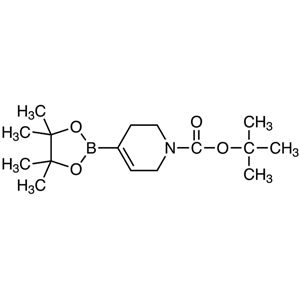
1-(tert-Butoxycarbonyl)-1,2,3,6-tetrahydro-4-(4,4,5,5-tetramethyl-1,3,2-dioxaborolan-2-yl)pyridine TCI B4051
Regular price Rp 2.332.050,00Regular priceRp 1.646.400,00Sale price Rp 2.332.050,00 -
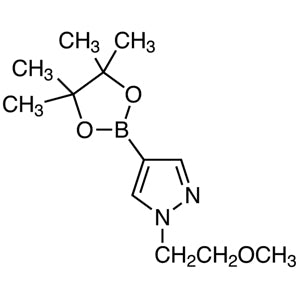
1-(2-Methoxyethyl)-4-(4,4,5,5-tetramethyl-1,3,2-dioxaborolan-2-yl)-1H-pyrazole TCI M3232
Regular price From Rp 980.700,00Regular priceRp 701.400,00Sale price From Rp 980.700,00