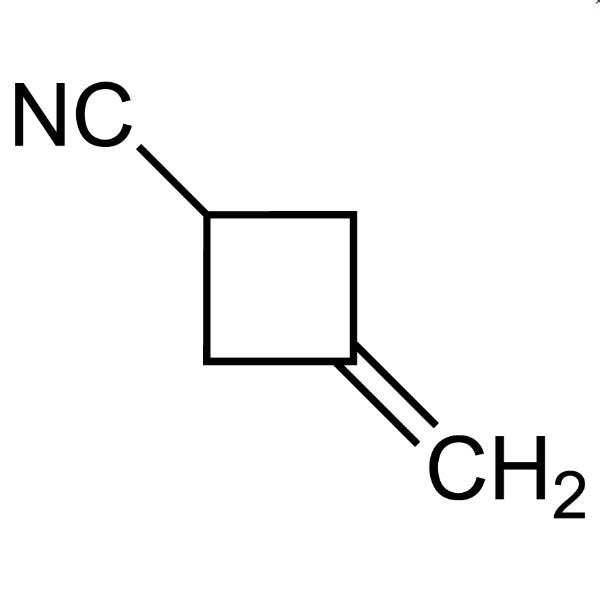
TCI M3911 3-Methylenecyclobutane-1-carbonitrile is a synthetic starting material that combines a strained cyclobutane ring with an exocyclic double bond and a nitrile group. The combination of these three structural elements makes it a versatile reagent for constructing three-dimensional aliphatic molecular frameworks. In the laboratory, this compound serves as an important intermediate for medicinal chemistry research aimed at increasing the proportion of sp3 carbon in drug candidate molecules, and it also functions as a precursor toward rigid ring systems such as substituted cyclobutane derivatives and bicyclic scaffolds.
The property that makes this material valuable is the presence of three reaction sites that can be processed separately. The exocyclic alkene is ready to undergo hydrogenation, epoxidation, hydroboration, cycloaddition, or oxidative cleavage to a ketone. The nitrile group can be reduced to a primary amine, hydrolyzed to a carboxylic acid, or converted into tetrazoles and amidines. Meanwhile, the strain of the four-membered ring keeps the molecular geometry rigid and promotes certain reactivity patterns that are not encountered with larger rings. This compound is generally a liquid at room temperature, which makes it straightforward to transfer.
In Indonesian laboratories, this building block is typically used by synthetic organic chemistry and medicinal chemistry research groups in universities, as well as by pharmaceutical and fine chemical research units developing new molecular scaffolds. Because it is supplied as a liquid, it fits well into small-scale schemes where volumetric transfer via syringe or pipette is more practical than weighing a solid, particularly during route scouting and exploratory reaction screening.
Related TCI products
- TCI A3039 103646-82-8 5-Amino-1-(p-tolyl)pyrazole-4-carbonitrile
- TCI C4103 24973-49-7 [1,1'-Biphenyl]-2-carbonitrile
- TCI B6956 690260-67-4 2'-Bromo-[1,1'-biphenyl]-3-carbonitrile
- TCI B5965 160521-46-0 3'-Bromo[1,1'-biphenyl]-4-carbonitrile
- TCI B5964 1040141-34-1 3'-Bromo[1,1'-biphenyl]-3-carbonitrile
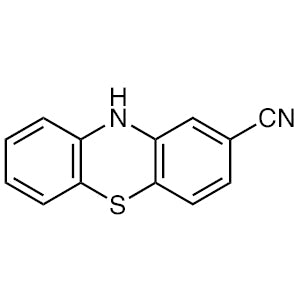
- TCI P2308 38642-74-9 10H-Phenothiazine-2-carbonitrile
- Medicinal chemistry scaffold construction: the strained four-membered ring raises the sp3 carbon content of drug candidate molecules, a design objective widely pursued in modern lead optimization programmes.
- Primary amine synthesis: the nitrile group can be reduced cleanly to a primary amine, giving direct access to cyclobutane-containing amine intermediates for further coupling and derivatization work.
- Carboxylic acid preparation: hydrolysis of the nitrile function yields the corresponding carboxylic acid, a convenient handle for amide formation and other downstream functional group interconversions.
- Tetrazole and amidine chemistry: conversion of the nitrile into tetrazoles or amidines provides bioisosteric replacements frequently required in structure-activity relationship studies of candidate compounds.
- Alkene functionalization studies: the exocyclic double bond supports hydrogenation, epoxidation, hydroboration, cycloaddition, and oxidative cleavage to a ketone, allowing several divergent routes from one common starting material.
| Brand | TCI |
|---|---|
| CAS number | 15760-35-7 |
| Molecular formula | — |
| Purity | — |
| Category | Chemistry > Building Blocks > Non-Heterocyclic Building Blocks |
| Pack sizes | available in the catalogue pack sizes offered by TCI for this article number |
| Physical form | generally a liquid at room temperature |
| Storage | store according to the conditions stated on the manufacturer label and safety data sheet |
Store the container tightly closed in a cool, dry, well-ventilated area away from heat sources, ignition sources, and incompatible materials, following the conditions stated on the manufacturer label and safety data sheet. Keep the material in its original supplier container or in a compatible sealed glass bottle, and reseal immediately after each withdrawal to limit exposure to air and moisture. Handle in a fume hood using nitrile gloves, safety goggles, and a laboratory coat. Transfer liquid volumes with a syringe or pipette rather than by pouring, avoid inhalation of vapours, and collect residues as chemical waste in accordance with institutional laboratory waste procedures.
—
Produk Terkait
-
5-Amino-1-(p-tolyl)pyrazole-4-carbonitrile TCI A3039
Regular price Rp 3.312.750,00Regular price -
[1,1'-Biphenyl]-2-carbonitrile TCI C4103
Regular price From Rp 2.094.750,00Regular price -
2'-Bromo-[1,1'-biphenyl]-3-carbonitrile TCI B6956
Regular price From Rp 2.757.300,00Regular price -
3'-Bromo[1,1'-biphenyl]-4-carbonitrile TCI B5965
Regular price From Rp 2.359.350,00Regular price -
3'-Bromo[1,1'-biphenyl]-3-carbonitrile TCI B5964
Regular price From Rp 2.094.750,00Regular price -
10H-Phenothiazine-2-carbonitrile TCI P2308
Regular price From Rp 848.400,00Regular price -
5-Norbornene-2-carbonitrile(mixtureofisomers) TCI N0897
Regular price From Rp 1.298.850,00Regular price -
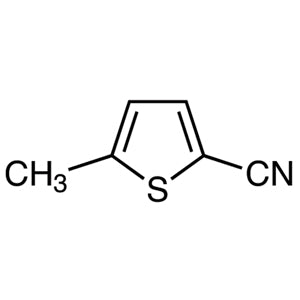
5-Methylthiophene-2-carbonitrile TCI M2959
Regular price Rp 1.749.300,00Regular price

![[1,1'-Biphenyl]-2-carbonitrile (CAS 24973-49-7) - TCI C4103 - AMI Scientific](http://amiscientific.com/cdn/shop/files/TCI2510C4103.jpg?v=1769180472&width=533)
![2'-Bromo-[1,1'-biphenyl]-3-carbonitrile (CAS 690260-67-4) - TCI B6956 - AMI Scientific](http://amiscientific.com/cdn/shop/files/TCI2510B6956.jpg?v=1771058291&width=533)
![3'-Bromo[1,1'-biphenyl]-4-carbonitrile (CAS 160521-46-0) - TCI B5965 - AMI Scientific](http://amiscientific.com/cdn/shop/files/TCI2510B5965.jpg?v=1769180247&width=533)
![3'-Bromo[1,1'-biphenyl]-3-carbonitrile (CAS 1040141-34-1) - TCI B5964 - AMI Scientific](http://amiscientific.com/cdn/shop/files/TCI2510B5964.jpg?v=1769144661&width=533)