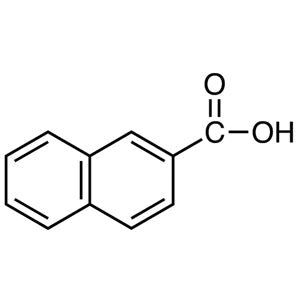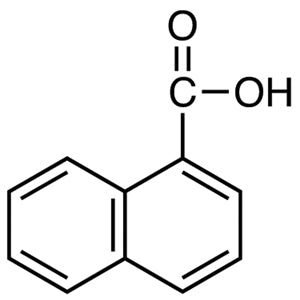
1-Naphthoic acid is an aromatic carboxylic acid in which the carboxyl group is bonded to the alpha position of the naphthalene framework. The compound serves as a versatile building block in organic synthesis, because its carboxyl group can be converted into a wide range of derivative functional groups, including esters, amides, acid chlorides, alcohols, and aldehydes. The bulky naphthalene framework contributes hydrophobic character and structural rigidity, qualities that are frequently required when researchers design molecules intended to engage in aromatic stacking interactions. In the laboratory, the compound is also useful as a starting material for ligand preparation and as a comparison compound in various analytical studies.
Among the properties that make this material a preferred choice is the acidity of its carboxylate group, which allows the formation of water-soluble salts, combined with a naphthalene core that absorbs ultraviolet light strongly and is capable of fluorescing. The difference in alpha substitution position compared with the beta isomer produces a distinct geometry and a different degree of steric hindrance, so 1-naphthoic acid is often selected specifically when a study demands a particular bond angle or packing density, for example in the design of metal-organic frameworks. It is supplied as a stable crystalline solid.
In Indonesian laboratories, this building block is typically used in university and institutional research settings where organic synthesis, coordination chemistry, and materials development are carried out. Researchers draw on it when preparing derivative compounds, developing ligands, or running analytical comparison work. Because it is handled as a crystalline solid, it suits routine weighing and dissolution procedures on ordinary laboratory benches and fits readily into standard synthetic and analytical workflows.
- Organic synthesis building block: the carboxyl group provides a reliable handle for conversion into esters, amides, acid chlorides, alcohols, and aldehydes during multistep preparations.
- Ligand precursor preparation: the carboxylate can coordinate metal centres, while the rigid naphthalene framework helps fix the geometry required in coordination chemistry work.
- Metal-organic framework design: the alpha substitution position gives bond angles and packing density that differ from the beta isomer, allowing deliberate control of framework architecture.
- Analytical reference compound: the material serves as a comparison compound in analytical studies, supported by strong ultraviolet absorption and fluorescence from the naphthalene core.
- Aromatic stacking studies: the bulky, hydrophobic, and structurally rigid naphthalene framework suits molecular design work that depends on aromatic stacking interactions between ring systems.
| Brand | TCI |
|---|---|
| CAS number | 86-55-5 |
| Molecular formula | — |
| Purity | — |
| Category | Chemistry > Building Blocks > Non-Heterocyclic Building Blocks |
| Pack sizes | available in the pack sizes listed for this catalogue item |
| Physical form | stable crystalline solid |
| Storage | keep in a closed container under the conditions indicated on the manufacturer's label |
- Catalogue code: N0024
Store the material in a tightly closed original container, kept in a cool, dry, and well-ventilated area away from moisture and incompatible substances, and follow the conditions stated on the manufacturer's label. Suitable containers include the supplied glass or plastic packaging with a secure closure; transfer only into clean, clearly labelled vessels. As with any laboratory chemical in solid form, weigh and transfer the material with care to limit dust generation, work in a fume hood where appropriate, and wear a laboratory coat, safety glasses, and chemically resistant gloves. Consult the manufacturer's safety data sheet before use and dispose of residues through established laboratory waste procedures.
—
Produk Terkait
-
4-Bromo-1-naphthoicAcid TCI B4949
Regular price From Rp 769.650,00Regular price -
6-Bromo-2-naphthoicAcid TCI B3823
Regular price From Rp 1.431.150,00Regular price -
4-Bromo-3-hydroxy-2-naphthoicAcid TCI B3229
Regular price From Rp 2.174.550,00Regular price -
7-Bromo-3-hydroxy-2-naphthoicAcid TCI B3180
Regular price From Rp 769.650,00Regular price -
1-Bromo-2-naphthoicAcid TCI B1617
Regular price Rp 610.050,00Regular price -
6-Acetoxy-2-naphthoicAcid TCI A0970
Regular price From Rp 1.644.300,00Regular price -
2-NaphthoicAcid TCI N0025
Regular price From Rp 743.400,00Regular price -
4-Methoxy-1-naphthoicAcid TCI M2763
Regular price From Rp 823.200,00Regular price